Pearson+ LogoPearson+ Logo
Ch. 13 - Regulation of Gene Expression in Eukaryotes
Sanders - Genetic Analysis: An Integrated Approach 3rd Edition
Sanders3rd EditionGenetic Analysis: An Integrated ApproachISBN: 9780135564172Not the one you use?Change textbook
Chapter 13, Problem 2b

Describe and give an example (real or hypothetical) of each of the following:
Insulator sequence action

Verified step by step guidance
1
Understand the concept of an insulator sequence: An insulator sequence is a DNA element that acts as a boundary or barrier to prevent the interaction between enhancers and promoters of adjacent genes. It ensures that regulatory elements like enhancers only affect their target gene and not neighboring genes.
Explain the two main functions of insulator sequences: (1) Blocking enhancer-promoter interactions when placed between them, and (2) acting as a barrier to prevent the spread of heterochromatin into euchromatic regions, thereby maintaining gene expression patterns.
Provide a real-world example: The best-known example of an insulator sequence is the CTCF-binding site in vertebrates. CTCF is a protein that binds to these insulator sequences and mediates their function. For instance, in the beta-globin gene cluster, CTCF-binding insulators prevent enhancers from activating non-target genes.
Provide a hypothetical example: Imagine two genes, Gene A and Gene B, located next to each other. If Gene A has an enhancer that could potentially activate Gene B, an insulator sequence placed between the enhancer and Gene B would block this interaction, ensuring that the enhancer only activates Gene A.
Summarize the importance of insulator sequences: Insulator sequences are crucial for maintaining proper gene regulation and preventing inappropriate gene activation, which could lead to developmental issues or diseases such as cancer.

Verified video answer for a similar problem:

This video solution was recommended by our tutors as helpful for the problem above.
Video duration:
3m
Was this helpful?

Key Concepts

Here are the essential concepts you must grasp in order to answer the question correctly.

Insulator Sequences

Insulator sequences are DNA elements that function to block the interaction between enhancers and promoters, thereby regulating gene expression. They act as boundary elements that prevent the spread of heterochromatin and maintain the integrity of gene regulatory domains. For example, the CTCF protein binds to insulator sequences, helping to organize the three-dimensional structure of the genome.
Recommended video:
Guided course
08:41
Sequencing Difficulties

Gene Regulation

Gene regulation refers to the mechanisms that control the expression of genes, determining when and how much of a gene product is made. This process is crucial for cellular differentiation and response to environmental signals. Insulators play a key role in gene regulation by ensuring that only the intended genes are activated in response to specific signals, preventing unintended gene activation.
Recommended video:
Guided course
09:22
Review of Regulation

Chromatin Structure

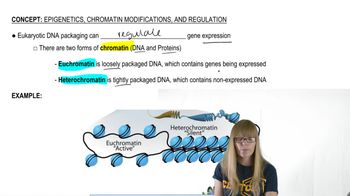
Chromatin structure refers to the organization of DNA and proteins in the nucleus, which influences gene accessibility and expression. Chromatin can exist in a more condensed form (heterochromatin) or a more relaxed form (euchromatin), affecting gene activity. Insulators help maintain this structure by preventing the inappropriate spread of heterochromatin, thus preserving the functional state of active genes.
Recommended video: