Pearson+ LogoPearson+ Logo
Ch. 12 - Regulation of Gene Expression in Bacteria and Bacteriophage
Sanders - Genetic Analysis: An Integrated Approach 3rd Edition
Sanders3rd EditionGenetic Analysis: An Integrated ApproachISBN: 9780135564172Not the one you use?Change textbook
Chapter 12, Problem 29a

The bacterial insertion sequence IS10 uses antisense RNA to regulate translation of the mRNA that produces the enzyme transposase, which is required for insertion sequence transposition. Transcription of the antisense RNA gene is controlled by POUT, which is more than 10 times more efficient at transcription than the PIN promoter, which controls transposase gene transcription.
If a mutation reduced the transcriptional efficiency of POUT so as to be equal to that of PIN, what is the likely effect on the transposition of IS10?

Verified step by step guidance
1
Understand the role of antisense RNA in regulating transposase production. Antisense RNA binds to the mRNA of the transposase gene, preventing its translation into the transposase enzyme. This regulation ensures controlled transposition activity of IS10.
Recognize the significance of the POUT promoter. POUT drives the transcription of the antisense RNA gene and is normally much more efficient than the PIN promoter, which drives the transcription of the transposase gene. This imbalance ensures that antisense RNA is produced in higher quantities, effectively suppressing transposase production.
Analyze the mutation described in the problem. The mutation reduces the transcriptional efficiency of POUT, making it equal to that of PIN. This means that the production of antisense RNA will decrease, while the production of transposase mRNA remains unchanged.
Predict the effect of reduced antisense RNA levels. With less antisense RNA available to bind to transposase mRNA, more transposase enzyme will be produced. This increase in transposase levels will likely lead to higher rates of IS10 transposition.
Conclude the likely outcome. The mutation disrupts the regulatory balance between antisense RNA and transposase mRNA, leading to increased transposition activity of IS10, which could have significant effects on the bacterial genome, such as increased genetic instability or altered gene expression.

Verified video answer for a similar problem:

This video solution was recommended by our tutors as helpful for the problem above.
Video duration:
4m
Was this helpful?

Key Concepts

Here are the essential concepts you must grasp in order to answer the question correctly.

Antisense RNA

Antisense RNA is a strand of RNA that is complementary to a specific mRNA strand. It can bind to the mRNA and inhibit its translation, effectively regulating gene expression. In the context of IS10, the antisense RNA regulates the translation of transposase, which is crucial for the transposition process.
Recommended video:

Transcriptional Efficiency

Transcriptional efficiency refers to the rate at which a gene is transcribed into mRNA. It is influenced by various factors, including promoter strength and regulatory elements. In this scenario, the POUT promoter is significantly more efficient than the PIN promoter, affecting the levels of antisense RNA and transposase produced, which in turn impacts transposition.
Recommended video:
Guided course
09:16
Eukaryotic Transcription

Transposition

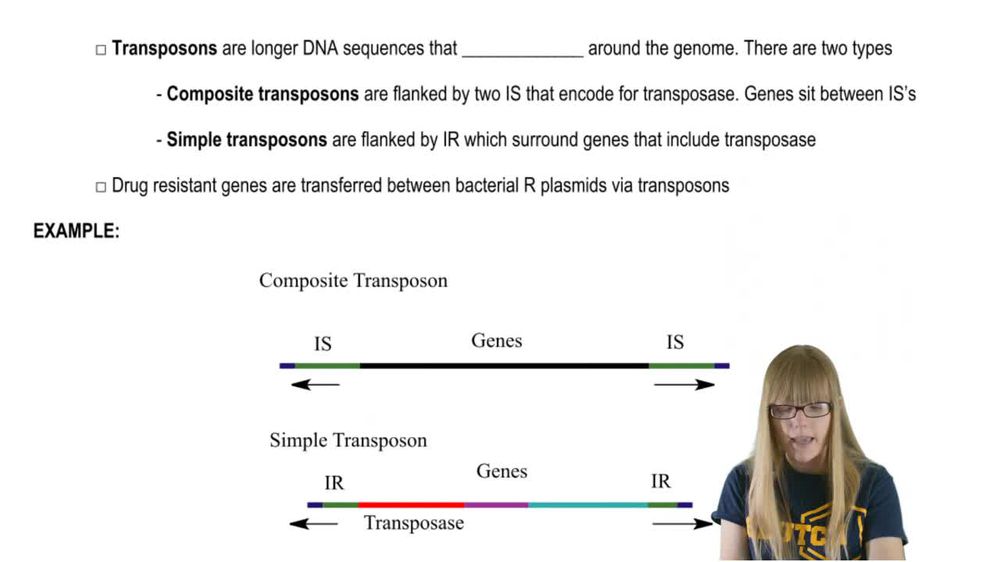
Transposition is the process by which a transposable element, such as IS10, moves from one location in the genome to another. This process is mediated by the enzyme transposase, which is produced in response to the transcription of the transposase gene. The efficiency of transposition is directly linked to the levels of transposase and the regulatory mechanisms controlling its expression.
Recommended video:
Guided course
06:10
Prokaryotic Transposable Elements
Related Practice
Textbook Question

How would mutations that inactivate each of the following genes affect the determination of the lytic or lysogenic life cycle in mutated λ phage strains? Explain your answers.

int

392
views
Textbook Question

How would mutations that inactivate each of the following genes affect the determination of the lytic or lysogenic life cycle in mutated λ phage strains? Explain your answers.

cII and cro

443
views
Textbook Question

How would mutations that inactivate each of the following genes affect the determination of the lytic or lysogenic life cycle in mutated λ phage strains? Explain your answers.

N

354
views
Textbook Question

The bacterial insertion sequence IS10 uses antisense RNA to regulate translation of the mRNA that produces the enzyme transposase, which is required for insertion sequence transposition. Transcription of the antisense RNA gene is controlled by POUT, which is more than 10 times more efficient at transcription than the PIN promoter, which controls transposase gene transcription.

If a mutation of PIN eliminates its ability to function in transcription, what is the likely effect on the transposition of IS10?

451
views
Textbook Question

For an E. coli strain with the lac operon genotype I⁺ P⁺ O⁺ Z⁺ Y⁺, identify the level of transcription of the operon genes in each growth medium listed. Specify transcription as 'none,' 'basal,' or 'activated' for each medium, and provide an explanation to justify your answer.

Growth medium contains lactose and glucose.

827
views
Textbook Question

For an E. coli strain with the lac operon genotype I⁺ P⁺ O⁺ Z⁺ Y⁺, identify the level of transcription of the operon genes in each growth medium listed. Specify transcription as 'none,' 'basal,' or 'activated' for each medium, and provide an explanation to justify your answer.

Growth medium contains glucose but no lactose.

843
views