Pearson+ LogoPearson+ Logo
Ch. 12 - Regulation of Gene Expression in Bacteria and Bacteriophage
Sanders - Genetic Analysis: An Integrated Approach 3rd Edition
Sanders3rd EditionGenetic Analysis: An Integrated ApproachISBN: 9780135564172Not the one you use?Change textbook
Chapter 12, Problem 28e

How would mutations that inactivate each of the following genes affect the determination of the lytic or lysogenic life cycle in mutated λ phage strains? Explain your answers.
cII and cro

Verified step by step guidance
1
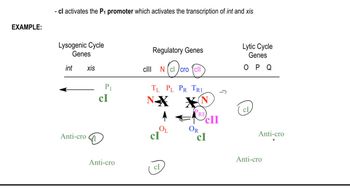
Understand the context: The λ phage can enter either the lytic or lysogenic life cycle. The decision is regulated by a genetic switch involving key genes such as cII and cro. The cII gene promotes lysogeny, while the cro gene promotes the lytic cycle. Mutations in these genes can disrupt this balance.
Analyze the role of cII: The cII protein activates the transcription of genes required for lysogeny, such as the cI gene, which encodes the λ repressor. If cII is inactivated by mutation, the transcription of cI will be impaired, reducing the likelihood of lysogeny and favoring the lytic cycle.
Analyze the role of cro: The cro protein represses the transcription of the cI gene, thereby inhibiting lysogeny and promoting the lytic cycle. If cro is inactivated by mutation, the repression of cI will be lifted, allowing the λ repressor to accumulate and favor lysogeny over the lytic cycle.
Consider the combined effects: A mutation in cII would make it difficult for the phage to establish lysogeny, as the cI gene would not be activated. Conversely, a mutation in cro would make it difficult for the phage to enter the lytic cycle, as cI repression would be lost. The specific life cycle outcome depends on which gene is mutated and the environmental conditions.
Summarize the outcomes: Inactivation of cII skews the balance toward the lytic cycle, while inactivation of cro skews the balance toward lysogeny. These effects highlight the importance of the genetic switch in determining the phage's life cycle.

Verified video answer for a similar problem:

This video solution was recommended by our tutors as helpful for the problem above.
Video duration:
3m
Was this helpful?

Key Concepts

Here are the essential concepts you must grasp in order to answer the question correctly.

Lytic and Lysogenic Cycles

The lytic and lysogenic cycles are two distinct pathways that bacteriophages, like λ phage, can follow after infecting a host bacterium. In the lytic cycle, the phage replicates rapidly, leading to the destruction of the host cell and the release of new phage particles. In contrast, the lysogenic cycle involves the integration of the phage DNA into the host genome, allowing it to replicate along with the host cell without causing immediate harm.
Recommended video:
Guided course
08:04
Decision Between Lytic and Lysogenic Cycles

cII Protein

The cII protein is a key regulatory protein in λ phage that promotes the lysogenic cycle. It activates the transcription of genes necessary for lysogeny, including the repressor protein cI, which maintains the phage in a dormant state within the host. If cII is inactivated by mutations, the phage is more likely to enter the lytic cycle due to the lack of lysogenic promotion.
Recommended video:

cro Protein

The cro protein is another regulatory protein in λ phage that plays a crucial role in determining the lytic cycle. It represses the expression of the cI gene, thereby favoring the lytic pathway. Mutations that inactivate cro can lead to increased levels of cI, promoting lysogeny and preventing the lytic cycle, as the phage would be unable to effectively suppress the lysogenic state.
Recommended video:
Related Practice
Textbook Question

How would mutations that inactivate each of the following genes affect the determination of the lytic or lysogenic life cycle in mutated λ phage strains? Explain your answers.

cII

604
views
Textbook Question

How would mutations that inactivate each of the following genes affect the determination of the lytic or lysogenic life cycle in mutated λ phage strains? Explain your answers.

cro

406
views
Textbook Question

How would mutations that inactivate each of the following genes affect the determination of the lytic or lysogenic life cycle in mutated λ phage strains? Explain your answers.

int

392
views
Textbook Question

How would mutations that inactivate each of the following genes affect the determination of the lytic or lysogenic life cycle in mutated λ phage strains? Explain your answers.

N

354
views
Textbook Question

The bacterial insertion sequence IS10 uses antisense RNA to regulate translation of the mRNA that produces the enzyme transposase, which is required for insertion sequence transposition. Transcription of the antisense RNA gene is controlled by POUT, which is more than 10 times more efficient at transcription than the PIN promoter, which controls transposase gene transcription.

If a mutation reduced the transcriptional efficiency of POUT so as to be equal to that of PIN, what is the likely effect on the transposition of IS10?

650
views
Textbook Question

The bacterial insertion sequence IS10 uses antisense RNA to regulate translation of the mRNA that produces the enzyme transposase, which is required for insertion sequence transposition. Transcription of the antisense RNA gene is controlled by POUT, which is more than 10 times more efficient at transcription than the PIN promoter, which controls transposase gene transcription.

If a mutation of PIN eliminates its ability to function in transcription, what is the likely effect on the transposition of IS10?

451
views