Back

Mendel's Experiments and Laws definitions

Control buttons has been changed to "navigation" mode.
1/15
  • Gregor Mendel

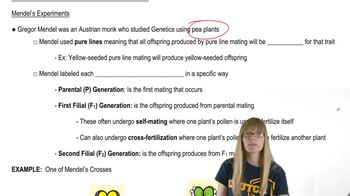
    An Austrian monk recognized as the founder of genetics through systematic experiments with pea plants.
  • Pea Plants

    Model organisms chosen for genetic studies due to ease of breeding and availability of pure lines.
  • Pure Line

    A group where all offspring consistently display the same trait as their parents across generations.
  • Parental Generation

    The initial group in a genetic cross, serving as the starting point for observing inheritance patterns.
  • First Filial Generation

    The immediate offspring resulting from the mating of the parental generation, often labeled F1.
  • Second Filial Generation

    The group produced by self-mating or crossing F1 individuals, commonly labeled F2.
  • Self Mating

    A process where an organism fertilizes itself, commonly used in plant genetics to analyze inheritance.
  • Cross Fertilization

    A technique where pollen from one plant fertilizes another, enabling genetic variation studies.
  • Trait

    A specific characteristic, such as seed color, observed and tracked across generations in genetic studies.
  • Gene

    A hereditary factor responsible for determining a particular trait, existing in different forms.
  • Allele

    A variant form of a gene, such as those determining yellow or green seed color in pea plants.
  • Dominant

    A form of an allele that masks the presence of another, resulting in its trait being expressed.
  • Recessive

    A form of an allele whose trait is only expressed when two copies are present, often masked by a dominant allele.
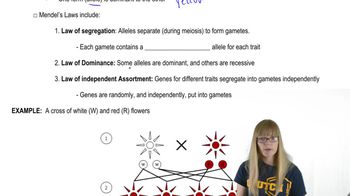
  • Law of Segregation

    A principle stating that alleles separate during meiosis, so each gamete carries only one allele for each trait.
  • Law of Dominance

    A rule explaining that one allele can mask the effect of another, leading to dominant and recessive trait patterns.