Skip to main content
Genetics
My Course
Learn
Exam Prep
AI Tutor
Study Guides
Textbook Solutions
Flashcards
Explore
Try the app
My Course
Learn
Exam Prep
AI Tutor
Study Guides
Textbook Solutions
Flashcards
Explore
Try the app
Back
Probability and Genetics definitions
You can tap to flip the card.
Probability
You can tap to flip the card.
👆
Probability
Mathematical measure used to predict the chance of specific genetic outcomes, such as phenotypes or alleles, in offspring.
Track progress
Control buttons has been changed to "navigation" mode.
1/15
Related flashcards
Related practice
Recommended videos
Probability and Genetics quiz #1
Probability and Genetics
24 Terms
Probability and Genetics
2. Mendel's Laws of Inheritance
7 problems
Topic
Kylia
Pedigrees
2. Mendel's Laws of Inheritance
7 problems
Topic
Kylia
2. Mendel's Laws of Inheritance - Part 1 of 2
4 topics
10 problems
Chapter
Kylia
2. Mendel's Laws of Inheritance - Part 2 of 2
4 topics
10 problems
Chapter
Kylia
Guided course
07:41
Probability
3410
views
27
rank
5
comments
Terms in this set (15)
Hide definitions
Probability
Mathematical measure used to predict the chance of specific genetic outcomes, such as phenotypes or alleles, in offspring.
Product Law
Rule applied to calculate the likelihood of two independent events occurring together by multiplying their individual probabilities.
Sum Law
Rule used to determine the chance of independent events occurring in multiple ways by adding their individual probabilities.
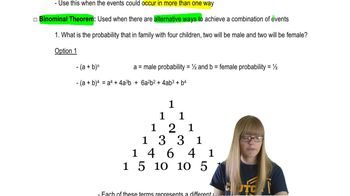
Binomial Theorem
Mathematical approach for finding probabilities of combinations of outcomes, especially when events can occur in various ways.
Coefficient Table
Reference chart providing numerical values to simplify calculations of probabilities in binomial scenarios.
Phenotype
Observable characteristic or trait of an organism, whose probability can be predicted using probability laws.
Allele
Variant form of a gene, whose likelihood of being inherited can be calculated using probability principles.
Mutation
Genetic change whose occurrence in offspring can be estimated using probability calculations.
Independent Events
Occurrences where the outcome of one does not affect the outcome of another, crucial for applying product and sum laws.
Combination
Specific arrangement of outcomes, such as the number of males and females in a family, analyzed using binomial methods.
Outcome
Possible result in a probability scenario, such as heads or tails in a coin toss or male or female in offspring.
Event
A single occurrence or trial in a probability context, like the birth of a child or a coin toss.
Formula
Mathematical expression used to calculate probabilities, such as (a + b)^n in binomial problems.
Coefficient
Numerical factor in a binomial expansion indicating the number of ways a particular combination can occur.
Probability Laws
Set of mathematical rules, including product and sum laws, used to predict genetic outcomes.
 BackBack
 07:41
07:41