Pearson+ LogoPearson+ Logo
Ch. 1 - The Molecular Basis of Heredity, Variation, and Evolution
Sanders - Genetic Analysis: An Integrated Approach 3rd Edition
Sanders3rd EditionGenetic Analysis: An Integrated ApproachISBN: 9780135564172Not the one you use?Change textbook
Chapter 1, Problem 10n

Define each of the following terms:
Mutation

Verified step by step guidance
1
A mutation is a permanent change in the DNA sequence of an organism's genome. This change can occur in a single nucleotide or involve larger segments of DNA.
Mutations can arise due to errors during DNA replication, exposure to mutagens (e.g., radiation, chemicals), or through spontaneous chemical changes in the DNA.
Mutations can be classified into different types, such as point mutations (e.g., substitutions, insertions, deletions), chromosomal mutations (e.g., duplications, inversions), and frameshift mutations.
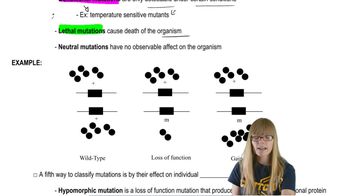
The effects of mutations can vary: they may be neutral (no effect on the organism), beneficial (providing an advantage), or harmful (causing diseases or disorders).
Mutations are a key source of genetic variation, which is essential for evolution, but they can also lead to genetic disorders if they disrupt critical genes or regulatory regions.

Verified video answer for a similar problem:

This video solution was recommended by our tutors as helpful for the problem above.
Video duration:
2m
Was this helpful?

Key Concepts

Here are the essential concepts you must grasp in order to answer the question correctly.

Mutation

A mutation is a change in the DNA sequence of an organism's genome. This alteration can occur due to various factors, including errors during DNA replication, exposure to radiation, or chemical agents. Mutations can be classified as point mutations, which involve a single nucleotide change, or larger-scale mutations that affect larger segments of DNA. They can have neutral, beneficial, or harmful effects on an organism's phenotype.
Recommended video:
Guided course
10:48
Mutations and Phenotypes

Types of Mutations

Mutations can be categorized into several types, including silent, missense, and nonsense mutations. Silent mutations do not change the amino acid sequence of a protein, while missense mutations result in a different amino acid being incorporated, potentially altering protein function. Nonsense mutations create a premature stop codon, leading to truncated proteins. Understanding these types is crucial for predicting the impact of mutations on biological functions.
Recommended video:
Guided course
10:48
Mutations and Phenotypes

Role of Mutations in Evolution

Mutations are a primary source of genetic variation, which is essential for the process of evolution. They provide the raw material for natural selection to act upon, allowing populations to adapt to changing environments. While many mutations are neutral or deleterious, beneficial mutations can enhance survival and reproduction, contributing to the evolutionary fitness of organisms. This interplay between mutation and selection is fundamental to evolutionary biology.
Recommended video: