Pearson+ LogoPearson+ Logo
Ch. 10 - Eukaryotic Chromosome Abnormalities and Molecular Organization
Sanders - Genetic Analysis: An Integrated Approach 3rd Edition
Sanders3rd EditionGenetic Analysis: An Integrated ApproachISBN: 9780135564172Not the one you use?Change textbook
Chapter 10, Problem 24b

A boy with Down syndrome (trisomy 21) has 46 chromosomes. His parents and his two older sisters have a normal phenotype, but each has 45 chromosomes.
How many chromosomes do you expect to see in karyotypes of the parents?

Verified step by step guidance
1
Understand the problem: Down syndrome (trisomy 21) occurs when there is an extra copy of chromosome 21. The boy has 46 chromosomes, which is unusual because individuals with Down syndrome typically have 47 chromosomes. The parents and sisters have 45 chromosomes, which suggests a balanced translocation involving chromosome 21.
Recall the concept of a balanced translocation: A balanced translocation occurs when two chromosomes exchange segments without any genetic material being lost or gained. Individuals with a balanced translocation typically have a normal phenotype but may pass on an unbalanced chromosome arrangement to their offspring.
Determine the parental karyotype: Since the parents have 45 chromosomes, one of them likely carries a balanced translocation involving chromosome 21 and another chromosome. This means that one chromosome 21 is fused with another chromosome, reducing the total chromosome count to 45.
Explain the inheritance pattern: The boy inherited the extra chromosome 21 from the parent with the balanced translocation. This occurred because the parent passed on the translocated chromosome along with a normal chromosome 21, resulting in trisomy 21 in the boy.
Conclude the expected chromosome count: Both parents are expected to have 45 chromosomes, with one of them carrying the balanced translocation. The other parent likely has a normal karyotype with 46 chromosomes, but this is not explicitly stated in the problem and would require further clarification.

Verified video answer for a similar problem:

This video solution was recommended by our tutors as helpful for the problem above.
Video duration:
2m
Was this helpful?

Key Concepts

Here are the essential concepts you must grasp in order to answer the question correctly.

Karyotype

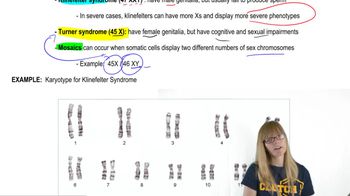
A karyotype is a visual representation of an individual's chromosomes, organized in pairs and arranged by size. It is used to identify chromosomal abnormalities, such as aneuploidy, which is an abnormal number of chromosomes. In humans, a normal karyotype consists of 46 chromosomes, arranged into 23 pairs.
Recommended video:
Guided course
10:35
Human Sex Chromosomes

Aneuploidy

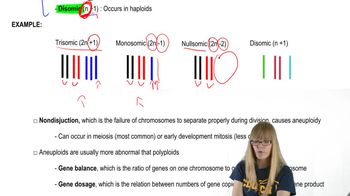
Aneuploidy refers to the presence of an abnormal number of chromosomes in a cell. This can occur due to nondisjunction during meiosis, leading to gametes with an incorrect number of chromosomes. In the case of Down syndrome, which is caused by trisomy 21, there is an extra copy of chromosome 21, resulting in a total of 47 chromosomes in affected individuals.
Recommended video:

Inheritance Patterns

Inheritance patterns describe how genetic traits and conditions are passed from parents to offspring. In the context of Down syndrome, it is important to understand that while the boy has 47 chromosomes, his parents and sisters, having 45 chromosomes, suggest a possible chromosomal abnormality in the parents. This could indicate a structural rearrangement or a condition like Turner syndrome, which affects the number of sex chromosomes.
Recommended video:
Guided course
05:13
Organelle Inheritance
Related Practice
Textbook Question

Two experimental varieties of strawberry are produced by crossing a hexaploid line that contains 48 chromosomes and a tetraploid line that contains 32 chromosomes. Experimental variety 1 contains 40 chromosomes, and experimental variety 2 contains 56 chromosomes.

How many chromosomes from the tetraploid lines are contributed to experimental variety 1? To experimental variety 2?

446
views
Textbook Question

In the tomato, Solanum esculentum, tall (D−)(D−) is dominant to dwarf (dd) plant height, smooth fruit (P−) is dominant to peach fruit (pp), and round fruit shape (O−) is dominant to oblate fruit shape (oo). These three genes are linked on chromosome 1 of tomato in the order dwarf–peach–oblate. There are 12 map units between dwarf and peach and 17 map units between peach and oblate. A trihybrid plant (DPO/dpo) is test-crossed to a plant that is homozygous recessive at the three loci (dpo/dpo). The accompanying table shows the progeny plants. Identify the mechanism responsible for the resulting data that do not agree with the established genetic map.

623
views
Textbook Question

A boy with Down syndrome (trisomy 21) has 46 chromosomes. His parents and his two older sisters have a normal phenotype, but each has 45 chromosomes.

Explain how this is possible.

497
views
Textbook Question

A boy with Down syndrome (trisomy 21) has 46 chromosomes. His parents and his two older sisters have a normal phenotype, but each has 45 chromosomes.

What term best describes this kind of chromosome abnormality?

394
views
Textbook Question

A boy with Down syndrome (trisomy 21) has 46 chromosomes. His parents and his two older sisters have a normal phenotype, but each has 45 chromosomes.

What is the probability the next child of this couple will have a normal phenotype and have 46 chromosomes? Explain your answer.

512
views
Textbook Question

Experimental evidence demonstrates that the nucleosomes present in a cell after the completion of S phase are composed of some 'old' histone dimers and some newly synthesized histone dimers. Describe the general design for an experiment that uses a protein label such as ³⁵S to show that nucleosomes are often a mixture of old and new histone dimers following DNA replication.

499
views