Pearson+ LogoPearson+ Logo
Ch. 10 - Eukaryotic Chromosome Abnormalities and Molecular Organization
Sanders - Genetic Analysis: An Integrated Approach 3rd Edition
Sanders3rd EditionGenetic Analysis: An Integrated ApproachISBN: 9780135564172Not the one you use?Change textbook
Chapter 10, Problem 24a

A boy with Down syndrome (trisomy 21) has 46 chromosomes. His parents and his two older sisters have a normal phenotype, but each has 45 chromosomes.
Explain how this is possible.

Verified step by step guidance
1
Understand that Down syndrome (trisomy 21) typically results from an individual having three copies of chromosome 21, leading to a total of 47 chromosomes. However, in this case, the boy has 46 chromosomes, which is unusual and requires further investigation.
Recognize that the parents and sisters each have 45 chromosomes, which is fewer than the normal 46 chromosomes in humans. This suggests the presence of a chromosomal rearrangement, such as a Robertsonian translocation, which can involve chromosome 21.
Explain that a Robertsonian translocation occurs when two acrocentric chromosomes (e.g., chromosome 21 and another chromosome) fuse at their centromeres, forming a single chromosome. This reduces the total chromosome count but does not necessarily result in a loss of genetic material.
Propose that one of the parents likely carries a balanced Robertsonian translocation involving chromosome 21. In this case, the parent would have 45 chromosomes but a normal phenotype because no critical genetic material is lost or duplicated.
Describe how the boy inherited an unbalanced combination of chromosomes: two normal copies of chromosome 21 and the translocated chromosome. This results in trisomy 21 (Down syndrome) despite the total chromosome count being 46.

Verified video answer for a similar problem:

This video solution was recommended by our tutors as helpful for the problem above.
Video duration:
3m
Was this helpful?

Key Concepts

Here are the essential concepts you must grasp in order to answer the question correctly.

Chromosomal Abnormalities

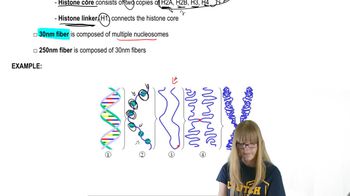
Chromosomal abnormalities occur when there is a deviation from the normal number or structure of chromosomes. In the case of Down syndrome, also known as trisomy 21, an individual has three copies of chromosome 21 instead of the usual two. This can happen due to nondisjunction during meiosis, where chromosomes fail to separate properly, leading to gametes with an abnormal number of chromosomes.
Recommended video:
Guided course
07:10
Chromosome Structure

Nondisjunction

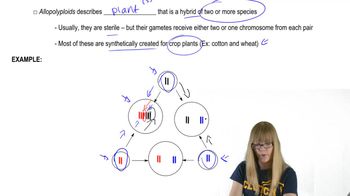
Nondisjunction is the failure of homologous chromosomes or sister chromatids to separate properly during cell division. This can occur during meiosis, resulting in gametes that have an extra chromosome or are missing one. If such a gamete participates in fertilization, it can lead to conditions like Down syndrome, where the resulting zygote has an abnormal number of chromosomes.
Recommended video:
Guided course
04:34
Allopolyploidy

Phenotype vs. Genotype

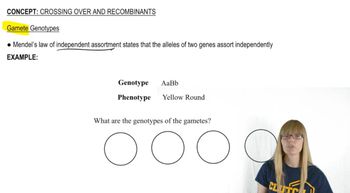
Phenotype refers to the observable characteristics or traits of an organism, while genotype refers to the genetic makeup. In this scenario, the boy with Down syndrome has a distinct phenotype due to his extra chromosome, but his parents and sisters may have a normal phenotype despite having 45 chromosomes, possibly due to a balanced chromosomal rearrangement or a different chromosomal abnormality that does not affect their phenotype.
Recommended video:
Guided course
07:52
Gamete Genotypes
Related Practice
Textbook Question

Two experimental varieties of strawberry are produced by crossing a hexaploid line that contains 48 chromosomes and a tetraploid line that contains 32 chromosomes. Experimental variety 1 contains 40 chromosomes, and experimental variety 2 contains 56 chromosomes.

How many chromosomes from the hexaploid line are contributed to experimental variety 1? To experimental variety 2?

635
views
Textbook Question

Two experimental varieties of strawberry are produced by crossing a hexaploid line that contains 48 chromosomes and a tetraploid line that contains 32 chromosomes. Experimental variety 1 contains 40 chromosomes, and experimental variety 2 contains 56 chromosomes.

How many chromosomes from the tetraploid lines are contributed to experimental variety 1? To experimental variety 2?

446
views
Textbook Question

In the tomato, Solanum esculentum, tall (D−)(D−) is dominant to dwarf (dd) plant height, smooth fruit (P−) is dominant to peach fruit (pp), and round fruit shape (O−) is dominant to oblate fruit shape (oo). These three genes are linked on chromosome 1 of tomato in the order dwarf–peach–oblate. There are 12 map units between dwarf and peach and 17 map units between peach and oblate. A trihybrid plant (DPO/dpo) is test-crossed to a plant that is homozygous recessive at the three loci (dpo/dpo). The accompanying table shows the progeny plants. Identify the mechanism responsible for the resulting data that do not agree with the established genetic map.

623
views
Textbook Question

A boy with Down syndrome (trisomy 21) has 46 chromosomes. His parents and his two older sisters have a normal phenotype, but each has 45 chromosomes.

How many chromosomes do you expect to see in karyotypes of the parents?

926
views
Textbook Question

A boy with Down syndrome (trisomy 21) has 46 chromosomes. His parents and his two older sisters have a normal phenotype, but each has 45 chromosomes.

What term best describes this kind of chromosome abnormality?

394
views
Textbook Question

A boy with Down syndrome (trisomy 21) has 46 chromosomes. His parents and his two older sisters have a normal phenotype, but each has 45 chromosomes.

What is the probability the next child of this couple will have a normal phenotype and have 46 chromosomes? Explain your answer.

512
views