In the tomato, Solanum esculentum, tall (D−)(D−) is dominant to dwarf (dd) plant height, smooth fruit (P−) is dominant to peach fruit (pp), and round fruit shape (O−) is dominant to oblate fruit shape (oo). These three genes are linked on chromosome 1 of tomato in the order dwarf–peach–oblate. There are 12 map units between dwarf and peach and 17 map units between peach and oblate. A trihybrid plant (DPO/dpo) is test-crossed to a plant that is homozygous recessive at the three loci (dpo/dpo). The accompanying table shows the progeny plants. Identify the mechanism responsible for the resulting data that do not agree with the established genetic map.

Sanders 3rd Edition
Ch. 10 - Eukaryotic Chromosome Abnormalities and Molecular Organization
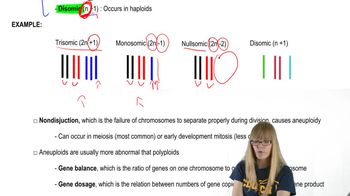
Problem 24cA boy with Down syndrome (trisomy 21) has 46 chromosomes. His parents and his two older sisters have a normal phenotype, but each has 45 chromosomes.
What term best describes this kind of chromosome abnormality?
Verified step by step guidance
Verified video answer for a similar problem:
Key Concepts
Chromosome Number Abnormalities
Aneuploidy
Phenotype vs. Genotype
A boy with Down syndrome (trisomy 21) has 46 chromosomes. His parents and his two older sisters have a normal phenotype, but each has 45 chromosomes.
Explain how this is possible.
A boy with Down syndrome (trisomy 21) has 46 chromosomes. His parents and his two older sisters have a normal phenotype, but each has 45 chromosomes.
How many chromosomes do you expect to see in karyotypes of the parents?
A boy with Down syndrome (trisomy 21) has 46 chromosomes. His parents and his two older sisters have a normal phenotype, but each has 45 chromosomes.
What is the probability the next child of this couple will have a normal phenotype and have 46 chromosomes? Explain your answer.
Experimental evidence demonstrates that the nucleosomes present in a cell after the completion of S phase are composed of some 'old' histone dimers and some newly synthesized histone dimers. Describe the general design for an experiment that uses a protein label such as ³⁵S to show that nucleosomes are often a mixture of old and new histone dimers following DNA replication.
DNase I cuts DNA that is not protected by bound proteins but is unable to cut DNA that is complexed with proteins. Human DNA is isolated, stripped of its nonhistone proteins, and mixed with DNase I. Samples are removed after 30 minutes, 1 hour, and 4 hours and run separately in gel electrophoresis. The resulting gel is stained to make all DNA fragments in it visible, and the results are shown in the figure. DNA fragment sizes in base pairs (bp) are estimated by the scale to the left of the gel. Examine the gel results and speculate why longer DNase I treatment produces different results.