Pearson+ LogoPearson+ Logo
Ch. 11 - Gene Mutation, DNA Repair, and Homologous Recombination
Sanders - Genetic Analysis: An Integrated Approach 3rd Edition
Sanders3rd EditionGenetic Analysis: An Integrated ApproachISBN: 9780135564172Not the one you use?Change textbook
Chapter 11, Problem 15

A 1-mL sample of the bacterium E. coli is exposed to ultraviolet light. The sample is used to inoculate a 500-mL flask of complete medium that allows growth of all bacterial cells. The 500-mL culture is grown on the benchtop, and two equal-sized samples are removed and plated on identical complete-medium growth plates. Plate 1 is immediately wrapped in a dark cloth, but plate 2 is not covered. Both plates are left at room temperature for 36 hours and then examined. Plate 2 is seen to contain many more growing colonies than plate 1.
Thinking about DNA repair processes, how do you explain this observation?

Verified step by step guidance
1
Understand the context: The problem involves DNA repair mechanisms in E. coli exposed to ultraviolet (UV) light. UV light can cause damage to DNA, such as the formation of thymine dimers, which disrupt normal DNA replication and transcription.
Recognize the experimental setup: Plate 1 is wrapped in a dark cloth, preventing exposure to light, while Plate 2 is left uncovered, allowing exposure to light. Both plates are incubated for 36 hours at room temperature.
Recall the role of photoreactivation: Photoreactivation is a DNA repair process in which an enzyme called photolyase uses visible light to repair UV-induced thymine dimers. This process requires light to activate the enzyme and repair the DNA damage.
Explain the difference in colony growth: Plate 2, exposed to light, allows photolyase to repair the UV-induced DNA damage, enabling more bacterial cells to survive and form colonies. Plate 1, kept in the dark, does not allow photoreactivation, resulting in fewer colonies due to unrepaired DNA damage.
Conclude the observation: The difference in colony numbers between Plate 1 and Plate 2 demonstrates the importance of light-dependent DNA repair mechanisms, specifically photoreactivation, in recovering from UV-induced DNA damage.

Verified video answer for a similar problem:

This video solution was recommended by our tutors as helpful for the problem above.
Video duration:
3m
Was this helpful?

Key Concepts

Here are the essential concepts you must grasp in order to answer the question correctly.

Ultraviolet (UV) Light and DNA Damage

Ultraviolet light is a form of electromagnetic radiation that can cause damage to DNA by inducing the formation of pyrimidine dimers, primarily thymine dimers. These dimers disrupt normal base pairing during DNA replication, leading to mutations if not repaired. Understanding how UV light affects DNA is crucial for explaining the differences in bacterial growth observed in the experiment.
Recommended video:
Guided course
01:45
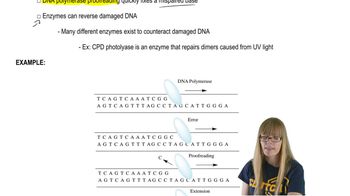
DNA Proofreading

DNA Repair Mechanisms

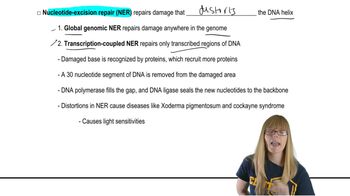
Bacteria possess several DNA repair mechanisms to correct damage caused by UV light, including photoreactivation and nucleotide excision repair. Photoreactivation involves the enzyme photolyase, which uses visible light to directly reverse the formation of pyrimidine dimers. In contrast, nucleotide excision repair removes damaged sections of DNA and replaces them with the correct nucleotides, ensuring the integrity of the genetic material.
Recommended video:
Guided course
05:44
Repair Pathways

Effect of Light on Bacterial Growth

The experiment highlights the role of light in bacterial growth and DNA repair. Plate 1, covered in a dark cloth, prevents photoreactivation, leaving the bacteria unable to repair UV-induced damage effectively. In contrast, Plate 2, exposed to light, allows photolyase to function, leading to more successful DNA repair and consequently a higher number of growing colonies. This illustrates the importance of environmental factors in microbial survival and growth.
Recommended video:
Guided course
03:38
Maternal Effect
Related Practice
Textbook Question

Several types of mutation are identified and described in the chapter. These include (1) promoter mutation, (2) splice site mutation, (3) missense mutation, (4) frameshift mutation, and 5) nonsense mutation. Match the following mutation descriptions with the type(s) of mutations listed above. More than one mutation type might match a description.


A mutation that produces a mutant protein that differs from the wild-type protein at one amino acid position.

996
views
Textbook Question

Several types of mutation are identified and described in the chapter. These include (1) promoter mutation, (2) splice site mutation, (3) missense mutation, (4) frameshift mutation, and 5) nonsense mutation. Match the following mutation descriptions with the type(s) of mutations listed above. More than one mutation type might match a description.


A mutation that produces a protein that is shorter than the wild-type protein but does not have any amino acid changes in the portion produced.

618
views
Textbook Question

Several types of mutation are identified and described in the chapter. These include (1) promoter mutation, (2) splice site mutation, (3) missense mutation, (4) frameshift mutation, and 5) nonsense mutation. Match the following mutation descriptions with the type(s) of mutations listed above. More than one mutation type might match a description.


A null mutation that does not produce any functional protein product.

513
views
Textbook Question

A strain of E. coli is identified as having a null mutation of the RecA gene. What biological property do you expect to be absent in the mutant strain? What is the molecular basis for the missing property?

470
views
Textbook Question

Describe the difference between DNA transposons and retrotransposons.

726
views
Textbook Question

How are flanking direct repeat sequences created by transposition?

766
views