Pearson+ LogoPearson+ Logo
Ch. 11 - Gene Mutation, DNA Repair, and Homologous Recombination
Sanders - Genetic Analysis: An Integrated Approach 3rd Edition
Sanders3rd EditionGenetic Analysis: An Integrated ApproachISBN: 9780135564172Not the one you use?Change textbook
Chapter 11, Problem 17

Describe the difference between DNA transposons and retrotransposons.

Verified step by step guidance
1
DNA transposons, also known as 'jumping genes', move within the genome by a 'cut and paste' mechanism. They are excised from one location and inserted into another.
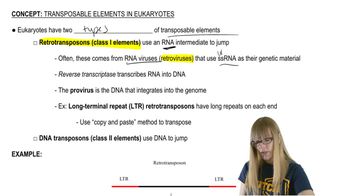
Retrotransposons move by a 'copy and paste' mechanism. They are transcribed into RNA, then reverse transcribed into DNA, which is inserted at a new location.
DNA transposons do not require an RNA intermediate for their movement, whereas retrotransposons do.
Retrotransposons often contain long terminal repeats (LTRs) at their ends, which are not present in DNA transposons.
The enzyme transposase is required for the movement of DNA transposons, while reverse transcriptase is necessary for retrotransposons.

Verified video answer for a similar problem:

This video solution was recommended by our tutors as helpful for the problem above.
Video duration:
1m
Was this helpful?

Key Concepts

Here are the essential concepts you must grasp in order to answer the question correctly.

DNA Transposons

DNA transposons, also known as 'jumping genes,' are segments of DNA that can move from one location to another within the genome. They typically replicate themselves and insert copies into new genomic sites, a process facilitated by the enzyme transposase. This movement can lead to mutations and genomic rearrangements, influencing gene expression and evolution.
Recommended video:
Guided course
01:45
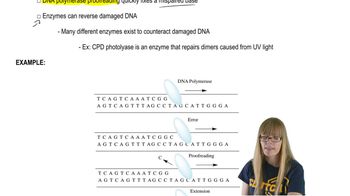
DNA Proofreading

Retrotransposons

Retrotransposons are a type of transposable element that move within the genome via an RNA intermediate. They are transcribed into RNA, which is then reverse-transcribed back into DNA and integrated into a new location in the genome. This process often involves the enzyme reverse transcriptase and can contribute to genetic diversity and evolution.
Recommended video:
Guided course
03:14
Eukaryotic Transposable Elements

Mechanisms of Transposition

The mechanisms of transposition differ between DNA transposons and retrotransposons. DNA transposons utilize a 'cut-and-paste' mechanism, while retrotransposons employ a 'copy-and-paste' strategy. Understanding these mechanisms is crucial for grasping how these elements can affect genomic stability, gene regulation, and evolutionary processes.
Recommended video:
Guided course
06:10
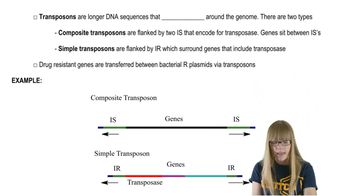
Prokaryotic Transposable Elements
Related Practice
Textbook Question

Several types of mutation are identified and described in the chapter. These include (1) promoter mutation, (2) splice site mutation, (3) missense mutation, (4) frameshift mutation, and 5) nonsense mutation. Match the following mutation descriptions with the type(s) of mutations listed above. More than one mutation type might match a description.


A null mutation that does not produce any functional protein product.

513
views
Textbook Question

A 1-mL sample of the bacterium E. coli is exposed to ultraviolet light. The sample is used to inoculate a 500-mL flask of complete medium that allows growth of all bacterial cells. The 500-mL culture is grown on the benchtop, and two equal-sized samples are removed and plated on identical complete-medium growth plates. Plate 1 is immediately wrapped in a dark cloth, but plate 2 is not covered. Both plates are left at room temperature for 36 hours and then examined. Plate 2 is seen to contain many more growing colonies than plate 1.

Thinking about DNA repair processes, how do you explain this observation?

476
views
Textbook Question

A strain of E. coli is identified as having a null mutation of the RecA gene. What biological property do you expect to be absent in the mutant strain? What is the molecular basis for the missing property?

470
views
Textbook Question

How are flanking direct repeat sequences created by transposition?

766
views
Textbook Question

Using the adenine–thymine base pair in this DNA sequence

...GCTC...

...CGAG...

Give the sequence after a transition mutation.

613
views
Textbook Question

Using the adenine–thymine base pair in this DNA sequence

...GCTC...

...CGAG...

Give the sequence after a transversion mutation.

628
views