Pearson+ LogoPearson+ Logo
Ch. 11 - Gene Mutation, DNA Repair, and Homologous Recombination
Sanders - Genetic Analysis: An Integrated Approach 3rd Edition
Sanders3rd EditionGenetic Analysis: An Integrated ApproachISBN: 9780135564172Not the one you use?Change textbook
Chapter 11, Problem 29b

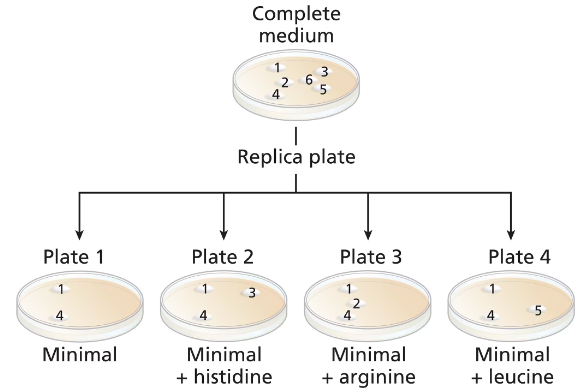
A wild-type culture of haploid yeast is exposed to ethyl methanesulfonate (EMS). Yeast cells are plated on a complete medium, and 6 colonies (colonies numbered 1 to 6) are transferred to a new complete medium plate for further study. Four replica plates are made from the complete medium plate to plates containing minimal medium or minimal medium plus one amino acid (replica plates numbered 1 to 4) with the following results:
Diagram showing yeast colonies on a complete medium and their transfer to replica plates with varying minimal media conditions.
Identify the colonies that are auxotrophic (mutant). What growth information leads to your answer? 

Verified step by step guidance
1
Understand the problem: Auxotrophic mutants are yeast cells that cannot synthesize a specific compound (e.g., an amino acid) required for growth. These mutants will not grow on minimal medium unless the missing compound is provided. The goal is to identify which colonies are auxotrophic based on their growth patterns on the replica plates.
Analyze the experimental setup: The wild-type yeast culture was exposed to EMS, a mutagen that induces random mutations. Colonies were grown on complete medium (which contains all necessary nutrients) and then transferred to minimal medium (which lacks specific nutrients) and minimal medium supplemented with individual amino acids.
Interpret the growth data: Examine the growth patterns of the colonies on the replica plates. Colonies that grow on complete medium but fail to grow on minimal medium are likely auxotrophic. Further, if a colony grows on minimal medium supplemented with a specific amino acid, it indicates that the colony is auxotrophic for that amino acid.
Identify auxotrophic colonies: Compare the growth results across the replica plates. Colonies that fail to grow on minimal medium but grow on minimal medium supplemented with a specific amino acid are auxotrophic for that amino acid. Record these colonies and the corresponding amino acid deficiencies.
Summarize the findings: List the colonies identified as auxotrophic and specify the amino acid(s) they require for growth. Explain how the growth patterns on the replica plates led to this conclusion, emphasizing the role of minimal medium and supplemented amino acids in identifying the mutants.

Verified video answer for a similar problem:

This video solution was recommended by our tutors as helpful for the problem above.
Video duration:
5m
Was this helpful?

Key Concepts

Here are the essential concepts you must grasp in order to answer the question correctly.

Auxotrophy

Auxotrophy refers to the inability of an organism to synthesize a particular compound required for its growth, often due to mutations in genes involved in metabolic pathways. In yeast, auxotrophic mutants cannot grow on minimal media unless specific nutrients, such as amino acids, are provided. Identifying auxotrophic colonies involves observing their growth patterns on different media.
Recommended video:
Guided course
09:35
Bacteria in the Laboratory

Ethyl Methanesulfonate (EMS)

Ethyl methanesulfonate (EMS) is a chemical mutagen that induces mutations in DNA by alkylating bases, leading to errors during DNA replication. This process can result in various mutations, including point mutations that may affect metabolic functions. Understanding the role of EMS is crucial for analyzing the resulting phenotypes of yeast colonies after exposure.

Replica Plating

Replica plating is a technique used to transfer colonies from one agar plate to another, allowing for the comparison of growth under different conditions. This method helps identify mutants by observing which colonies can grow on minimal media versus those that require additional nutrients. It is essential for determining the auxotrophic status of the yeast colonies in the experiment.
Recommended video:
Guided course
09:06
Meiosis Steps
Related Practice
Textbook Question

In an Ames test using hisSalmonella bacteria a researcher determines that adding a test compound plus the S9 extract produces a large number of his⁺ revertants but mixing the his⁻ strain plus the test compound without adding S9 does not produce an elevated number of his⁺ revertants.

What is the reason for the different experimental results described?

737
views
Textbook Question

In an Ames test using hisSalmonella bacteria a researcher determines that adding a test compound plus the S9 extract produces a large number of his⁺ revertants but mixing the his⁻ strain plus the test compound without adding S9 does not produce an elevated number of his⁺ revertants.

Is the test compound still considered to be a potential mutagen? Explain why or why not.

471
views
Textbook Question

A wild-type culture of haploid yeast is exposed to ethyl methanesulfonate (EMS). Yeast cells are plated on a complete medium, and 6 colonies (colonies numbered 1 to 6) are transferred to a new complete medium plate for further study. Four replica plates are made from the complete medium plate to plates containing minimal medium or minimal medium plus one amino acid (replica plates numbered 1 to 4) with the following results:

Identify the colonies that are prototrophic (wild type). What growth information leads to your answer? 

436
views
Textbook Question

A wild-type culture of haploid yeast is exposed to ethyl methanesulfonate (EMS). Yeast cells are plated on a complete medium, and 6 colonies (colonies numbered 1 to 6) are transferred to a new complete medium plate for further study. Four replica plates are made from the complete medium plate to plates containing minimal medium or minimal medium plus one amino acid (replica plates numbered 1 to 4) with the following results:

Identify any colonies that are his⁻, arg⁻, leu⁻.

444
views
Textbook Question

A wild-type culture of haploid yeast is exposed to ethyl methanesulfonate (EMS). Yeast cells are plated on a complete medium, and 6 colonies (colonies numbered 1 to 6) are transferred to a new complete medium plate for further study. Four replica plates are made from the complete medium plate to plates containing minimal medium or minimal medium plus one amino acid (replica plates numbered 1 to 4) with the following results:

For colonies 1, 3, and 5, write '+' for the wild-type synthesis and '−' for the mutant synthesis of histidine and leucine.

504
views
Textbook Question

A wild-type culture of haploid yeast is exposed to ethyl methanesulfonate (EMS). Yeast cells are plated on a complete medium, and 6 colonies (colonies numbered 1 to 6) are transferred to a new complete medium plate for further study. Four replica plates are made from the complete medium plate to plates containing minimal medium or minimal medium plus one amino acid (replica plates numbered 1 to 4) with the following results:

Are there any colonies for which genotype information cannot be determined? If so, which colony or colonies?

574
views