Following the spill of a mixture of chemicals into a small pond, bacteria from the pond are tested and show an unusually high rate of mutation. A number of mutant cultures are grown from mutant colonies and treated with known mutagens to study the rate of reversion. Most of the mutant cultures show a significantly higher reversion rate when exposed to base analogs such as proflavin and 2-aminopurine. What does this suggest about the nature of the chemicals in the spill?

Sanders 3rd Edition
Ch. 11 - Gene Mutation, DNA Repair, and Homologous Recombination
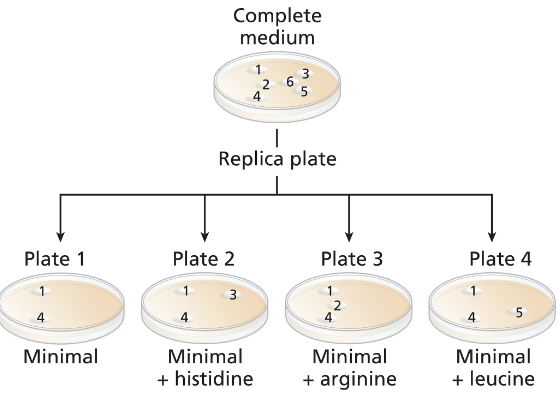
Problem 29aA wild-type culture of haploid yeast is exposed to ethyl methanesulfonate (EMS). Yeast cells are plated on a complete medium, and 6 colonies (colonies numbered 1 to 6) are transferred to a new complete medium plate for further study. Four replica plates are made from the complete medium plate to plates containing minimal medium or minimal medium plus one amino acid (replica plates numbered 1 to 4) with the following results:

Identify the colonies that are prototrophic (wild type). What growth information leads to your answer?
Verified step by step guidance
Verified video answer for a similar problem:
Key Concepts
Prototrophy vs. Auxotrophy
Minimal Medium
Replica Plating
In an Ames test using his⁻ Salmonella bacteria a researcher determines that adding a test compound plus the S9 extract produces a large number of his⁺ revertants but mixing the his⁻ strain plus the test compound without adding S9 does not produce an elevated number of his⁺ revertants.
What is the reason for the different experimental results described?
In an Ames test using his⁻ Salmonella bacteria a researcher determines that adding a test compound plus the S9 extract produces a large number of his⁺ revertants but mixing the his⁻ strain plus the test compound without adding S9 does not produce an elevated number of his⁺ revertants.
Is the test compound still considered to be a potential mutagen? Explain why or why not.
A wild-type culture of haploid yeast is exposed to ethyl methanesulfonate (EMS). Yeast cells are plated on a complete medium, and 6 colonies (colonies numbered 1 to 6) are transferred to a new complete medium plate for further study. Four replica plates are made from the complete medium plate to plates containing minimal medium or minimal medium plus one amino acid (replica plates numbered 1 to 4) with the following results:
Identify the colonies that are auxotrophic (mutant). What growth information leads to your answer?
A wild-type culture of haploid yeast is exposed to ethyl methanesulfonate (EMS). Yeast cells are plated on a complete medium, and 6 colonies (colonies numbered 1 to 6) are transferred to a new complete medium plate for further study. Four replica plates are made from the complete medium plate to plates containing minimal medium or minimal medium plus one amino acid (replica plates numbered 1 to 4) with the following results:
Identify any colonies that are his⁻, arg⁻, leu⁻.
A wild-type culture of haploid yeast is exposed to ethyl methanesulfonate (EMS). Yeast cells are plated on a complete medium, and 6 colonies (colonies numbered 1 to 6) are transferred to a new complete medium plate for further study. Four replica plates are made from the complete medium plate to plates containing minimal medium or minimal medium plus one amino acid (replica plates numbered 1 to 4) with the following results:
For colonies 1, 3, and 5, write '+' for the wild-type synthesis and '−' for the mutant synthesis of histidine and leucine.