Pearson+ LogoPearson+ Logo
Ch. 11 - Gene Mutation, DNA Repair, and Homologous Recombination
Sanders - Genetic Analysis: An Integrated Approach 3rd Edition
Sanders3rd EditionGenetic Analysis: An Integrated ApproachISBN: 9780135564172Not the one you use?Change textbook
Chapter 11, Problem 29d

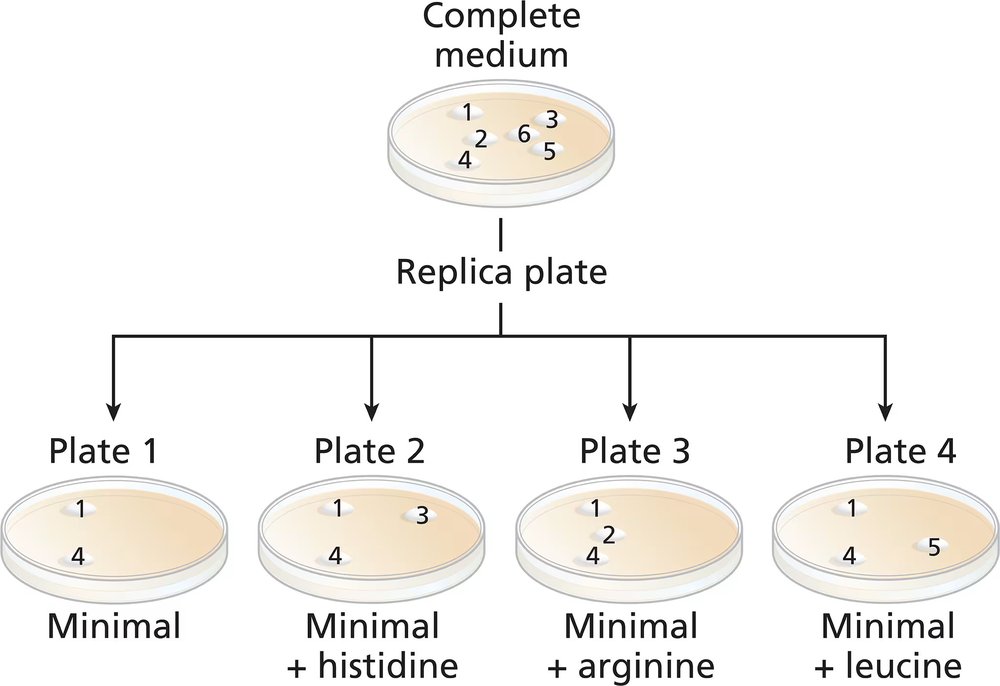
A wild-type culture of haploid yeast is exposed to ethyl methanesulfonate (EMS). Yeast cells are plated on a complete medium, and 6 colonies (colonies numbered 1 to 6) are transferred to a new complete medium plate for further study. Four replica plates are made from the complete medium plate to plates containing minimal medium or minimal medium plus one amino acid (replica plates numbered 1 to 4) with the following results:
Diagram showing yeast colonies on a complete medium plate and their transfer to replica plates with minimal media.
For colonies 1, 3, and 5, write '+' for the wild-type synthesis and '−' for the mutant synthesis of histidine and leucine.

Verified step by step guidance
1
Step 1: Understand the experimental setup. The yeast cells are haploid, meaning they have a single set of chromosomes. They were exposed to EMS, a chemical mutagen that induces mutations. The colonies were then tested on different media to determine their ability to synthesize amino acids like histidine and leucine.
Step 2: Analyze the results from the replica plates. Colonies that grow on minimal medium are wild-type for amino acid synthesis, as they can synthesize all required amino acids. Colonies that fail to grow on minimal medium but grow on minimal medium supplemented with a specific amino acid are mutants for the synthesis of that amino acid.
Step 3: For colonies 1, 3, and 5, check their growth patterns on the replica plates. If a colony grows on minimal medium, it is wild-type ('+') for both histidine and leucine synthesis. If it grows only on minimal medium supplemented with histidine, it is mutant ('−') for histidine synthesis. Similarly, if it grows only on minimal medium supplemented with leucine, it is mutant ('−') for leucine synthesis.
Step 4: Assign '+' or '−' for histidine and leucine synthesis for colonies 1, 3, and 5 based on their growth patterns. For example, if colony 1 grows on minimal medium but not on minimal medium supplemented with histidine, it is '+' for histidine synthesis and '−' for leucine synthesis.
Step 5: Summarize the results for colonies 1, 3, and 5. Ensure that the '+' and '−' assignments are consistent with the growth data from the replica plates. This will indicate whether each colony is wild-type or mutant for histidine and leucine synthesis.

Verified video answer for a similar problem:

This video solution was recommended by our tutors as helpful for the problem above.
Video duration:
1m
Was this helpful?

Key Concepts

Here are the essential concepts you must grasp in order to answer the question correctly.

Haploid Organisms

Haploid organisms, like yeast, have a single set of chromosomes, which means they carry only one allele for each gene. This genetic simplicity allows for easier observation of mutations and their effects, as any change in a gene will directly manifest in the phenotype. In experiments, haploid yeast can be used to study gene function and the impact of mutagens like ethyl methanesulfonate (EMS).
Recommended video:
Guided course
02:45
Haploid Genetics

Mutagenesis

Mutagenesis is the process by which the genetic information of an organism is changed, resulting in mutations. Ethyl methanesulfonate (EMS) is a chemical mutagen that induces point mutations, often leading to changes in amino acid sequences of proteins. Understanding mutagenesis is crucial for interpreting the results of experiments that assess the effects of mutagens on yeast, particularly in relation to amino acid synthesis.
Recommended video:
Guided course
04:29
Induced Mutations

Amino Acid Synthesis Pathways

Amino acid synthesis pathways are biochemical routes through which organisms produce amino acids, essential for protein synthesis. In yeast, certain amino acids can be synthesized from simpler compounds, but mutations can disrupt these pathways, leading to auxotrophy, where the organism cannot grow without the addition of specific amino acids. The ability to synthesize histidine and leucine is critical for understanding the nutritional requirements of the yeast colonies in the experiment.
Recommended video:
Guided course
02:43
Translesion Synthesis
Related Practice
Textbook Question

A wild-type culture of haploid yeast is exposed to ethyl methanesulfonate (EMS). Yeast cells are plated on a complete medium, and 6 colonies (colonies numbered 1 to 6) are transferred to a new complete medium plate for further study. Four replica plates are made from the complete medium plate to plates containing minimal medium or minimal medium plus one amino acid (replica plates numbered 1 to 4) with the following results:

Identify the colonies that are prototrophic (wild type). What growth information leads to your answer? 

436
views
Textbook Question

A wild-type culture of haploid yeast is exposed to ethyl methanesulfonate (EMS). Yeast cells are plated on a complete medium, and 6 colonies (colonies numbered 1 to 6) are transferred to a new complete medium plate for further study. Four replica plates are made from the complete medium plate to plates containing minimal medium or minimal medium plus one amino acid (replica plates numbered 1 to 4) with the following results:

Identify the colonies that are auxotrophic (mutant). What growth information leads to your answer? 

555
views
Textbook Question

A wild-type culture of haploid yeast is exposed to ethyl methanesulfonate (EMS). Yeast cells are plated on a complete medium, and 6 colonies (colonies numbered 1 to 6) are transferred to a new complete medium plate for further study. Four replica plates are made from the complete medium plate to plates containing minimal medium or minimal medium plus one amino acid (replica plates numbered 1 to 4) with the following results:

Identify any colonies that are his⁻, arg⁻, leu⁻.

444
views
Textbook Question

A wild-type culture of haploid yeast is exposed to ethyl methanesulfonate (EMS). Yeast cells are plated on a complete medium, and 6 colonies (colonies numbered 1 to 6) are transferred to a new complete medium plate for further study. Four replica plates are made from the complete medium plate to plates containing minimal medium or minimal medium plus one amino acid (replica plates numbered 1 to 4) with the following results:

Are there any colonies for which genotype information cannot be determined? If so, which colony or colonies?

574
views
Textbook Question

A fragment of a wild-type polypeptide is sequenced for seven amino acids. The same polypeptide region is sequenced in four mutants.

Use the available information to characterize each mutant.

523
views
Textbook Question

A fragment of a wild-type polypeptide is sequenced for seven amino acids. The same polypeptide region is sequenced in four mutants.

Determine the wild-type mRNA sequence.

577
views