Pearson+ LogoPearson+ Logo
Ch. 11 - Gene Mutation, DNA Repair, and Homologous Recombination
Sanders - Genetic Analysis: An Integrated Approach 3rd Edition
Sanders3rd EditionGenetic Analysis: An Integrated ApproachISBN: 9780135564172Not the one you use?Change textbook
Chapter 11, Problem 40b

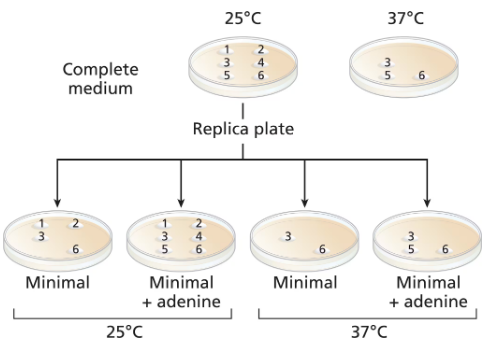
Common baker's yeast (Saccharomyces cerevisiae) is normally grown at 37°C, but it will grow actively at temperatures down to approximately 25°C. A haploid culture of wild-type yeast is mutagenized with EMS. Cells from the mutagenized culture are spread on a complete-medium plate and grown at 25°C. Six colonies (1 to 6) are selected from the original complete-medium plate and transferred to two fresh complete-medium plates. The new complete plates (shown) are grown at 25°C and 37°C. Four replica plates are made onto minimal medium or minimal plus adenine from the 25°C complete-medium plate. The new plates are grown at either 25°C or 37°C and the growth results are shown.
Diagram showing yeast colonies on complete and replica plates at 25°C and 37°C, indicating growth conditions and mutation analysis.
Classify the nature of the mutations in colonies 1, 2, and 5.

Verified step by step guidance
1
Step 1: Understand the experimental setup. The yeast cells were mutagenized using EMS (ethyl methanesulfonate), which induces point mutations. The colonies were grown under different conditions (temperature and media) to observe their growth patterns. The goal is to classify the mutations based on these observations.
Step 2: Analyze the growth results for colonies 1, 2, and 5. Look at the growth patterns on complete medium at 25°C and 37°C, as well as on minimal medium and minimal medium plus adenine at both temperatures. This will help determine if the mutations affect temperature sensitivity or nutrient requirements.
Step 3: Determine if the mutations are temperature-sensitive. If a colony grows at 25°C but not at 37°C, it suggests a temperature-sensitive mutation affecting a gene required for growth at higher temperatures.
Step 4: Assess nutrient requirements. If a colony grows on minimal medium plus adenine but not on minimal medium alone, it indicates an adenine auxotrophy mutation, meaning the colony requires adenine supplementation to grow.
Step 5: Classify the mutations. Based on the growth patterns, assign the nature of the mutations for colonies 1, 2, and 5. For example, a colony that is temperature-sensitive and adenine auxotrophic would have both types of mutations. Use the data provided to make these classifications.

Verified video answer for a similar problem:

This video solution was recommended by our tutors as helpful for the problem above.
Video duration:
1m
Was this helpful?

Key Concepts

Here are the essential concepts you must grasp in order to answer the question correctly.

Mutagenesis

Mutagenesis is the process by which the genetic information of an organism is changed, resulting in a mutation. In this context, the wild-type yeast is treated with EMS (ethyl methanesulfonate), a chemical mutagen that induces random mutations in the DNA. Understanding mutagenesis is crucial for analyzing the resulting phenotypes of the yeast colonies, as it helps to identify whether the mutations are beneficial, neutral, or harmful.
Recommended video:
Guided course
04:29
Induced Mutations

Haploid Organisms

Haploid organisms, like the yeast Saccharomyces cerevisiae, have a single set of chromosomes, which simplifies the analysis of genetic mutations. In haploids, any mutation will directly affect the phenotype since there is no second allele to mask its effects. This characteristic makes haploid yeast an excellent model organism for studying gene function and mutation effects, particularly in experiments involving mutagenesis.
Recommended video:
Guided course
02:45
Haploid Genetics

Phenotypic Analysis

Phenotypic analysis involves observing and classifying the physical and functional traits of organisms resulting from their genetic makeup. In this experiment, the growth of yeast colonies at different temperatures and on various media allows researchers to determine the nature of mutations present in colonies 1, 2, and 5. By comparing growth patterns, researchers can infer whether mutations are related to temperature sensitivity or nutrient utilization, which is essential for classifying the mutations.
Recommended video:
Guided course
02:48
Chi Square Analysis
Related Practice
Textbook Question

Considering the Dumbo mutation in Problem 37, what kinds of additional evidence would help you determine whether Dumbo is a mutation of a regulatory sequence or of a protein-coding gene?

438
views
Textbook Question

Thinking back to the discussion of gain-of-function and loss-of-function mutations, explain why gain-of-function mutations are often dominant and why loss-of-function mutations are often recessive. Give an example of a type of gain-of-function mutation that is dominant and of a loss-of-function mutation that is recessive.

733
views
Textbook Question

Common baker's yeast (Saccharomyces cerevisiae) is normally grown at 37°C, but it will grow actively at temperatures down to approximately 25°C. A haploid culture of wild-type yeast is mutagenized with EMS. Cells from the mutagenized culture are spread on a complete-medium plate and grown at 25°C. Six colonies (1 to 6) are selected from the original complete-medium plate and transferred to two fresh complete-medium plates. The new complete plates (shown) are grown at 25°C and 37°C. Four replica plates are made onto minimal medium or minimal plus adenine from the 25°C complete-medium plate. The new plates are grown at either 25°C or 37°C and the growth results are shown.

Which colonies are prototrophic and which are auxotrophic? What growth information is used to make these determinations?

607
views
Textbook Question

Common baker's yeast (Saccharomyces cerevisiae) is normally grown at 37°C, but it will grow actively at temperatures down to approximately 25°C. A haploid culture of wild-type yeast is mutagenized with EMS. Cells from the mutagenized culture are spread on a complete-medium plate and grown at 25°C. Six colonies (1 to 6) are selected from the original complete-medium plate and transferred to two fresh complete-medium plates. The new complete plates (shown) are grown at 25°C and 37°C. Four replica plates are made onto minimal medium or minimal plus adenine from the 25°C complete-medium plate. The new plates are grown at either 25°C or 37°C and the growth results are shown.

What can you say about colony 4?

1031
views
Textbook Question

The two gels illustrated contain dideoxynucleotide DNA-sequencing information for a wild-type segment and mutant segment of DNA corresponding to the N-terminal end of a protein. The start codon and the next five codons are sequenced.

Write the DNA sequence of both alleles, including strand polarity.

553
views
Textbook Question

The two gels illustrated contain dideoxynucleotide DNA-sequencing information for a wild-type segment and mutant segment of DNA corresponding to the N-terminal end of a protein. The start codon and the next five codons are sequenced.

Identify the template and nontemplate strands of DNA.

604
views