Pearson+ LogoPearson+ Logo
Ch. 11 - Gene Mutation, DNA Repair, and Homologous Recombination
Sanders - Genetic Analysis: An Integrated Approach 3rd Edition
Sanders3rd EditionGenetic Analysis: An Integrated ApproachISBN: 9780135564172Not the one you use?Change textbook
Chapter 11, Problem 41d

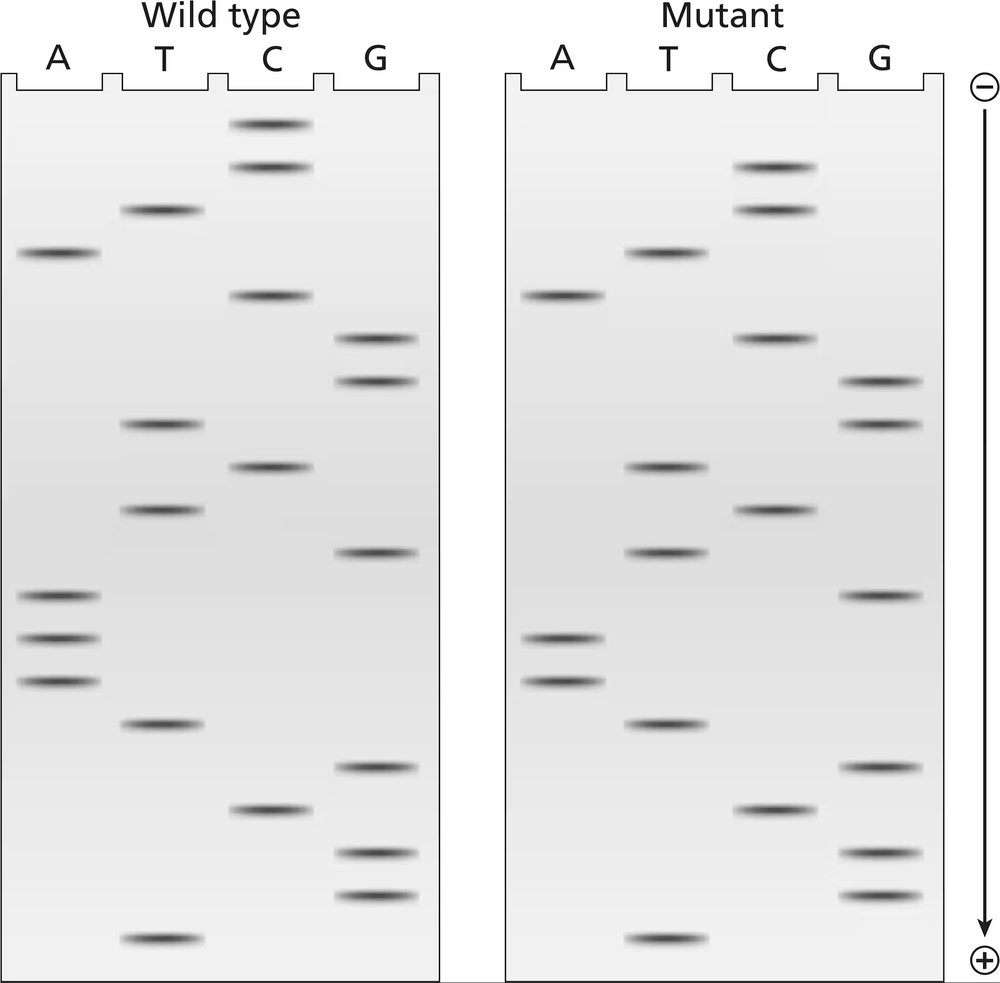
The two gels illustrated contain dideoxynucleotide DNA-sequencing information for a wild-type segment and mutant segment of DNA corresponding to the N-terminal end of a protein. The start codon and the next five codons are sequenced.
Gel images comparing dideoxynucleotide sequencing of wild-type and mutant DNA segments, showing codons for protein translation.
Determine the amino acid sequences translated from these mRNAs.

Verified step by step guidance
1
Examine the DNA sequencing gels for both the wild-type and mutant segments. Identify the sequence of nucleotides (A, T, G, C) for each strand by reading the gel from bottom to top, as smaller fragments migrate further in the gel.
Convert the DNA sequences obtained from the gels into their corresponding mRNA sequences. Replace thymine (T) in the DNA sequence with uracil (U) to form the mRNA sequence.
Identify the start codon (AUG) in the mRNA sequence, as this marks the beginning of translation. Divide the mRNA sequence into codons (groups of three nucleotides) starting from the AUG codon.
Using the genetic code table, translate each codon into its corresponding amino acid. Continue translating until you encounter a stop codon (UAA, UAG, or UGA), which signals the end of translation.
Compare the amino acid sequences derived from the wild-type and mutant mRNA sequences. Note any differences in the amino acid sequence caused by the mutation, and consider how these changes might affect the protein's function.

Verified video answer for a similar problem:

This video solution was recommended by our tutors as helpful for the problem above.
Video duration:
1m
Was this helpful?

Key Concepts

Here are the essential concepts you must grasp in order to answer the question correctly.

Dideoxynucleotide Sequencing

Dideoxynucleotide sequencing, also known as Sanger sequencing, is a method used to determine the nucleotide sequence of DNA. It involves incorporating dideoxynucleotides, which terminate DNA strand elongation, allowing for the generation of fragments of varying lengths. By analyzing these fragments through gel electrophoresis, researchers can deduce the sequence of the original DNA template.
Recommended video:
Guided course
04:12
Sanger Sequencing

Codons and Translation

Codons are sequences of three nucleotides in mRNA that correspond to specific amino acids during protein synthesis. The process of translation occurs in ribosomes, where the mRNA is read in sets of codons, and transfer RNA (tRNA) molecules bring the appropriate amino acids to form a polypeptide chain. Understanding codons is essential for translating mRNA into the correct amino acid sequence.
Recommended video:
Guided course
07:58
Translation initiation

Wild-Type vs. Mutant DNA

Wild-type DNA refers to the normal, non-mutated version of a gene, while mutant DNA contains alterations that may affect gene function. These mutations can lead to changes in the amino acid sequence of proteins, potentially impacting their structure and function. Analyzing both wild-type and mutant sequences is crucial for understanding the effects of genetic variations on protein translation.
Recommended video:
Guided course
10:48
Mutations and Phenotypes