Pearson+ LogoPearson+ Logo
Ch. 12 - Regulation of Gene Expression in Bacteria and Bacteriophage
Sanders - Genetic Analysis: An Integrated Approach 3rd Edition
Sanders3rd EditionGenetic Analysis: An Integrated ApproachISBN: 9780135564172Not the one you use?Change textbook
Chapter 12, Problem 36

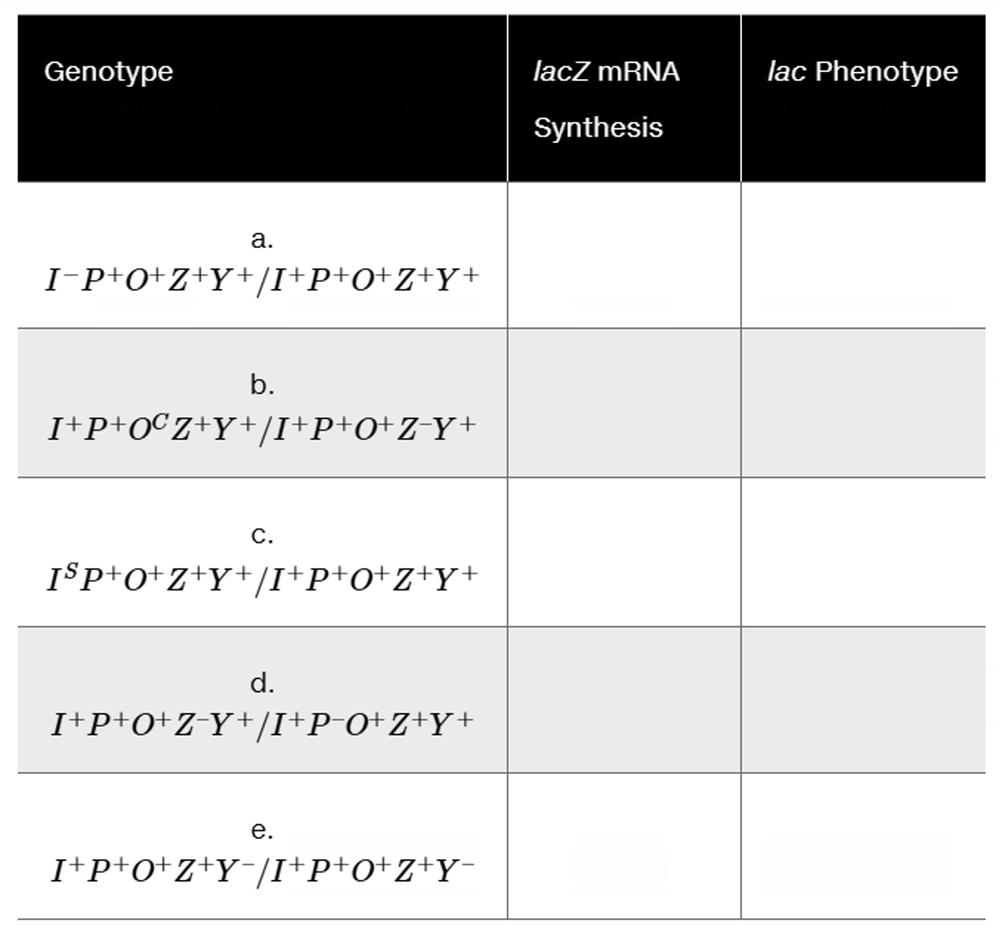
For the following lac operon partial diploids, determine whether the synthesis of lacZ mRNA is 'constitutive,' 'inducible,' or 'uninducible,' and indicate whether the partial diploid is or (able or not able to utilize lactose). 
Table displaying genotypes, lacZ mRNA synthesis, and lac phenotype for various lac operon partial diploids.

Verified step by step guidance
1
Understand the lac operon: The lac operon in E. coli is a set of genes involved in lactose metabolism. It includes the structural genes lacZ, lacY, and lacA, as well as regulatory elements like the promoter (P), operator (O), and the lacI gene, which encodes the repressor protein. The operon is regulated by the presence or absence of lactose and glucose.
Identify the genotype of the partial diploid: Carefully examine the genotype provided in the problem (not explicitly stated here). Look for mutations in the lacI, lacO, or lacZ genes, as well as whether the operon is in a cis or trans configuration. For example, mutations like lacI⁻ (nonfunctional repressor), lacOᶜ (constitutive operator), or lacZ⁻ (nonfunctional β-galactosidase) will affect the operon's behavior.
Determine the regulatory state: Analyze whether the lac operon is 'constitutive' (always on), 'inducible' (turned on in the presence of lactose), or 'uninducible' (never on). For example, a lacOᶜ mutation causes constitutive expression because the repressor cannot bind to the operator, while a lacI⁻ mutation also leads to constitutive expression due to the absence of a functional repressor.
Assess lactose utilization: Determine whether the partial diploid can utilize lactose. This depends on whether functional lacZ (β-galactosidase) and lacY (permease) proteins are produced. If either gene is nonfunctional in both copies of the operon, the cell will not be able to metabolize lactose.
Summarize the findings: Based on the analysis, classify the synthesis of lacZ mRNA as 'constitutive,' 'inducible,' or 'uninducible,' and state whether the partial diploid can utilize lactose. Ensure that your conclusions are consistent with the genotype and regulatory mechanisms of the lac operon.

Verified video answer for a similar problem:

This video solution was recommended by our tutors as helpful for the problem above.
Video duration:
2m
Was this helpful?

Key Concepts

Here are the essential concepts you must grasp in order to answer the question correctly.

Lac Operon

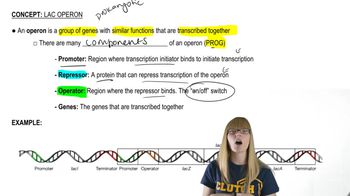
The lac operon is a set of genes in E. coli that are involved in the metabolism of lactose. It consists of structural genes (lacZ, lacY, and lacA) and regulatory elements that control their expression. The operon is typically off when lactose is absent and can be turned on (induced) in the presence of lactose, allowing the bacteria to utilize this sugar as an energy source.
Recommended video:
Guided course
04:27
Lac Operon Overview

Constitutive vs. Inducible Expression

Constitutive expression refers to genes that are continuously expressed regardless of environmental conditions, while inducible expression refers to genes that are turned on in response to specific stimuli, such as the presence of lactose for the lac operon. Understanding these terms is crucial for determining how the lac operon functions under different genetic configurations.
Recommended video:
Guided course
04:29
Induced Mutations

Partial Diploids

Partial diploids are bacterial cells that contain two copies of certain genes, typically due to the introduction of a plasmid or a chromosomal mutation. This genetic arrangement allows researchers to study gene interactions and regulatory mechanisms more effectively, particularly in operons like the lac operon, where the effects of mutations can be analyzed in a controlled manner.
Recommended video:
Guided course
27:36
Diploid Genetics
Related Practice
Textbook Question

Northern blot analysis is performed on cellular mRNA isolated from E. coli. The probe used in the northern blot analysis hybridizes to a portion of the lacY sequence. Below is an example of the gel from northern blot analysis for a wild-type lac⁺ bacterial strain. In this gel, lane 1 is from bacteria grown in a medium containing only glucose (minimal medium). Lane 2 is from bacteria in a medium containing only lactose. Following the style of this diagram, draw the gel appearance for northern blots of the bacteria listed below. In each case, lane 1 is for mRNA isolated after growth in a glucose-containing (minimal) medium, and lane 2 is for mRNA isolated after growth in a lactose-only medium.

lac⁻ bacteria with the genotype I⁺ P⁺ OC Z⁻ Y⁻ 

642
views
Textbook Question

Northern blot analysis is performed on cellular mRNA isolated from E. coli. The probe used in the northern blot analysis hybridizes to a portion of the lacY sequence. Below is an example of the gel from northern blot analysis for a wild-type lac⁺ bacterial strain. In this gel, lane 1 is from bacteria grown in a medium containing only glucose (minimal medium). Lane 2 is from bacteria in a medium containing only lactose. Following the style of this diagram, draw the gel appearance for northern blots of the bacteria listed below. In each case, lane 1 is for mRNA isolated after growth in a glucose-containing (minimal) medium, and lane 2 is for mRNA isolated after growth in a lactose-only medium.

lac⁻ bacteria with the genotype I⁺ P⁺ O⁺ Z⁺ Y⁺ and a mutation that prevents CAP–cAMP binding to the CAP site 

687
views
Textbook Question

A bacterial inducible operon, similar to the lac operon, contains three genes—R, T, and S—that are involved in coordinated regulation of transcription. One of these genes is an operator region, one is a regulatory protein, and the third produces a structural enzyme. In the table below, '+' indicates that the structural enzyme is synthesized and '−' indicates that it is not produced. Use the information provided to determine which gene is the operator, which produces the regulatory protein, and which produces the enzyme.

703
views
Textbook Question

The electrophoresis gel shown in part (a) is from a DNase I footprint analysis of an operon transcription control region. DNA sequence analysis of a 35-bp region is shown in part (b). The control region, labeled with ³²P at one end, is shown in a map in part (c). Separate samples of control-region DNA are exposed to DNase I, and the resulting DNase I–digested DNA is run in separate lanes of the electrophoresis gel. Unprotected DNA is in lane 1, DNA protected by repressor protein is in lane 2, and RNA polymerase–protected DNA is in lane 3. The numbers along the electrophoresis gel correspond to the 35-bp sequence labeled on the map in part (c). Use the information provided to solve the following problems.

Determine the DNA sequence of the 35-bp region examined.

474
views
Textbook Question

The electrophoresis gel shown in part (a) is from a DNase I footprint analysis of an operon transcription control region. DNA sequence analysis of a 35-bp region is shown in part (b). The control region, labeled with ³²P at one end, is shown in a map in part (c). Separate samples of control-region DNA are exposed to DNase I, and the resulting DNase I–digested DNA is run in separate lanes of the electrophoresis gel. Unprotected DNA is in lane 1, DNA protected by repressor protein is in lane 2, and RNA polymerase–protected DNA is in lane 3. The numbers along the electrophoresis gel correspond to the 35-bp sequence labeled on the map in part (c). Use the information provided to solve the following problems.

Locate the regions of the sequence protected by repressor protein and by RNA polymerase.

438
views