Pearson+ LogoPearson+ Logo
Ch. 12 - Regulation of Gene Expression in Bacteria and Bacteriophage
Sanders - Genetic Analysis: An Integrated Approach 3rd Edition
Sanders3rd EditionGenetic Analysis: An Integrated ApproachISBN: 9780135564172Not the one you use?Change textbook
Chapter 12, Problem 35

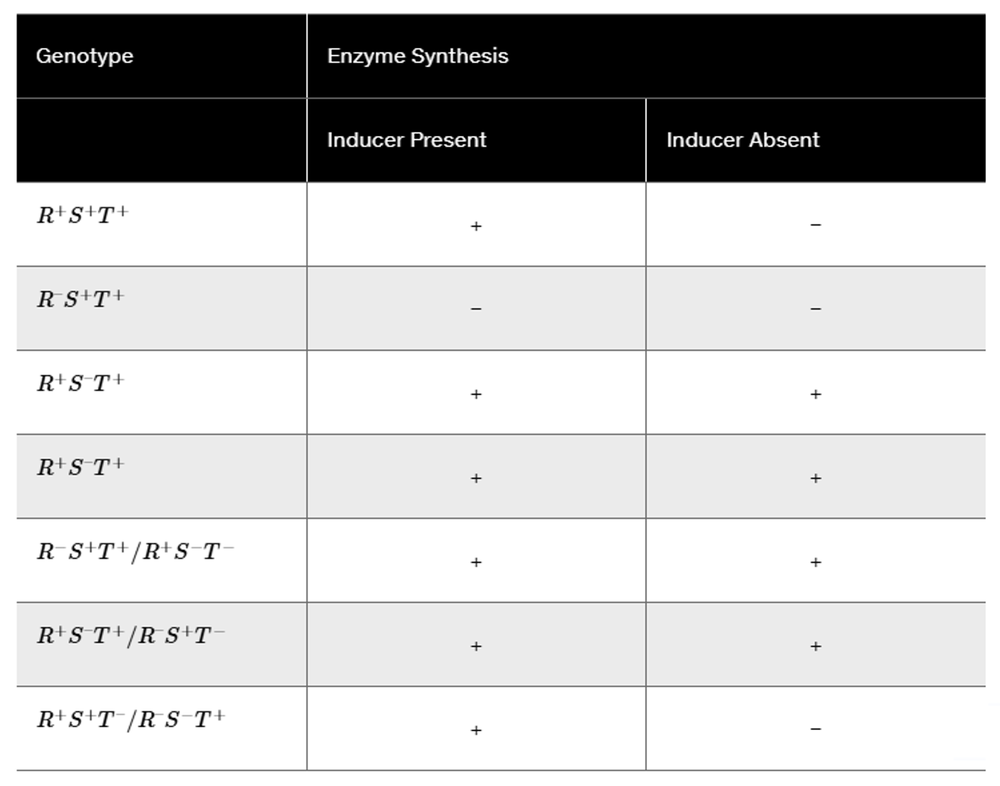
A bacterial inducible operon, similar to the lac operon, contains three genes—R, T, and S—that are involved in coordinated regulation of transcription. One of these genes is an operator region, one is a regulatory protein, and the third produces a structural enzyme. In the table below, '+' indicates that the structural enzyme is synthesized and '−' indicates that it is not produced. Use the information provided to determine which gene is the operator, which produces the regulatory protein, and which produces the enzyme.
Table displaying genotypes and enzyme synthesis in response to an inducer, indicating synthesis presence or absence.

Verified step by step guidance
1
Analyze the table to identify the role of each gene (R, S, T) based on the patterns of enzyme synthesis under different genotypes and conditions (inducer present or absent).
Determine which gene is the regulatory protein by observing the effect of its absence (R⁻) on enzyme synthesis. If enzyme synthesis is completely absent regardless of the inducer, this gene likely encodes the regulatory protein.
Identify the operator gene by examining the behavior of the system when the operator is mutated (e.g., S⁻). If enzyme synthesis occurs constitutively (both in the presence and absence of the inducer), this gene is likely the operator.
Assign the structural enzyme gene by process of elimination. The remaining gene, which directly correlates with enzyme production, is responsible for encoding the structural enzyme.
Verify your assignments by cross-referencing the genotypes and phenotypes in the table, ensuring that the roles of R, S, and T align with the observed patterns of enzyme synthesis under all conditions.

Verified video answer for a similar problem:

This video solution was recommended by our tutors as helpful for the problem above.
Video duration:
4m
Was this helpful?

Key Concepts

Here are the essential concepts you must grasp in order to answer the question correctly.

Operon Structure

An operon is a cluster of genes under the control of a single promoter, allowing coordinated regulation of gene expression. In bacterial systems, operons typically consist of structural genes that encode proteins, a promoter where RNA polymerase binds, and an operator that acts as a regulatory switch. Understanding the operon structure is crucial for analyzing how genes are turned on or off in response to environmental signals.
Recommended video:
Guided course
03:45
Arabinose Operon

Regulatory Proteins

Regulatory proteins are molecules that bind to specific DNA sequences, such as operators, to control the transcription of adjacent genes. In the context of an inducible operon, these proteins can act as repressors or activators, determining whether the structural genes are expressed based on the presence or absence of an inducer. This concept is essential for understanding how gene expression is modulated in response to cellular needs.
Recommended video:

Inducible Systems

Inducible systems are genetic regulatory mechanisms that allow the expression of genes to be activated in response to specific signals, such as the presence of an inducer. In the case of the lac operon, for example, the presence of lactose induces the expression of genes necessary for its metabolism. Recognizing how inducers influence gene expression is vital for interpreting the data presented in the question regarding enzyme synthesis.
Recommended video:
Guided course
04:29
Induced Mutations
Related Practice
Textbook Question

Northern blot analysis is performed on cellular mRNA isolated from E. coli. The probe used in the northern blot analysis hybridizes to a portion of the lacY sequence. Below is an example of the gel from northern blot analysis for a wild-type lac⁺ bacterial strain. In this gel, lane 1 is from bacteria grown in a medium containing only glucose (minimal medium). Lane 2 is from bacteria in a medium containing only lactose. Following the style of this diagram, draw the gel appearance for northern blots of the bacteria listed below. In each case, lane 1 is for mRNA isolated after growth in a glucose-containing (minimal) medium, and lane 2 is for mRNA isolated after growth in a lactose-only medium.

lac⁻ bacteria with the genotype I⁺ P⁺ O⁺ Z⁻ Y⁺ that has a polar mutation affecting the lacZ gene 

607
views
Textbook Question

Northern blot analysis is performed on cellular mRNA isolated from E. coli. The probe used in the northern blot analysis hybridizes to a portion of the lacY sequence. Below is an example of the gel from northern blot analysis for a wild-type lac⁺ bacterial strain. In this gel, lane 1 is from bacteria grown in a medium containing only glucose (minimal medium). Lane 2 is from bacteria in a medium containing only lactose. Following the style of this diagram, draw the gel appearance for northern blots of the bacteria listed below. In each case, lane 1 is for mRNA isolated after growth in a glucose-containing (minimal) medium, and lane 2 is for mRNA isolated after growth in a lactose-only medium.

lac⁻ bacteria with the genotype I⁺ P⁺ OC Z⁻ Y⁻ 

642
views
Textbook Question

Northern blot analysis is performed on cellular mRNA isolated from E. coli. The probe used in the northern blot analysis hybridizes to a portion of the lacY sequence. Below is an example of the gel from northern blot analysis for a wild-type lac⁺ bacterial strain. In this gel, lane 1 is from bacteria grown in a medium containing only glucose (minimal medium). Lane 2 is from bacteria in a medium containing only lactose. Following the style of this diagram, draw the gel appearance for northern blots of the bacteria listed below. In each case, lane 1 is for mRNA isolated after growth in a glucose-containing (minimal) medium, and lane 2 is for mRNA isolated after growth in a lactose-only medium.

lac⁻ bacteria with the genotype I⁺ P⁺ O⁺ Z⁺ Y⁺ and a mutation that prevents CAP–cAMP binding to the CAP site 

687
views
Textbook Question

For the following lac operon partial diploids, determine whether the synthesis of lacZ mRNA is 'constitutive,' 'inducible,' or 'uninducible,' and indicate whether the partial diploid is or (able or not able to utilize lactose). 

873
views
Textbook Question

The electrophoresis gel shown in part (a) is from a DNase I footprint analysis of an operon transcription control region. DNA sequence analysis of a 35-bp region is shown in part (b). The control region, labeled with ³²P at one end, is shown in a map in part (c). Separate samples of control-region DNA are exposed to DNase I, and the resulting DNase I–digested DNA is run in separate lanes of the electrophoresis gel. Unprotected DNA is in lane 1, DNA protected by repressor protein is in lane 2, and RNA polymerase–protected DNA is in lane 3. The numbers along the electrophoresis gel correspond to the 35-bp sequence labeled on the map in part (c). Use the information provided to solve the following problems.

Determine the DNA sequence of the 35-bp region examined.

474
views
Textbook Question

The electrophoresis gel shown in part (a) is from a DNase I footprint analysis of an operon transcription control region. DNA sequence analysis of a 35-bp region is shown in part (b). The control region, labeled with ³²P at one end, is shown in a map in part (c). Separate samples of control-region DNA are exposed to DNase I, and the resulting DNase I–digested DNA is run in separate lanes of the electrophoresis gel. Unprotected DNA is in lane 1, DNA protected by repressor protein is in lane 2, and RNA polymerase–protected DNA is in lane 3. The numbers along the electrophoresis gel correspond to the 35-bp sequence labeled on the map in part (c). Use the information provided to solve the following problems.

Locate the regions of the sequence protected by repressor protein and by RNA polymerase.

438
views