Pearson+ LogoPearson+ Logo
Ch. 12 - Regulation of Gene Expression in Bacteria and Bacteriophage
Sanders - Genetic Analysis: An Integrated Approach 3rd Edition
Sanders3rd EditionGenetic Analysis: An Integrated ApproachISBN: 9780135564172Not the one you use?Change textbook
Chapter 12, Problem 5

The transcription of -galactosidase and permease is inducible in lac⁺ bacteria with a wild-type lac operon. Explain the mechanism by which lactose gains access to the cell to induce transcription of the genes.

Verified step by step guidance
1
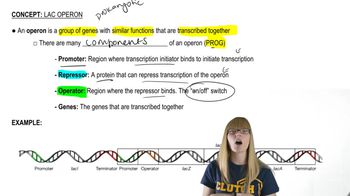
Understand the lac operon system: The lac operon is a group of genes in bacteria that are responsible for the metabolism of lactose. It includes structural genes (lacZ for β-galactosidase, lacY for permease, and lacA for transacetylase), a promoter, an operator, and a regulatory gene (lacI). The operon is inducible, meaning it is activated in the presence of lactose.
Recognize the role of permease (lacY): Permease is a protein encoded by the lacY gene that facilitates the transport of lactose into the bacterial cell. Even in the absence of lactose, there is a low level of permease produced due to basal transcription of the lac operon.
Describe the initial entry of lactose: A small amount of lactose can enter the bacterial cell through the permease proteins that are produced at basal levels. This initial entry of lactose is crucial for the induction process.
Explain the role of lactose as an inducer: Once inside the cell, lactose is converted into allolactose, which acts as an inducer. Allolactose binds to the repressor protein (encoded by lacI), causing a conformational change that prevents the repressor from binding to the operator region of the lac operon.
Detail the induction of transcription: With the repressor no longer bound to the operator, RNA polymerase can bind to the promoter and initiate transcription of the lac operon genes. This leads to increased production of β-galactosidase (lacZ) and permease (lacY), allowing the cell to metabolize lactose more efficiently.

Verified video answer for a similar problem:

This video solution was recommended by our tutors as helpful for the problem above.
Video duration:
3m
Was this helpful?

Key Concepts

Here are the essential concepts you must grasp in order to answer the question correctly.

Lac Operon

The lac operon is a set of genes in bacteria that are responsible for the metabolism of lactose. It consists of structural genes that code for enzymes like β-galactosidase and permease, which are involved in lactose uptake and breakdown. The operon is regulated by the presence or absence of lactose, allowing the bacteria to efficiently use lactose as an energy source when available.
Recommended video:
Guided course
04:27
Lac Operon Overview

Induction Mechanism

Induction in the lac operon occurs when lactose is present in the environment. Lactose is converted to allolactose, which acts as an inducer by binding to the repressor protein. This binding causes a conformational change that releases the repressor from the operator region of the operon, allowing RNA polymerase to transcribe the genes necessary for lactose metabolism.
Recommended video:
Guided course
09:52
Spontaneous Mutations

Permease Function

Permease is a membrane protein that facilitates the transport of lactose into the bacterial cell. Once lactose is outside the cell, permease helps in its uptake by creating a pathway through the cell membrane. This transport is crucial for the induction of the lac operon, as the presence of lactose inside the cell is necessary for the subsequent activation of transcription.
Recommended video:
Guided course
08:26
Functional Genomics