Pearson+ LogoPearson+ Logo
Ch. 12 - Regulation of Gene Expression in Bacteria and Bacteriophage
Sanders - Genetic Analysis: An Integrated Approach 3rd Edition
Sanders3rd EditionGenetic Analysis: An Integrated ApproachISBN: 9780135564172Not the one you use?Change textbook
Chapter 12, Problem 7

The trpL region contains four repeated DNA sequences that lead to the formation of stem-loop structures in mRNA. What are these stem-loop structures, and how do they affect transcription of the structural genes of the trp operon?

Verified step by step guidance
1
Understand the trp operon: The trp operon in bacteria is a group of genes involved in the biosynthesis of tryptophan. It is regulated by transcriptional attenuation, which involves the trpL region.
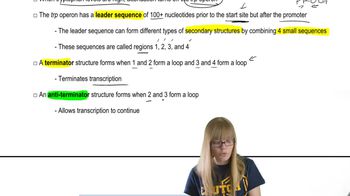
Identify the trpL region: The trpL region is a leader sequence located upstream of the structural genes. It contains four repeated DNA sequences (regions 1, 2, 3, and 4) that can form stem-loop structures in the mRNA transcript.
Explain the stem-loop structures: The stem-loop structures are formed by complementary base pairing between these regions. Specifically, regions 1 and 2 can pair, regions 2 and 3 can pair, and regions 3 and 4 can pair. The pairing of regions 3 and 4 forms a terminator stem-loop, which halts transcription.
Describe the role of tryptophan levels: When tryptophan levels are high, the ribosome quickly translates the leader peptide encoded by the trpL region, allowing regions 3 and 4 to pair and form the terminator stem-loop. This stops transcription of the structural genes.
Explain the alternative pairing: When tryptophan levels are low, the ribosome stalls at the trp codons in region 1, allowing regions 2 and 3 to pair instead. This prevents the formation of the terminator stem-loop, allowing transcription of the structural genes to proceed.

Verified video answer for a similar problem:

This video solution was recommended by our tutors as helpful for the problem above.
Video duration:
2m
Was this helpful?

Key Concepts

Here are the essential concepts you must grasp in order to answer the question correctly.

Stem-Loop Structures

Stem-loop structures are secondary RNA structures formed when a single strand of RNA folds back on itself, creating a double-stranded 'stem' and a loop. These structures play a crucial role in the regulation of gene expression, particularly in prokaryotes, by influencing the stability of mRNA and its interaction with ribosomes.
Recommended video:
Guided course
03:49
Ribosome Structure

trp Operon

The trp operon is a group of genes in bacteria that are involved in the biosynthesis of the amino acid tryptophan. It is regulated by a feedback mechanism where the presence of tryptophan inhibits the transcription of the operon, allowing the cell to conserve resources when tryptophan is abundant.
Recommended video:
Guided course
09:11
Trp Attenuation

Transcription Termination

Transcription termination is the process by which RNA polymerase stops synthesizing RNA and detaches from the DNA template. In the trp operon, the formation of stem-loop structures in the mRNA can signal RNA polymerase to terminate transcription prematurely, thereby preventing the synthesis of downstream structural genes when tryptophan levels are sufficient.
Recommended video:
Guided course
10:14
Prokaryotic Transcription