Pearson+ LogoPearson+ Logo
Ch. 12 - Regulation of Gene Expression in Bacteria and Bacteriophage
Sanders - Genetic Analysis: An Integrated Approach 3rd Edition
Sanders3rd EditionGenetic Analysis: An Integrated ApproachISBN: 9780135564172Not the one you use?Change textbook
Chapter 12, Problem 9

What role does cAMP play in transcription of lac operon genes? What role does CAP play in transcription of lac operon genes?

Verified step by step guidance
1
Understand the lac operon: The lac operon is a set of genes in E. coli that are involved in the metabolism of lactose. It is regulated by the presence or absence of lactose and glucose in the environment.
Explain the role of cAMP: Cyclic AMP (cAMP) is a signaling molecule that accumulates in the cell when glucose levels are low. It acts as a signal to indicate that the cell needs to utilize alternative energy sources, such as lactose.
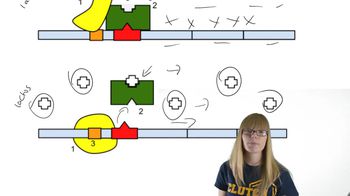
Describe the interaction between cAMP and CAP: cAMP binds to the Catabolite Activator Protein (CAP), forming a cAMP-CAP complex. This complex is essential for the activation of the lac operon.
Explain the role of CAP: CAP, when bound to cAMP, binds to a specific site near the promoter of the lac operon. This binding enhances the ability of RNA polymerase to attach to the promoter, thereby increasing the transcription of the lac operon genes.
Summarize the relationship: In summary, cAMP signals low glucose levels, and the cAMP-CAP complex facilitates the transcription of the lac operon genes by enhancing RNA polymerase binding. This ensures that the cell can metabolize lactose when glucose is scarce.

Verified video answer for a similar problem:

This video solution was recommended by our tutors as helpful for the problem above.
Video duration:
2m
Was this helpful?

Key Concepts

Here are the essential concepts you must grasp in order to answer the question correctly.

cAMP (cyclic Adenosine Monophosphate)

cAMP is a secondary messenger important in cellular signaling. In the context of the lac operon, cAMP levels increase when glucose is scarce, leading to the activation of the transcription of genes responsible for lactose metabolism. It binds to the CAP protein, facilitating the recruitment of RNA polymerase to the promoter region of the lac operon.
Recommended video:
Guided course
06:55
Lac Operon Regulation

CAP (Catabolite Activator Protein)

CAP is a transcriptional activator that enhances the expression of the lac operon in the presence of cAMP. When cAMP binds to CAP, the complex binds to the promoter region of the lac operon, promoting the binding of RNA polymerase and thus increasing transcription of the operon genes. This mechanism ensures that the cell efficiently utilizes available energy sources.
Recommended video:

lac Operon

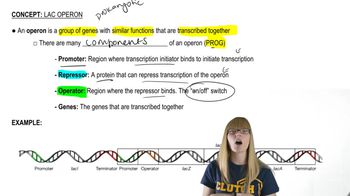
The lac operon is a set of genes in E. coli that are involved in the metabolism of lactose. It consists of three structural genes (lacZ, lacY, and lacA) and is regulated by the presence of lactose and glucose. The operon is an example of gene regulation, where the presence of lactose induces transcription, while glucose availability inhibits it through catabolite repression.
Recommended video:
Guided course
04:27
Lac Operon Overview