Pearson+ LogoPearson+ Logo
Ch. 12 - Regulation of Gene Expression in Bacteria and Bacteriophage
Sanders - Genetic Analysis: An Integrated Approach 3rd Edition
Sanders3rd EditionGenetic Analysis: An Integrated ApproachISBN: 9780135564172Not the one you use?Change textbook
Chapter 12, Problem 25c

What is the likely effect of each of the following mutations of the trpL region on attenuation control of trp operon gene transcription? Explain your reasoning.
The entire trpL region is deleted.

Verified step by step guidance
1
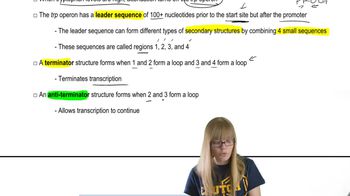
Understand the role of the trpL region: The trpL region is part of the leader sequence in the trp operon. It contains sequences that form stem-loop structures in the mRNA, which are critical for attenuation control. Attenuation is a regulatory mechanism that halts transcription of the trp operon when tryptophan levels are sufficient.
Recognize the impact of deleting the trpL region: Without the trpL region, the leader sequence cannot form the necessary stem-loop structures. These structures are essential for sensing tryptophan levels and regulating transcription termination.
Consider the consequences for attenuation: In the absence of the trpL region, attenuation control is likely disrupted. This means the operon may no longer respond properly to tryptophan levels, leading to unregulated transcription of the trp operon genes regardless of tryptophan availability.
Explain the reasoning: The deletion removes the sequences required for the formation of the terminator stem-loop and the anti-terminator stem-loop. These structures are key to the attenuation mechanism, which relies on ribosome stalling and the formation of specific secondary structures in the mRNA.
Conclude the likely effect: The deletion of the trpL region would likely result in constitutive transcription of the trp operon genes, as attenuation control is entirely lost. This could lead to overproduction of enzymes involved in tryptophan synthesis, even when tryptophan is abundant.

Verified video answer for a similar problem:

This video solution was recommended by our tutors as helpful for the problem above.
Video duration:
2m
Was this helpful?

Key Concepts

Here are the essential concepts you must grasp in order to answer the question correctly.

Attenuation Control

Attenuation control is a regulatory mechanism in prokaryotic gene expression, particularly in the trp operon, where the formation of specific RNA structures in the leader region (trpL) determines whether transcription will continue or terminate. This process relies on the availability of tryptophan and the ribosome's movement along the mRNA, influencing the formation of either a transcription-terminating or a transcription-allowing structure.
Recommended video:
Guided course
09:11
Trp Attenuation

trp Operon

The trp operon is a cluster of genes in bacteria that encode enzymes necessary for the biosynthesis of the amino acid tryptophan. It is regulated by both repression and attenuation mechanisms, allowing the cell to efficiently manage tryptophan levels. The operon includes a leader sequence (trpL) that plays a crucial role in the attenuation process.
Recommended video:
Guided course
09:11
Trp Attenuation

Mutations and Their Effects

Mutations are changes in the DNA sequence that can affect gene function and regulation. In the context of the trp operon, a deletion of the trpL region would eliminate the leader sequence responsible for attenuation control. This would likely result in continuous transcription of the operon, leading to overproduction of tryptophan, as the regulatory feedback mechanism would be disrupted.
Recommended video:
Guided course
03:38
Maternal Effect
Related Practice
Textbook Question

A repressible operon system, like the trp operon, contains three genes, G, Z, and W. Operon genes are synthesized when the end product of the operon synthesis pathway is absent, but there is no synthesis when the end product is present. One of these genes is an operator, one is a regulatory protein, and the other is a structural enzyme involved in synthesis of the end product. In the table below, '+' indicates that the enzyme is synthesized by the operon and '−' means that no enzyme synthesis occurs. Use this information to determine which gene corresponds to each operon function.

1117
views
Textbook Question

What is the likely effect of each of the following mutations of the trpL region on attenuation control of trp operon gene transcription? Explain your reasoning.

Region 3 is deleted.

512
views
Textbook Question

What is the likely effect of each of the following mutations of the trpL region on attenuation control of trp operon gene transcription? Explain your reasoning.

Region 4 is deleted.

426
views
Textbook Question

What is the likely effect of each of the following mutations of the trpL region on attenuation control of trp operon gene transcription? Explain your reasoning.

The start (AUG) codon of the trpL polypeptide is deleted.

650
views
Textbook Question

What is the likely effect of each of the following mutations of the trpL region on attenuation control of trp operon gene transcription? Explain your reasoning.

Two nucleotides are inserted into the trpL region immediately after the polypeptide stop codon.

649
views
Textbook Question

What is the likely effect of each of the following mutations of the trpL region on attenuation control of trp operon gene transcription? Explain your reasoning.

Twenty nucleotides are inserted into the trpL region immediately after the polypeptide stop codon.

562
views