Pearson+ LogoPearson+ Logo
Ch. 13 - Regulation of Gene Expression in Eukaryotes
Sanders - Genetic Analysis: An Integrated Approach 3rd Edition
Sanders3rd EditionGenetic Analysis: An Integrated ApproachISBN: 9780135564172Not the one you use?Change textbook
Chapter 13, Problem 22

The majority of this chapter focused on gene regulation at the transcriptional level, but the quantity of functional protein product in a cell can be regulated in many other ways as well. Discuss possible reasons why transcriptional regulation or posttranscriptional regulation may have evolved for different types of genes.

Verified step by step guidance
1
Understand the concept of gene regulation: Gene regulation refers to the mechanisms that control the expression of genes, determining when, where, and how much of a gene product (RNA or protein) is produced. This can occur at various stages, including transcriptional, posttranscriptional, translational, and posttranslational levels.
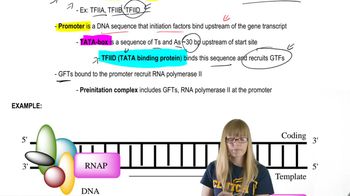
Examine transcriptional regulation: Transcriptional regulation occurs at the level of DNA transcription into RNA. It is often the most energy-efficient method of regulation because it prevents the synthesis of unnecessary RNA and proteins. This type of regulation is particularly important for genes that need to be tightly controlled or expressed only under specific conditions, such as developmental genes or stress-response genes.
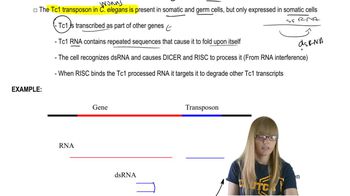
Explore posttranscriptional regulation: Posttranscriptional regulation occurs after RNA is synthesized but before it is translated into protein. This includes processes such as RNA splicing, RNA stability, and RNA interference. Posttranscriptional regulation allows for rapid adjustments in gene expression and is often used for genes that need to respond quickly to environmental changes or cellular signals.
Consider evolutionary advantages: Transcriptional regulation may have evolved for genes that require long-term, stable control of expression, as it conserves energy and resources. On the other hand, posttranscriptional regulation may have evolved for genes that need dynamic and flexible control, allowing cells to quickly adapt to changing conditions.
Relate to gene function: Different types of genes may favor different regulatory mechanisms based on their function. For example, housekeeping genes, which are required for basic cellular functions, are often regulated at the transcriptional level to ensure consistent expression. In contrast, genes involved in stress responses or signaling pathways may rely on posttranscriptional regulation for rapid and reversible control.

Verified video answer for a similar problem:

This video solution was recommended by our tutors as helpful for the problem above.
Video duration:
2m
Was this helpful?

Key Concepts

Here are the essential concepts you must grasp in order to answer the question correctly.

Transcriptional Regulation

Transcriptional regulation refers to the mechanisms that control the transcription of genes into mRNA, thereby influencing the amount of protein produced. This process can involve various factors, such as transcription factors, enhancers, and silencers, which interact with the DNA to either promote or inhibit gene expression. The evolution of transcriptional regulation allows cells to respond dynamically to environmental changes and developmental cues.
Recommended video:
Guided course
09:16
Eukaryotic Transcription

Posttranscriptional Regulation

Posttranscriptional regulation encompasses the processes that occur after mRNA is synthesized, affecting its stability, splicing, translation, and degradation. Mechanisms such as alternative splicing, RNA interference, and mRNA editing enable cells to fine-tune protein production and adapt to specific cellular needs. This type of regulation can evolve to provide additional layers of control, allowing for more complex responses to stimuli.
Recommended video:

Evolutionary Adaptation of Gene Regulation

The evolution of gene regulation, both transcriptional and posttranscriptional, is driven by the need for organisms to adapt to their environments and optimize resource use. Different types of genes may require distinct regulatory mechanisms based on their functions, expression patterns, and the physiological demands of the organism. This adaptability can enhance survival and reproductive success, leading to the diversification of regulatory strategies across species.
Recommended video:
Guided course
09:22
Review of Regulation
Related Practice
Textbook Question

Using the components in the accompanying diagram, design regulatory modules (i.e., enhancer/silencer modules) required for 'your' gene to be expressed only in differentiating (early) and differentiated (late) liver cells. Answer the three questions presented below by describing the roles that activators, enhancers, repressors, silencers, pioneer factors, insulators, chromatin remodeling complexes, and chromatin readers, writers, and erasers will play in the regulation of expression of your gene, that is, what factors will bind and be active in each case? Specify which transcription factors need to be pioneer factors. How will the gene be activated in the proper cell type?

518
views
Textbook Question

Using the components in the accompanying diagram, design regulatory modules (i.e., enhancer/silencer modules) required for 'your' gene to be expressed only in differentiating (early) and differentiated (late) liver cells. Answer the three questions presented below by describing the roles that activators, enhancers, repressors, silencers, pioneer factors, insulators, chromatin remodeling complexes, and chromatin readers, writers, and erasers will play in the regulation of expression of your gene, that is, what factors will bind and be active in each case? Specify which transcription factors need to be pioneer factors. How will its expression be maintained?

423
views
Textbook Question

Using the components in the accompanying diagram, design regulatory modules (i.e., enhancer/silencer modules) required for 'your' gene to be expressed only in differentiating (early) and differentiated (late) liver cells. Answer the three questions presented below by describing the roles that activators, enhancers, repressors, silencers, pioneer factors, insulators, chromatin remodeling complexes, and chromatin readers, writers, and erasers will play in the regulation of expression of your gene, that is, what factors will bind and be active in each case? Specify which transcription factors need to be pioneer factors. How will expression be prevented in other cell types?

593
views
Textbook Question

Microbiologists describe the processes of transcription and translation as 'coupled' in bacteria. This term indicates that a bacterial mRNA can be undergoing transcription at the same moment it is also undergoing translation. Is coupling of transcription and translation possible in single-celled eukaryotes such as yeast? Why or why not?

645
views
Textbook Question
The Drosophila even-skipped (eve) gene is expressed in seven stripes in the segmentation pattern of the embryo. A sequence segment of 8 kb 5' to the transcription start site (shown as in the accompanying figure) is required to drive expression of a reporter gene (lacZ) in the same pattern as the endogenous eve gene. Remarkably, expression of most of the seven stripes appears to be specified independently, with stripe 2 expression directed by regulatory sequences in the region 1.7 kb 5' to the transcription start site. To further examine stripe 2 regulatory sequences, you create a series of constructs, each containing different fragments of the 1.7-kb region of the 5' sequence. In the lower part of the figure, the bars at left represent the sequences of DNA included in your reporter gene constructs, and the + and − signs at right indicate whether the corresponding eve-lacZ reporter gene directs stripe 2 expression in Drosophila embryos transformed through P element mediation. How would you interpret the results—that is, where do the regulatory sequences responsible for stripe 2 expression reside?
851
views