Using the components in the accompanying diagram, design regulatory modules (i.e., enhancer/silencer modules) required for 'your' gene to be expressed only in differentiating (early) and differentiated (late) liver cells. Answer the three questions presented below by describing the roles that activators, enhancers, repressors, silencers, pioneer factors, insulators, chromatin remodeling complexes, and chromatin readers, writers, and erasers will play in the regulation of expression of your gene, that is, what factors will bind and be active in each case? Specify which transcription factors need to be pioneer factors. How will its expression be maintained?

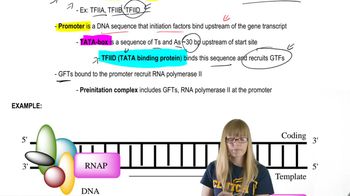
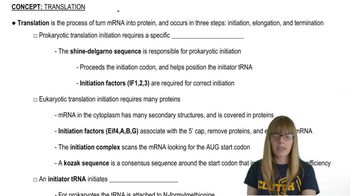
Microbiologists describe the processes of transcription and translation as 'coupled' in bacteria. This term indicates that a bacterial mRNA can be undergoing transcription at the same moment it is also undergoing translation. Is coupling of transcription and translation possible in single-celled eukaryotes such as yeast? Why or why not?
Verified step by step guidance
Verified video answer for a similar problem:
Key Concepts
Transcription
Translation
Eukaryotic Cell Structure
Using the components in the accompanying diagram, design regulatory modules (i.e., enhancer/silencer modules) required for 'your' gene to be expressed only in differentiating (early) and differentiated (late) liver cells. Answer the three questions presented below by describing the roles that activators, enhancers, repressors, silencers, pioneer factors, insulators, chromatin remodeling complexes, and chromatin readers, writers, and erasers will play in the regulation of expression of your gene, that is, what factors will bind and be active in each case? Specify which transcription factors need to be pioneer factors. How will expression be prevented in other cell types?
The majority of this chapter focused on gene regulation at the transcriptional level, but the quantity of functional protein product in a cell can be regulated in many other ways as well. Discuss possible reasons why transcriptional regulation or posttranscriptional regulation may have evolved for different types of genes.
