Pearson+ LogoPearson+ Logo
Ch. 13 - Regulation of Gene Expression in Eukaryotes
Sanders - Genetic Analysis: An Integrated Approach 3rd Edition
Sanders3rd EditionGenetic Analysis: An Integrated ApproachISBN: 9780135564172Not the one you use?Change textbook
Chapter 13, Problem 21c

Using the components in the accompanying diagram, design regulatory modules (i.e., enhancer/silencer modules) required for 'your' gene to be expressed only in differentiating (early) and differentiated (late) liver cells. Answer the three questions presented below by describing the roles that activators, enhancers, repressors, silencers, pioneer factors, insulators, chromatin remodeling complexes, and chromatin readers, writers, and erasers will play in the regulation of expression of your gene, that is, what factors will bind and be active in each case? Specify which transcription factors need to be pioneer factors. How will expression be prevented in other cell types?

Verified step by step guidance
1
Identify the regulatory elements required for gene expression in differentiating (early) and differentiated (late) liver cells. These include enhancers, silencers, and insulators. Enhancers will be specific DNA sequences that bind activators to promote transcription, while silencers will bind repressors to inhibit transcription in non-liver cells.
Determine the transcription factors (TFs) that are specific to early and late liver cells. For early liver cells, activators specific to differentiation (e.g., liver-specific pioneer factors) will bind to enhancers to initiate chromatin remodeling and transcription. For late liver cells, differentiated-specific activators will bind to enhancers to maintain transcription. Pioneer factors are crucial as they can bind to closed chromatin and recruit chromatin remodeling complexes to open the chromatin structure.
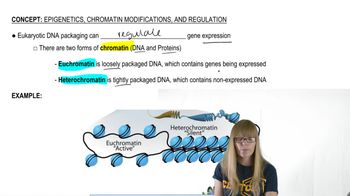
Describe the role of chromatin remodeling complexes and chromatin readers, writers, and erasers. Chromatin remodeling complexes will be recruited by pioneer factors to open the chromatin structure, allowing access to transcription machinery. Chromatin writers (e.g., histone acetyltransferases) will add activating marks, while erasers (e.g., histone deacetylases) will remove repressive marks. Chromatin readers will recognize these marks and stabilize the transcriptional state.
Explain how expression will be prevented in other cell types. Silencers and repressors will bind to regulatory modules in non-liver cells to inhibit transcription. Insulators will prevent the spread of activating signals to non-target genes. Additionally, chromatin in non-liver cells will remain in a closed state due to the absence of liver-specific pioneer factors and activators.
Summarize the interplay of all components. In early liver cells, pioneer factors and activators bind to enhancers, recruit chromatin remodelers, and initiate transcription. In late liver cells, differentiated-specific activators maintain transcription. In non-liver cells, repressors bind to silencers, and chromatin remains closed, preventing gene expression.

Verified video answer for a similar problem:

This video solution was recommended by our tutors as helpful for the problem above.
Video duration:
2m
Was this helpful?

Key Concepts

Here are the essential concepts you must grasp in order to answer the question correctly.

Enhancers and Silencers

Enhancers are regulatory DNA sequences that, when bound by specific transcription factors, increase the likelihood of transcription of a particular gene. Conversely, silencers are sequences that can bind repressors to inhibit gene expression. Both elements play crucial roles in determining the spatial and temporal expression of genes, allowing for precise control in different cell types, such as liver cells during differentiation.
Recommended video:
Guided course
09:16
Eukaryotic Transcription

Pioneer Factors

Pioneer factors are a subset of transcription factors that can bind to compacted chromatin and initiate the opening of chromatin structure, allowing other transcription factors to access DNA. They are essential for establishing cell-type-specific gene expression patterns, particularly during early differentiation stages. Identifying which transcription factors act as pioneer factors is critical for understanding how gene expression is initiated in differentiating liver cells.
Recommended video:
Guided course
08:52
F Factor and Hfr

Chromatin Remodeling and Modifications

Chromatin remodeling complexes and the actions of chromatin readers, writers, and erasers are vital for regulating gene expression. These complexes alter the structure of chromatin, making it more or less accessible for transcription. Writers add chemical modifications (like methylation or acetylation), while erasers remove them, influencing whether genes are turned on or off. This dynamic regulation is essential for preventing expression in non-liver cell types.
Recommended video:
Related Practice
Textbook Question

A muscle enzyme called ME1 is produced by transcription and translation of the ME1 gene in several muscles during mouse development, including heart muscle, in a highly regulated manner. Production of ME1 appears to be turned on and turned off at different times during development. To test the possible role of enhancers and silencers in ME1 transcription, a biologist creates a recombinant genetic system that fuses the ME1 promoter, along with DNA that is upstream of the promoter, to the bacterial lacZ (β-galactosidase) gene. The lacZ gene is chosen for the ease and simplicity of assaying production of the encoded enzyme. The diagram shows bars that indicate the extent of six deletions the biologist makes to the ME1 promoter and upstream sequences. The blue deletion labeled D is within the promoter whereas the gray bars span potential enhancer/silencer modules. The table displays the percentage of β-galactosidase activity in each deletion mutant in comparison with the recombinant gene system without any deletions.


Given the information available from deletion analysis, can you give a molecular explanation for the observation that ME1 expression appears to turn on and turn off at various times during normal mouse development?

569
views
Textbook Question

Using the components in the accompanying diagram, design regulatory modules (i.e., enhancer/silencer modules) required for 'your' gene to be expressed only in differentiating (early) and differentiated (late) liver cells. Answer the three questions presented below by describing the roles that activators, enhancers, repressors, silencers, pioneer factors, insulators, chromatin remodeling complexes, and chromatin readers, writers, and erasers will play in the regulation of expression of your gene, that is, what factors will bind and be active in each case? Specify which transcription factors need to be pioneer factors. How will the gene be activated in the proper cell type?

518
views
Textbook Question

Using the components in the accompanying diagram, design regulatory modules (i.e., enhancer/silencer modules) required for 'your' gene to be expressed only in differentiating (early) and differentiated (late) liver cells. Answer the three questions presented below by describing the roles that activators, enhancers, repressors, silencers, pioneer factors, insulators, chromatin remodeling complexes, and chromatin readers, writers, and erasers will play in the regulation of expression of your gene, that is, what factors will bind and be active in each case? Specify which transcription factors need to be pioneer factors. How will its expression be maintained?

423
views
Textbook Question

The majority of this chapter focused on gene regulation at the transcriptional level, but the quantity of functional protein product in a cell can be regulated in many other ways as well. Discuss possible reasons why transcriptional regulation or posttranscriptional regulation may have evolved for different types of genes.

589
views
Textbook Question

Microbiologists describe the processes of transcription and translation as 'coupled' in bacteria. This term indicates that a bacterial mRNA can be undergoing transcription at the same moment it is also undergoing translation. Is coupling of transcription and translation possible in single-celled eukaryotes such as yeast? Why or why not?

645
views
Textbook Question
The Drosophila even-skipped (eve) gene is expressed in seven stripes in the segmentation pattern of the embryo. A sequence segment of 8 kb 5' to the transcription start site (shown as in the accompanying figure) is required to drive expression of a reporter gene (lacZ) in the same pattern as the endogenous eve gene. Remarkably, expression of most of the seven stripes appears to be specified independently, with stripe 2 expression directed by regulatory sequences in the region 1.7 kb 5' to the transcription start site. To further examine stripe 2 regulatory sequences, you create a series of constructs, each containing different fragments of the 1.7-kb region of the 5' sequence. In the lower part of the figure, the bars at left represent the sequences of DNA included in your reporter gene constructs, and the + and − signs at right indicate whether the corresponding eve-lacZ reporter gene directs stripe 2 expression in Drosophila embryos transformed through P element mediation. How would you interpret the results—that is, where do the regulatory sequences responsible for stripe 2 expression reside?
851
views