Pearson+ LogoPearson+ Logo
Ch. 14 - Analysis of Gene Function via Forward Genetics and Reverse Genetics
Sanders - Genetic Analysis: An Integrated Approach 3rd Edition
Sanders3rd EditionGenetic Analysis: An Integrated ApproachISBN: 9780135564172Not the one you use?Change textbook
Chapter 14, Problem 19b

We designed a screen to identify conditional mutants of S. cerevisiae in which the secretory system was defective. Suppose we were successful in identifying 12 mutants.
Based on your knowledge of the genetic tools for studying baker's yeast, how would you clone the genes that are mutated in your respective yeast strains? What is an approach to cloning the human orthologs of the yeast genes?

Verified step by step guidance
1
Step 1: Begin by isolating the yeast strains with the identified mutations. Use selective media or temperature-sensitive conditions to ensure that only the mutant strains grow under the conditional environment.
Step 2: Perform complementation analysis to determine if the mutations are in the same gene or different genes. This involves introducing wild-type yeast genes into the mutant strains and observing whether the secretory defect is rescued.
Step 3: Use a yeast genomic library to clone the mutated genes. Transform the mutant yeast strains with plasmids containing fragments of the wild-type yeast genome and identify the plasmid that rescues the defect. This plasmid will contain the wild-type version of the mutated gene.
Step 4: Sequence the rescued gene to identify its nucleotide sequence. Compare this sequence to the yeast genome database to confirm the identity of the gene and its function in the secretory pathway.
Step 5: To clone the human orthologs of the yeast genes, use sequence homology analysis. Search human genome databases for genes with significant sequence similarity to the yeast gene. Once identified, clone the human ortholog using PCR or other molecular cloning techniques, and validate its function through expression studies in yeast or human cell lines.

Verified video answer for a similar problem:

This video solution was recommended by our tutors as helpful for the problem above.
Video duration:
1m
Was this helpful?

Key Concepts

Here are the essential concepts you must grasp in order to answer the question correctly.

Gene Cloning Techniques

Gene cloning involves isolating and amplifying a specific gene of interest. Common techniques include using restriction enzymes to cut DNA, ligating the gene into a vector, and transforming the vector into host cells, such as bacteria or yeast. This allows for the replication and study of the gene, facilitating the identification of mutations in the yeast strains.
Recommended video:
Guided course
07:
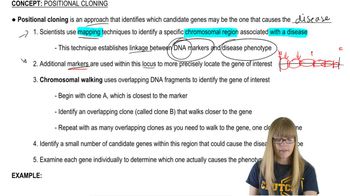
Positional Cloning

Conditional Mutants

Conditional mutants are organisms that exhibit a mutant phenotype only under certain environmental conditions, such as temperature or nutrient availability. In the context of S. cerevisiae, these mutants can help identify essential genes involved in specific cellular processes, like the secretory system, by allowing researchers to observe the effects of mutations under controlled conditions.
Recommended video:
Guided course
10:48
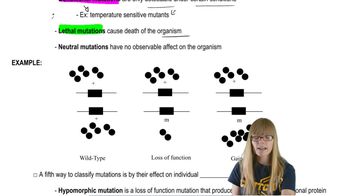
Mutations and Phenotypes

Orthologs and Functional Conservation

Orthologs are genes in different species that evolved from a common ancestral gene and typically retain the same function. Cloning human orthologs of yeast genes involves identifying these conserved genes through sequence similarity and functional studies, which can provide insights into gene function and disease mechanisms in humans based on findings from yeast models.
Recommended video:
Guided course
08:26
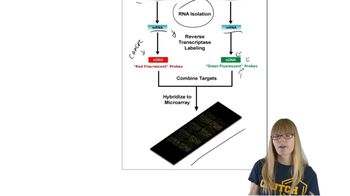
Functional Genomics
Related Practice
Textbook Question

How would you perform a genetic screen to identify genes directing Drosophila wing development? Once you have a collection of wing-development mutants, how would you analyze your mutagenesis to learn how many genes are represented and how many alleles of each gene? How would you discover whether the genes act in the same or different pathways, and if in the same pathway, how do you discover the order in which they act? How would you clone the genes?

493
views
Textbook Question

In enhancer trapping experiments, a minimal promoter and a reporter gene are placed adjacent to the end of a transposon so that genomic enhancers adjacent to the insertion site can act to drive expression of the reporter gene. In a modification of this approach, a series of enhancers and a promoter can be placed at the end of a transposon so that transcription is activated from the transposon into adjacent genomic DNA. What types of mutations do you expect to be induced by such a transposon in a mutagenesis experiment?

632
views
Textbook Question

We designed a screen to identify conditional mutants of S. cerevisiae in which the secretory system was defective. Suppose we were successful in identifying 12 mutants.

Describe the crosses you would perform to determine the number of different genes represented by the 12 mutations.

457
views
Textbook Question

How would you design a genetic screen to find genes involved in meiosis?

807
views
Textbook Question

The eyes of Drosophila develop from imaginal discs, groups of cells set aside in the fly embryo that differentiate into the adult structures during the pupal stage. Despite their importance in nature, eyes are dispensable for fruit fly life in the laboratory.

Devise a genetic screen to identify genes directing the development of the fly eye.

465
views
Textbook Question

The eyes of Drosophila develop from imaginal discs, groups of cells set aside in the fly embryo that differentiate into the adult structures during the pupal stage. Despite their importance in nature, eyes are dispensable for fruit fly life in the laboratory.

What complications might arise from genetic screens targeting an organ that differentiates late in development?

411
views