Translational fusions between a protein of interest and a reporter protein are used to determine the subcellular location of proteins in vivo. However, fusion to a reporter protein sometimes renders the protein of interest nonfunctional because the addition of the reporter protein interferes with proper protein folding, enzymatic activity, or protein–protein interactions. You have constructed a fusion between your protein of interest and a reporter gene. How will you show that the fusion protein retains its normal biological function?

Sanders 3rd Edition
Ch. 14 - Analysis of Gene Function via Forward Genetics and Reverse Genetics
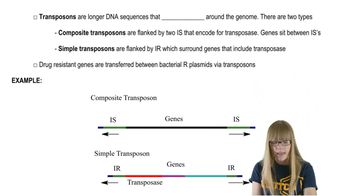
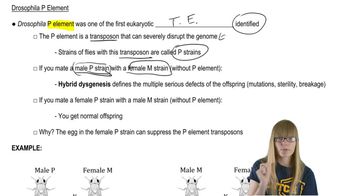
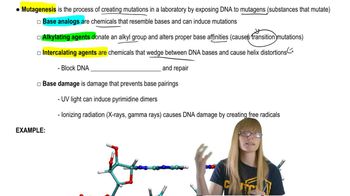
Problem 18In enhancer trapping experiments, a minimal promoter and a reporter gene are placed adjacent to the end of a transposon so that genomic enhancers adjacent to the insertion site can act to drive expression of the reporter gene. In a modification of this approach, a series of enhancers and a promoter can be placed at the end of a transposon so that transcription is activated from the transposon into adjacent genomic DNA. What types of mutations do you expect to be induced by such a transposon in a mutagenesis experiment?
Verified step by step guidance
Verified video answer for a similar problem:
Key Concepts
Transposons
Enhancer Elements
Mutagenesis
In humans, Duchenne muscular dystrophy is caused by a mutation in the dystrophin gene, which resides on the X chromosome. How would you create a mouse model of this genetic disease?
How would you perform a genetic screen to identify genes directing Drosophila wing development? Once you have a collection of wing-development mutants, how would you analyze your mutagenesis to learn how many genes are represented and how many alleles of each gene? How would you discover whether the genes act in the same or different pathways, and if in the same pathway, how do you discover the order in which they act? How would you clone the genes?
We designed a screen to identify conditional mutants of S. cerevisiae in which the secretory system was defective. Suppose we were successful in identifying 12 mutants.
Describe the crosses you would perform to determine the number of different genes represented by the 12 mutations.
We designed a screen to identify conditional mutants of S. cerevisiae in which the secretory system was defective. Suppose we were successful in identifying 12 mutants.
Based on your knowledge of the genetic tools for studying baker's yeast, how would you clone the genes that are mutated in your respective yeast strains? What is an approach to cloning the human orthologs of the yeast genes?
How would you design a genetic screen to find genes involved in meiosis?