Pearson+ LogoPearson+ Logo
Ch. 14 - Analysis of Gene Function via Forward Genetics and Reverse Genetics
Sanders - Genetic Analysis: An Integrated Approach 3rd Edition
Sanders3rd EditionGenetic Analysis: An Integrated ApproachISBN: 9780135564172Not the one you use?Change textbook
Chapter 14, Problem 17

How would you perform a genetic screen to identify genes directing Drosophila wing development? Once you have a collection of wing-development mutants, how would you analyze your mutagenesis to learn how many genes are represented and how many alleles of each gene? How would you discover whether the genes act in the same or different pathways, and if in the same pathway, how do you discover the order in which they act? How would you clone the genes?

Verified step by step guidance
1
Design a genetic screen to identify genes involved in Drosophila wing development: Use a mutagenesis approach, such as exposing flies to a mutagen (e.g., EMS or X-rays), to induce random mutations in the genome. Cross the mutagenized flies with wild-type flies and screen their progeny for phenotypic abnormalities in wing development. Select and maintain mutant lines with observable wing defects.
Analyze the collection of wing-development mutants to determine how many genes are represented: Perform complementation tests by crossing mutants with similar wing phenotypes. If the offspring display a wild-type phenotype, the mutations are in different genes. If the offspring display the mutant phenotype, the mutations are in the same gene. This allows you to group mutants into complementation groups, each representing a distinct gene.
Determine how many alleles of each gene are present: Count the number of mutants in each complementation group. Each mutant in a group represents a different allele of the same gene. This provides insight into the mutagenesis efficiency and the likelihood of identifying all genes involved in wing development.
Discover whether the genes act in the same or different pathways and determine the order of action if in the same pathway: Perform epistasis analysis by creating double mutants (e.g., crossing flies with mutations in two different genes). Analyze the phenotypes of the double mutants. If one mutation masks the effect of the other, the masked gene acts downstream in the pathway. This helps establish the genetic hierarchy of the pathway.
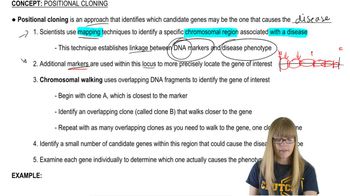
Clone the genes identified in the screen: Use positional cloning or molecular techniques such as mapping the mutations to specific chromosomal regions using genetic markers. Once the region is narrowed down, use sequencing to identify the gene and confirm its role in wing development by rescuing the mutant phenotype with a wild-type copy of the gene.

Verified video answer for a similar problem:

This video solution was recommended by our tutors as helpful for the problem above.
Video duration:
2m
Was this helpful?

Key Concepts

Here are the essential concepts you must grasp in order to answer the question correctly.

Genetic Screening

Genetic screening is a method used to identify and select individuals with specific phenotypic traits, often through mutagenesis. In Drosophila, this involves exposing the flies to mutagens to induce mutations, followed by observing offspring for wing development abnormalities. This process helps researchers pinpoint genes responsible for particular traits by correlating mutations with observable phenotypes.
Recommended video:
Guided course
03:45
Descriptive Genetics

Allelic Variation and Gene Representation

Allelic variation refers to the different forms of a gene that can exist at a specific locus. After identifying wing-development mutants, researchers analyze the mutagenesis results to determine how many distinct genes are involved and how many alleles exist for each gene. This can be achieved through genetic mapping and complementation tests, which help clarify the genetic diversity and redundancy in the pathways affecting wing development.
Recommended video:
Guided course
09:28
Genomic Variation

Pathway Analysis and Gene Cloning

Understanding whether genes act in the same or different pathways involves genetic interaction studies, such as epistasis analysis, to determine the order of gene function. If genes are found to be in the same pathway, researchers can use techniques like gene cloning to isolate and characterize these genes. Cloning allows for further functional studies, including the examination of gene expression and the effects of specific mutations on wing development.
Recommended video:
Guided course
07:
Positional Cloning
Related Practice
Textbook Question

When the S. cerevisiae genome was sequenced and surveyed for possible genes, only about 40% of those genes had been previously identified in forward genetic screens. This left about 60% of predicted genes with no known function, leading some to dub the genes fun (function unknown) genes. You wish to know the physical location of the encoded protein product. How will you obtain such information?

438
views
Textbook Question

Translational fusions between a protein of interest and a reporter protein are used to determine the subcellular location of proteins in vivo. However, fusion to a reporter protein sometimes renders the protein of interest nonfunctional because the addition of the reporter protein interferes with proper protein folding, enzymatic activity, or protein–protein interactions. You have constructed a fusion between your protein of interest and a reporter gene. How will you show that the fusion protein retains its normal biological function?

709
views
Textbook Question

In humans, Duchenne muscular dystrophy is caused by a mutation in the dystrophin gene, which resides on the X chromosome. How would you create a mouse model of this genetic disease?

809
views
Textbook Question

In enhancer trapping experiments, a minimal promoter and a reporter gene are placed adjacent to the end of a transposon so that genomic enhancers adjacent to the insertion site can act to drive expression of the reporter gene. In a modification of this approach, a series of enhancers and a promoter can be placed at the end of a transposon so that transcription is activated from the transposon into adjacent genomic DNA. What types of mutations do you expect to be induced by such a transposon in a mutagenesis experiment?

632
views
Textbook Question

We designed a screen to identify conditional mutants of S. cerevisiae in which the secretory system was defective. Suppose we were successful in identifying 12 mutants.

Describe the crosses you would perform to determine the number of different genes represented by the 12 mutations.

457
views
Textbook Question

We designed a screen to identify conditional mutants of S. cerevisiae in which the secretory system was defective. Suppose we were successful in identifying 12 mutants.

Based on your knowledge of the genetic tools for studying baker's yeast, how would you clone the genes that are mutated in your respective yeast strains? What is an approach to cloning the human orthologs of the yeast genes?

484
views