Pearson+ LogoPearson+ Logo
Ch. 14 - Analysis of Gene Function via Forward Genetics and Reverse Genetics
Sanders - Genetic Analysis: An Integrated Approach 3rd Edition
Sanders3rd EditionGenetic Analysis: An Integrated ApproachISBN: 9780135564172Not the one you use?Change textbook
Chapter 14, Problem 28c

Most organisms display a circadian rhythm, a cycling of biological processes that is roughly synchronized with day length (e.g., jet lag occurs in humans when rapid movement between time zones causes established circadian rhythms to be out of synch with daylight hours). In Drosophila, pupae eclose (emerge as adults after metamorphosis) at dawn.
In each case, how would you clone the genes you identified by mutation?

Verified step by step guidance
1
Step 1: Identify the mutated gene responsible for the circadian rhythm phenotype. This can be done by mapping the mutation to a specific chromosomal location using genetic linkage analysis or recombination mapping.
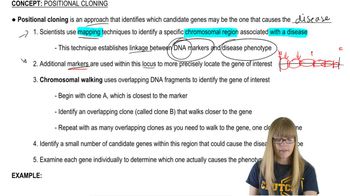
Step 2: Once the chromosomal location is identified, use molecular techniques such as positional cloning to narrow down the region containing the gene. This involves analyzing overlapping DNA fragments (e.g., BACs or cosmids) from the region of interest.
Step 3: Screen the candidate genes within the mapped region for mutations. This can be done by sequencing the DNA of the candidate genes from mutant and wild-type organisms to identify differences.
Step 4: Validate the identified gene by functional studies. For example, rescue the mutant phenotype by introducing a wild-type copy of the gene into the mutant organism using transgenic techniques.
Step 5: Confirm the gene's role in circadian rhythm by studying its expression pattern (e.g., using RT-PCR or in situ hybridization) and its interaction with other known circadian rhythm genes or proteins.

Verified video answer for a similar problem:

This video solution was recommended by our tutors as helpful for the problem above.
Video duration:
3m
Was this helpful?

Key Concepts

Here are the essential concepts you must grasp in order to answer the question correctly.

Circadian Rhythm

Circadian rhythms are internal biological clocks that regulate various physiological processes in organisms, typically following a 24-hour cycle. These rhythms are influenced by environmental cues, such as light and temperature, and play a crucial role in sleep-wake cycles, hormone release, and metabolism. Understanding circadian rhythms is essential for studying how organisms adapt to their environments and how disruptions can lead to conditions like jet lag.

Gene Cloning

Gene cloning is a molecular biology technique used to create copies of a specific gene or DNA sequence. This process typically involves isolating the gene of interest, inserting it into a vector (like a plasmid), and introducing it into a host organism, such as bacteria or yeast, for replication. Cloning genes is fundamental for studying gene function, producing proteins, and developing genetic therapies.
Recommended video:
Guided course
07:
Positional Cloning

Drosophila Genetics

Drosophila melanogaster, commonly known as the fruit fly, is a model organism widely used in genetic research due to its short life cycle, ease of manipulation, and well-mapped genome. Studies in Drosophila have provided insights into fundamental biological processes, including development, behavior, and circadian rhythms. Understanding the genetic basis of traits in Drosophila can help researchers identify and clone genes associated with specific phenotypes.
Recommended video:
Guided course
09:03
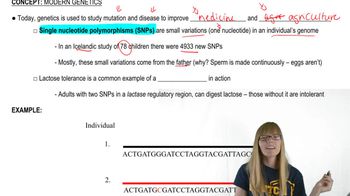
Modern Genetics
Related Practice
Textbook Question

In land plants, there is an alternation of generations between a haploid gametophyte generation and a diploid sporophytic generation. Both generations are typically multicellular and may be free-living. The male (pollen) and female (embryo sac) gametophytes are the haploid generation of flowering plants.

How would you conduct a screen to identify genes required for male gametophyte development?

499
views
Textbook Question

Most organisms display a circadian rhythm, a cycling of biological processes that is roughly synchronized with day length (e.g., jet lag occurs in humans when rapid movement between time zones causes established circadian rhythms to be out of synch with daylight hours). In Drosophila, pupae eclose (emerge as adults after metamorphosis) at dawn.

Using this knowledge, how would you screen for Drosophila mutants that have an impaired circadian rhythm?

623
views
Textbook Question

Most organisms display a circadian rhythm, a cycling of biological processes that is roughly synchronized with day length (e.g., jet lag occurs in humans when rapid movement between time zones causes established circadian rhythms to be out of synch with daylight hours). In Drosophila, pupae eclose (emerge as adults after metamorphosis) at dawn.

In most plants, such as Arabidopsis, genes whose encoded products have roles related to photosynthesis have expression patterns that vary in a circadian manner. Using this knowledge, how would you screen for Arabidopsis mutants that have an impaired circadian rhythm?

580
views
Textbook Question

Mutations in the Drosophila Ultrabithorax (Ubx) gene result in wings developing from two thoracic segments, rather than just one as in wild-type flies. In the mouse genome there are two Ubx orthologs . How would you determine whether the two mouse genes have distinct or redundant functions?

476
views
Textbook Question

How would you edit a specific nucleotide in a genome?

647
views
Textbook Question

Through a forward genetics screen in Arabidopsis you have identified a mutation that results in leaves curling upward, rather than being flat as in wild type. You have cloned the corresponding gene and note that it is a member of a small gene family composed of three additional members in Arabidopsis. How will you determine if the other three members of the gene family have similar or distinct functions as compared with the gene you first identified?

424
views