Pearson+ LogoPearson+ Logo
Ch. 14 - Analysis of Gene Function via Forward Genetics and Reverse Genetics
Sanders - Genetic Analysis: An Integrated Approach 3rd Edition
Sanders3rd EditionGenetic Analysis: An Integrated ApproachISBN: 9780135564172Not the one you use?Change textbook
Chapter 14, Problem 31

Through a forward genetics screen in Arabidopsis you have identified a mutation that results in leaves curling upward, rather than being flat as in wild type. You have cloned the corresponding gene and note that it is a member of a small gene family composed of three additional members in Arabidopsis. How will you determine if the other three members of the gene family have similar or distinct functions as compared with the gene you first identified?

Verified step by step guidance
1
Perform a sequence alignment of the gene you identified with the other three members of the gene family to determine their sequence similarity. This will help you assess whether they are likely to have similar functions based on conserved domains or motifs.
Analyze the expression patterns of the other three genes using techniques such as quantitative PCR (qPCR) or RNA sequencing. Compare their expression levels in different tissues, developmental stages, or environmental conditions to see if they overlap with the expression pattern of the gene you identified.
Generate loss-of-function mutants for each of the other three genes using techniques like CRISPR-Cas9 or T-DNA insertion. Observe the phenotypes of these mutants to determine if they exhibit leaf curling or other traits similar to the original mutant.
Create double or higher-order mutants by combining the loss-of-function mutation of the original gene with mutations in the other three genes. Analyze the phenotypes of these mutants to determine if the genes have redundant or distinct functions.
Perform protein-protein interaction studies, such as yeast two-hybrid assays or co-immunoprecipitation, to determine if the proteins encoded by the other three genes interact with the same partners as the protein encoded by the original gene. This can provide insights into their functional similarities or differences.

Verified video answer for a similar problem:

This video solution was recommended by our tutors as helpful for the problem above.
Video duration:
2m
Was this helpful?

Key Concepts

Here are the essential concepts you must grasp in order to answer the question correctly.

Gene Family

A gene family consists of a group of related genes that have similar sequences and often similar functions. In Arabidopsis, gene families can arise from gene duplication events, leading to multiple genes that may perform overlapping or distinct roles in plant development and physiology. Understanding the relationships within a gene family is crucial for determining functional similarities and differences among its members.
Recommended video:
Guided course
09:09
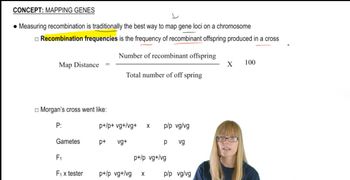
Mapping Genes

Functional Analysis

Functional analysis involves experimental approaches to determine the roles of specific genes in biological processes. Techniques such as gene knockout, overexpression, or RNA interference can be employed to assess the impact of each gene family member on leaf morphology. By comparing phenotypic outcomes, researchers can infer whether the other genes in the family have similar or distinct functions relative to the initially identified gene.
Recommended video:
Guided course
08:26
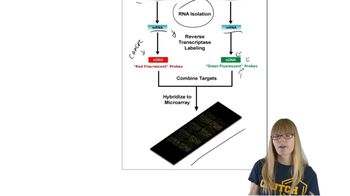
Functional Genomics

Phenotypic Characterization

Phenotypic characterization refers to the assessment of observable traits resulting from genetic expression. In this context, it involves examining the leaf shapes and curling patterns in plants with mutations in the gene family members. By analyzing these phenotypes under various conditions, researchers can draw conclusions about the functional roles of the genes and their contributions to the overall morphology of the plant.
Recommended video:
Guided course
10:48
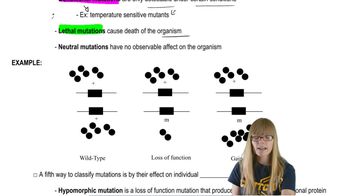
Mutations and Phenotypes