Pearson+ LogoPearson+ Logo
Ch. 15 - Recombinant DNA Technology and Its Applications
Sanders - Genetic Analysis: An Integrated Approach 3rd Edition
Sanders3rd EditionGenetic Analysis: An Integrated ApproachISBN: 9780135564172Not the one you use?Change textbook
Chapter 15, Problem 2a

The human genome is 3×10⁹ bp in length.
How many fragments would be predicted to result from the complete digestion of the human genome with the following enzymes: Sau3A (˘GATC), BamHI (G˘GATCC), EcoRI (G˘AATTC), and NotI (GC˘GGCCGC)?

Verified step by step guidance
1
Step 1: Understand the problem. The question asks how many fragments would result from the complete digestion of the human genome (3×10⁹ base pairs) using specific restriction enzymes. Each enzyme recognizes a specific sequence of DNA and cuts at that sequence. To solve this, we need to calculate the frequency of each recognition sequence in the genome and then determine the number of fragments produced.
Step 2: Calculate the probability of finding each recognition sequence in the genome. For a random sequence of DNA, the probability of finding a specific base at a given position is 1/4 (since there are four bases: A, T, G, C). For a recognition sequence of length n, the probability of finding that sequence is (1/4)^n. For example, Sau3A recognizes a 4-base sequence (˘GATC), so its probability is (1/4)^4.
Step 3: Determine the expected number of recognition sites for each enzyme. Multiply the probability of finding the recognition sequence by the total number of base pairs in the genome (3×10⁹ bp). For example, for Sau3A, the expected number of recognition sites is (1/4)^4 × 3×10⁹.
Step 4: Calculate the number of fragments produced. Each recognition site corresponds to a cut in the DNA, and the number of fragments produced is equal to the number of recognition sites plus one. Perform this calculation for each enzyme: Sau3A (˘GATC), BamHI (G˘GATCC), EcoRI (G˘AATTC), and NotI (GC˘GGCCGC).
Step 5: Summarize the results. After calculating the expected number of fragments for each enzyme, compare the values to understand how the length of the recognition sequence affects the number of fragments produced. Longer recognition sequences result in fewer cuts and larger fragments, while shorter sequences produce more cuts and smaller fragments.

Verified video answer for a similar problem:

This video solution was recommended by our tutors as helpful for the problem above.
Video duration:
9m
Was this helpful?

Key Concepts

Here are the essential concepts you must grasp in order to answer the question correctly.

Restriction Enzymes

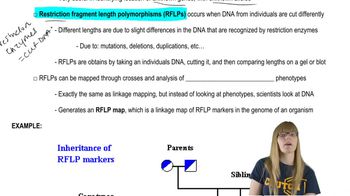
Restriction enzymes are proteins that cut DNA at specific sequences, known as recognition sites. Each enzyme recognizes a unique sequence of nucleotides, allowing for targeted cleavage of DNA. Understanding how these enzymes work is crucial for predicting the number of fragments generated from a given DNA sequence, such as the human genome.
Recommended video:
Guided course
07:11
Mapping with Markers

DNA Fragmentation

DNA fragmentation refers to the process of breaking down long DNA molecules into smaller pieces. When a restriction enzyme cuts the DNA, it creates fragments whose number and size depend on the frequency of the enzyme's recognition sites within the DNA. Analyzing the human genome's sequence helps estimate how many fragments will result from digestion with specific enzymes.
Recommended video:
Guided course
11:59
Steps to DNA Replication

Genome Size and Recognition Sites

The size of the genome, measured in base pairs (bp), is essential for understanding how many times a restriction enzyme can cut the DNA. The frequency of recognition sites for each enzyme determines the expected number of fragments. For example, if an enzyme recognizes a sequence that occurs every 1,000 bp, it would theoretically produce many fragments from a 3 billion bp genome.
Recommended video:
Guided course
02:48
Genomics Overview
Related Practice
Textbook Question

The results shown are from a DNA test for four genes used in a paternity identification case. DNA for the mother (M) and her child (C) are shown along with DNA from two possible fathers, F1 and F2. Based on the exclusion principle, is either man excluded as the possible father? Explain.

645
views
Textbook Question

The results shown are from a DNA test for four genes used in a paternity identification case. DNA for the mother (M) and her child (C) are shown along with DNA from two possible fathers, F1 and F2. What can you conclude based on the DNA results available?

439
views
Textbook Question

What purpose do the bla and lacZ genes serve in the plasmid vector pUC18?

950
views
Textbook Question

The human genome is 3×10⁹ bp in length.

How would your initial answer change if you knew that the average GC content of the human genome was 40%?

702
views
Textbook Question

Ligase catalyzes a reaction between the 5′ phosphate and the 3′ hydroxyl groups at the ends of DNA molecules. The enzyme calf intestinal phosphatase catalyzes the removal of the 5′5′ phosphate from DNA molecules. What would be the consequence of treating a cloning vector, before ligation, with calf intestinal phosphatase?

432
views
Textbook Question

You have constructed four different libraries: a genomic library made from DNA isolated from human brain tissue, a genomic library made from DNA isolated from human muscle tissue, a human brain cDNA library, and a human muscle cDNA library.

Which of these would have the greatest diversity of sequences?

832
views