Pearson+ LogoPearson+ Logo
Ch. 15 - Recombinant DNA Technology and Its Applications
Sanders - Genetic Analysis: An Integrated Approach 3rd Edition
Sanders3rd EditionGenetic Analysis: An Integrated ApproachISBN: 9780135564172Not the one you use?Change textbook
Chapter 15, Problem 5d

Using the genomic libraries, you wish to clone the human gene encoding myostatin, which is expressed only in muscle cells.
How frequently will a clone representing myostatin be found in the cDNA library made from brain?

Verified step by step guidance
1
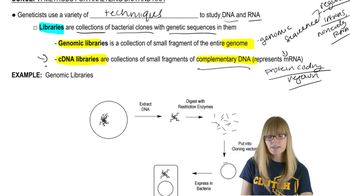
Understand the concept of cDNA libraries: A cDNA library is created by reverse transcribing mRNA from a specific tissue or cell type. It represents only the genes actively expressed in that tissue or cell type at the time of collection.
Recognize that myostatin is expressed exclusively in muscle cells. Therefore, mRNA for myostatin will be present in muscle cells but absent in other tissues, such as the brain.
Consider the source of the cDNA library: Since the cDNA library in this problem is made from brain tissue, it will only contain cDNA derived from mRNA expressed in brain cells.
Conclude that because myostatin is not expressed in brain cells, its mRNA will not be present in the brain tissue used to create the cDNA library. As a result, a clone representing myostatin will not be found in the brain-derived cDNA library.
Summarize the reasoning: The frequency of finding a clone for myostatin in the brain cDNA library is effectively zero because myostatin is not expressed in brain tissue.

Verified video answer for a similar problem:

This video solution was recommended by our tutors as helpful for the problem above.
Video duration:
3m
Was this helpful?

Key Concepts

Here are the essential concepts you must grasp in order to answer the question correctly.

cDNA Library

A cDNA library is a collection of complementary DNA (cDNA) sequences synthesized from messenger RNA (mRNA) transcripts. It represents the expressed genes of a specific tissue or cell type at a given time. Since myostatin is expressed only in muscle cells, a cDNA library derived from brain tissue will likely contain little to no myostatin clones, as brain cells do not express this gene.
Recommended video:
Guided course
07:40
Methods for Analyzing DNA and RNA

Gene Expression

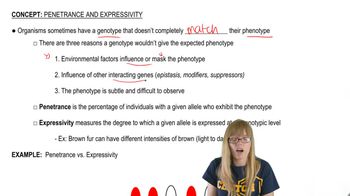
Gene expression refers to the process by which information from a gene is used to synthesize functional gene products, typically proteins. Different genes are expressed in different tissues, leading to the specialization of cells. Myostatin is specifically expressed in muscle cells, meaning it will not be present in tissues like the brain, which affects the likelihood of finding its clone in a cDNA library derived from that tissue.
Recommended video:
Guided course
02:09
Penetrance and Expressivity

Cloning

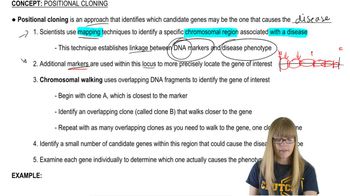
Cloning in genetics involves creating copies of a specific DNA sequence, often using techniques such as polymerase chain reaction (PCR) or vector-based methods. When attempting to clone a gene like myostatin, the source of the DNA is crucial. Since myostatin is not expressed in brain tissue, the cloning process from a brain-derived cDNA library would yield very few, if any, clones of the myostatin gene.
Recommended video:
Guided course
07:
Positional Cloning
Related Practice
Textbook Question

Using the genomic libraries, you wish to clone the human gene encoding myostatin, which is expressed only in muscle cells.

Assuming the human genome is 3x10⁹ bp and that the average insert size in the genomic libraries is 100 kb, how frequently will a clone representing myostatin be found in the genomic library made from muscle?

561
views
Textbook Question

Using the genomic libraries, you wish to clone the human gene encoding myostatin, which is expressed only in muscle cells.

How frequently will a clone representing myostatin be found in the genomic library made from brain?

504
views
Textbook Question

Using the genomic libraries, you wish to clone the human gene encoding myostatin, which is expressed only in muscle cells.

How frequently will a clone representing myostatin be found in the cDNA library made from muscle?

515
views
Textbook Question

The human genome is 3×10⁹ bp. You wish to design a primer to amplify a specific gene in the genome. In general, what length of oligonucleotide would be sufficient to amplify a single unique sequence? To simplify your calculation, assume that all bases occur with an equal frequency.

627
views
Textbook Question

Using animal models of human diseases can lead to insights into the cellular and genetic bases of the diseases. Duchenne muscular dystrophy (DMD) is the consequence of an X-linked recessive allele.

How would you make a mouse model of DMD?

613
views
Textbook Question

Using animal models of human diseases can lead to insights into the cellular and genetic bases of the diseases. Duchenne muscular dystrophy (DMD) is the consequence of an X-linked recessive allele.

How would you make a Drosophila model of DMD?

436
views