Pearson+ LogoPearson+ Logo
Ch. 15 - Recombinant DNA Technology and Its Applications
Sanders - Genetic Analysis: An Integrated Approach 3rd Edition
Sanders3rd EditionGenetic Analysis: An Integrated ApproachISBN: 9780135564172Not the one you use?Change textbook
Chapter 15, Problem 7a

Using animal models of human diseases can lead to insights into the cellular and genetic bases of the diseases. Duchenne muscular dystrophy (DMD) is the consequence of an X-linked recessive allele.
How would you make a mouse model of DMD?

Verified step by step guidance
1
Understand the genetic basis of Duchenne muscular dystrophy (DMD): DMD is caused by mutations in the dystrophin gene, which is located on the X chromosome. This gene encodes the dystrophin protein, essential for muscle function. Since DMD is X-linked recessive, males with one mutated allele exhibit the disease, while females require two mutated alleles to show symptoms.
Identify the mouse dystrophin gene: The mouse genome contains a homologous dystrophin gene similar to the human dystrophin gene. This gene must be targeted to create a model of DMD.
Use gene-editing techniques to introduce mutations: Employ a gene-editing tool such as CRISPR-Cas9 to introduce a specific mutation into the dystrophin gene in mouse embryonic stem cells. The mutation should mimic the type of mutation found in human DMD patients, such as a frameshift or nonsense mutation that disrupts dystrophin production.
Generate genetically modified mice: Inject the edited embryonic stem cells into mouse blastocysts and implant them into surrogate mothers. The resulting offspring will carry the targeted mutation in the dystrophin gene. Breed these mice to produce homozygous mutants (females with two mutated alleles or males with one mutated allele) to study the disease phenotype.
Validate the mouse model: Confirm the absence of dystrophin protein in the muscle tissue of the genetically modified mice using techniques such as Western blotting or immunohistochemistry. Assess the mice for symptoms of DMD, such as muscle weakness and degeneration, to ensure the model accurately reflects the human disease.

Verified video answer for a similar problem:

This video solution was recommended by our tutors as helpful for the problem above.
Video duration:
4m
Was this helpful?

Key Concepts

Here are the essential concepts you must grasp in order to answer the question correctly.

X-linked Recessive Inheritance

X-linked recessive inheritance refers to a pattern of genetic transmission where a gene located on the X chromosome is expressed in males (who have one X and one Y chromosome) if they inherit the recessive allele. In females, who have two X chromosomes, the presence of one normal allele can mask the effect of the recessive allele. This is crucial for understanding diseases like Duchenne muscular dystrophy (DMD), which predominantly affects males.
Recommended video:
Guided course
09:30
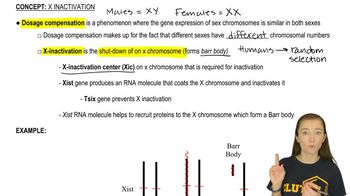
X-Inactivation

Animal Models in Genetics

Animal models, such as mice, are used in genetics to study human diseases by replicating the genetic and phenotypic characteristics of the condition. These models allow researchers to investigate disease mechanisms, test potential treatments, and understand the genetic basis of disorders. Creating a mouse model for DMD involves manipulating the mouse genome to mimic the human mutation responsible for the disease.
Recommended video:
Guided course
08:30
Genetics of Development

Gene Editing Techniques

Gene editing techniques, such as CRISPR-Cas9, enable precise modifications to an organism's DNA. In the context of creating a mouse model for DMD, these techniques can be employed to introduce specific mutations in the mouse genome that correspond to the mutations found in human patients. This allows for the study of disease progression and the evaluation of therapeutic strategies in a controlled environment.
Recommended video:
Guided course
09:09
Mapping Genes
Related Practice
Textbook Question

Using the genomic libraries, you wish to clone the human gene encoding myostatin, which is expressed only in muscle cells.

How frequently will a clone representing myostatin be found in the cDNA library made from muscle?

515
views
Textbook Question

Using the genomic libraries, you wish to clone the human gene encoding myostatin, which is expressed only in muscle cells.

How frequently will a clone representing myostatin be found in the cDNA library made from brain?

575
views
Textbook Question

The human genome is 3×10⁹ bp. You wish to design a primer to amplify a specific gene in the genome. In general, what length of oligonucleotide would be sufficient to amplify a single unique sequence? To simplify your calculation, assume that all bases occur with an equal frequency.

627
views
Textbook Question

Using animal models of human diseases can lead to insights into the cellular and genetic bases of the diseases. Duchenne muscular dystrophy (DMD) is the consequence of an X-linked recessive allele.

How would you make a Drosophila model of DMD?

436
views
Textbook Question
Compare methods for constructing homologous recombinant transgenic mice and yeast.
480
views
Textbook Question
Chimeric gene-fusion products can be used for medical or industrial purposes. One idea is to produce biological therapeutics for human medical use in animals from which the products can be easily harvested—in the milk of sheep or cattle, for example. Outline how you would produce human insulin in the milk of sheep.
492
views