Pearson+ LogoPearson+ Logo
Ch. 15 - Recombinant DNA Technology and Its Applications
Sanders - Genetic Analysis: An Integrated Approach 3rd Edition
Sanders3rd EditionGenetic Analysis: An Integrated ApproachISBN: 9780135564172Not the one you use?Change textbook
Chapter 15, Problem 6

The human genome is 3×10⁹ bp. You wish to design a primer to amplify a specific gene in the genome. In general, what length of oligonucleotide would be sufficient to amplify a single unique sequence? To simplify your calculation, assume that all bases occur with an equal frequency.

Verified step by step guidance
1
Understand that the goal is to find the length of an oligonucleotide (primer) that will uniquely bind to one specific sequence in the human genome, which is 3 × 10⁹ base pairs (bp) long.
Assume that each base (A, T, C, G) occurs with equal frequency, so the probability of any specific base at a position is 1/4.
Calculate the total number of possible sequences of length n as 4^n, since each position can be one of four bases.
To ensure uniqueness, the number of possible sequences of length n should be at least equal to the size of the genome, so set up the inequality: 4^n  3 imes 10^9.
Solve for n by taking the logarithm base 4 of both sides: n  rac{\u221A ext{log}(3 imes 10^9)}{ ext{log}(4)}. This will give the minimum primer length needed to uniquely amplify a single sequence.

Verified video answer for a similar problem:

This video solution was recommended by our tutors as helpful for the problem above.
Video duration:
5m
Was this helpful?

Key Concepts

Here are the essential concepts you must grasp in order to answer the question correctly.

Primer Specificity and Length

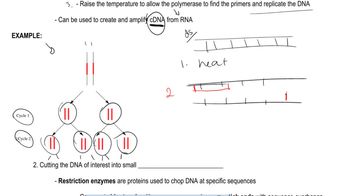
Primer specificity depends on its length and sequence uniqueness. Longer primers are more likely to bind uniquely to a target sequence in a large genome, reducing non-specific binding. Typically, primers between 18-25 nucleotides provide a good balance of specificity and efficient binding.
Recommended video:
Guided course
07:39
Genetic Cloning

Probability of Sequence Occurrence

The probability of a specific oligonucleotide sequence occurring in a genome depends on its length and base composition. Assuming equal base frequency, the chance of any particular sequence of length n is (1/4)^n. This helps estimate how long a primer must be to appear uniquely in a genome of given size.
Recommended video:

Human Genome Size and Complexity

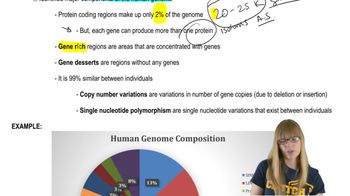
The human genome contains approximately 3×10⁹ base pairs, which influences primer design. To ensure a primer binds uniquely, its length must be sufficient so that the expected number of occurrences of that sequence in the genome is close to one or less, considering the genome's size and base distribution.
Recommended video:
Guided course
06:51
Human Genome Composition