Ch. 16 - Genomics: Genetics from a Whole-Genome Perspective
Chapter 16, Problem 16a

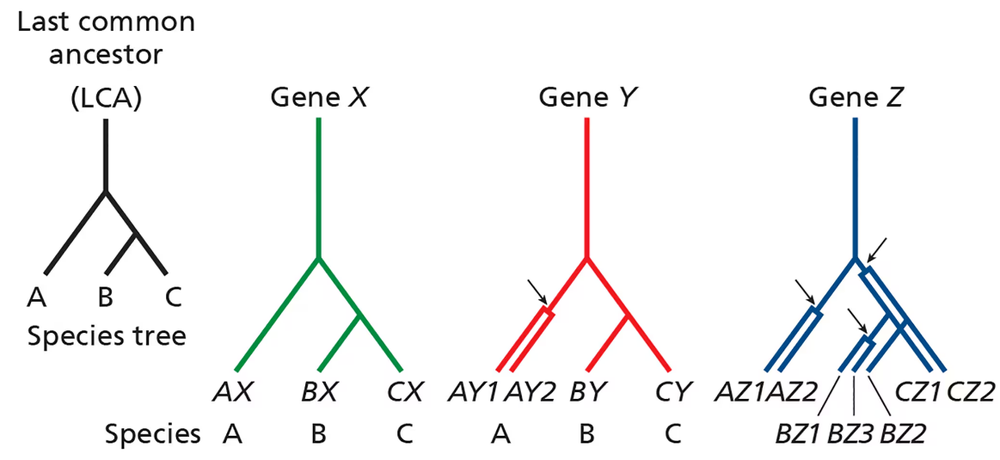
Consider the phylogenetic trees below pertaining to three related species (A, B, and C) that share a common ancestor (last common ancestor, or LCA). The lineage leading to species A diverges before the divergence of species B and C.
For gene X, no gene duplications have occurred in any lineage, and each gene X is derived from the ancestral gene X via speciation events. Are genes AX, BX, and CX orthologous, paralogous, or homologous?

Verified step by step guidance
1
Understand the definitions of orthologous, paralogous, and homologous genes: Orthologous genes are genes in different species that evolved from a common ancestral gene through speciation. Paralogs are genes related by duplication within a genome. Homologous genes are genes that share a common ancestry, which includes both orthologs and paralogs.
Analyze the phylogenetic tree: The problem states that species A, B, and C share a common ancestor, and the lineage leading to species A diverged before the divergence of species B and C. This indicates that the genes AX, BX, and CX are derived from the same ancestral gene X through speciation events.
Determine if gene duplications occurred: The problem explicitly states that no gene duplications have occurred in any lineage. This means that the genes AX, BX, and CX are not paralogous, as paralogs arise from gene duplication events.
Assess the relationship between the genes: Since AX, BX, and CX are derived from the same ancestral gene X through speciation events, they are orthologous. Orthologous genes are a subset of homologous genes, so they are also homologous.
Conclude the classification: Based on the analysis, genes AX, BX, and CX are orthologous because they are derived from the same ancestral gene through speciation events without any gene duplication.

Verified video answer for a similar problem:

This video solution was recommended by our tutors as helpful for the problem above.
Video duration:
2m
Was this helpful?

Key Concepts

Here are the essential concepts you must grasp in order to answer the question correctly.

Orthologs

Orthologs are genes in different species that evolved from a common ancestral gene through speciation. They typically retain the same function across species, making them crucial for understanding evolutionary relationships. In the context of species A, B, and C, genes AX, BX, and CX are considered orthologous because they originated from the same ancestral gene X before the species diverged.
Recommended video:

Paralogs

Paralogs are genes that arise from gene duplication events within the same species. They can evolve new functions or retain similar functions over time. In this scenario, since the question specifies that no gene duplications have occurred in any lineage, the concept of paralogs is not applicable to genes AX, BX, and CX.
Recommended video:

Homologs

Homologs refer to genes that share a common ancestry, which includes both orthologs and paralogs. While homologous genes can be found within the same species (paralogs) or across different species (orthologs), the distinction is important for evolutionary studies. In this case, genes AX, BX, and CX are homologous because they all derive from the ancestral gene X, despite being orthologs specifically due to their divergence in different species.
Recommended video:
Guided course
03:51
Recombination after Single Strand Breaks
Related Practice
Textbook Question

The two-hybrid method facilitates the discovery of protein–protein interactions. How does this technique work? Can you think of reasons for obtaining a false-positive result, that is, where the proteins encoded by two clones interact in the two-hybrid system but do not interact in the organism in which they naturally occur? Can you think of reasons you might obtain a false-negative result, in which the two proteins interact in vivo but fail to interact in the two-hybrid system?

392
views
Textbook Question

Go to http://blast.ncbi.nlm.nih.gov/Blast.cgi and follow the links to nucleotide BLAST. Type in the sequence below; it is broken up into codons to make it easier to copy.

5' ATG TTC GTC AAT CAG CAC CTT TGT GGT TCT CAC CTC GTT GAA GCTTTG TAC CTT GTT TGC GGT GAA CGT GGT TTC TTC TAC ACT CCT AAG ACT TAA 3'

As you will note on the BLAST page, there are several options for tailoring your query to obtain the most relevant information. Some are related to which sequences to search in the database. For example, the search can be limited taxonomically (e.g., restricted to mammals) or by the type of sequences in the database (e.g., cDNA or genomic). For our search, we will use the broadest database, the 'Nucleotide collection (nr/nt).' This is the nonredundant (nr) database of all nucleotide data (nt) in GenBank and can be selected in the 'Database' dialogue box. Other parameters can also be adjusted to make the search more or less sensitive to mismatches or gaps. For our purposes, we will use the default setting, which is automatically presented. Press 'BLAST' to search. What can you say about the DNA sequence?

412
views
Textbook Question

In the course of the Drosophila melanogaster genome project, the following genomic DNA sequences were obtained. Try to assemble the sequences into a single contig.

5' TTCCAGAACCGGCGAATGAAGCTGAAGAAG 3'

5' GAGCGGCAGATCAAGATCTGGTTCCAGAAC 3'

5' TGATCTGCCGCTCCGTCAGGCATAGCGCGT 3'

5' GGAGAATCGAGATGGCGCACGCGCTATGCC 3'

5' GGAGAATCGAGATGGCGCACGCGCTATGCC 3'

5' CCATCTCGATTCTCCGTCTGCGGGTCAGAT 3'

Go to the URL provided in Problem 14, and using the sequence you have just assembled, perform a blastn search in the 'Nucleotide collection (nr/nt)' database. Does the search produce sequences similar to your assembled sequence, and if so, what are they? Can you tell if your sequence is transcribed, and if it represents protein-coding sequence? Perform a tblastx search, first choosing the 'Nucleotide collection (nr/nt)' database and then limiting the search to human sequences by typing Homo sapiens in the organism box. Are homologous sequences found in the human genome? Annotate the assembled sequence.

473
views
Textbook Question

Consider the phylogenetic trees below pertaining to three related species (A, B, and C) that share a common ancestor (last common ancestor, or LCA). The lineage leading to species A diverges before the divergence of species B and C.

For gene Y, a gene duplication occurred in the lineage leading to A after it diverged from that, leading to B and C. Are genes AY1 and AY2 orthologous or paralogous? Are genes AY1 and BY orthologous or paralogous? Are genes BY and CY orthologous or paralogous?

415
views
Textbook Question

Consider the phylogenetic trees below pertaining to three related species (A, B, and C) that share a common ancestor (last common ancestor, or LCA). The lineage leading to species A diverges before the divergence of species B and C.

For gene Z, gene duplications have occurred in all species. Define orthology and paralogy relationships for the different Z genes.

357
views
Textbook Question

You have isolated a gene that is important for the production of milk and wish to study its regulation. You examine the genomes of human, mouse, dog, chicken, pufferfish, and yeast and note that all genomes except yeast have an orthologous gene.

What does the existence of orthologous genes in chicken and pufferfish tell you about the function of this gene?

422
views