Pearson+ LogoPearson+ Logo
Ch. 16 - Genomics: Genetics from a Whole-Genome Perspective
Sanders - Genetic Analysis: An Integrated Approach 3rd Edition
Sanders3rd EditionGenetic Analysis: An Integrated ApproachISBN: 9780135564172Not the one you use?Change textbook
Chapter 16, Problem 17

You have isolated a gene that is important for the production of milk and wish to study its regulation. You examine the genomes of human, mouse, dog, chicken, pufferfish, and yeast and note that all genomes except yeast have an orthologous gene.

What does the existence of orthologous genes in chicken and pufferfish tell you about the function of this gene?

Verified step by step guidance
1
span>1. Understand the concept of orthologous genes: Orthologous genes are genes in different species that evolved from a common ancestral gene by speciation. They typically retain the same function across species.
span>2. Analyze the presence of orthologous genes: The presence of orthologous genes in chicken and pufferfish suggests that the gene has been conserved through evolution, indicating its importance and potentially similar function across these species.
span>3. Consider evolutionary conservation: The fact that this gene is present in such diverse species as chicken and pufferfish implies that it plays a fundamental role that has been maintained over a long evolutionary timescale.
span>4. Evaluate the absence in yeast: The absence of the orthologous gene in yeast, a more distantly related organism, might suggest that the gene's function is specific to more complex organisms, possibly related to lactation or other vertebrate-specific processes.
span>5. Hypothesize the gene's function: Given its presence in mammals (human, mouse, dog) and other vertebrates (chicken, pufferfish), the gene likely plays a crucial role in a biological process that is common to these organisms, potentially related to milk production or another essential vertebrate function.

Verified video answer for a similar problem:

This video solution was recommended by our tutors as helpful for the problem above.
Video duration:
2m
Was this helpful?

Key Concepts

Here are the essential concepts you must grasp in order to answer the question correctly.

Orthologous Genes

Orthologous genes are genes in different species that evolved from a common ancestral gene and typically retain the same function. The presence of orthologs across diverse species suggests that the gene is conserved through evolution, indicating its importance in fundamental biological processes.
Recommended video:
Guided course
09:09
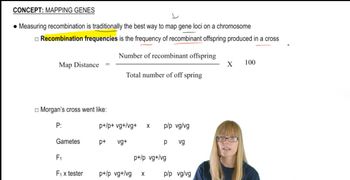
Mapping Genes

Gene Conservation

Gene conservation refers to the preservation of gene sequences and functions across different species over evolutionary time. When a gene is found in multiple organisms, it implies that the gene plays a critical role in survival or reproduction, as it has been maintained despite the divergence of species.
Recommended video:
Guided course
11:19
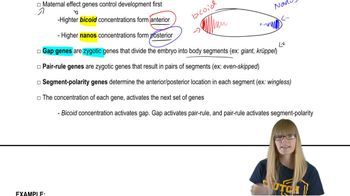
Segmentation Genes

Functional Implications of Gene Presence

The presence of orthologous genes in species like chicken and pufferfish suggests that the gene in question likely has a similar function in these organisms. This functional conservation can provide insights into the gene's role in processes such as milk production, as it may be involved in essential biological pathways that are shared among these species.
Recommended video:
Guided course
08:26
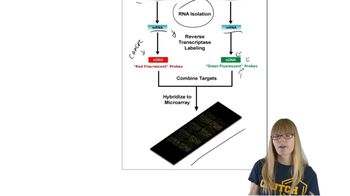
Functional Genomics
Related Practice
Textbook Question

Consider the phylogenetic trees below pertaining to three related species (A, B, and C) that share a common ancestor (last common ancestor, or LCA). The lineage leading to species A diverges before the divergence of species B and C.

For gene X, no gene duplications have occurred in any lineage, and each gene X is derived from the ancestral gene X via speciation events. Are genes AX, BX, and CX orthologous, paralogous, or homologous?

388
views
Textbook Question

Consider the phylogenetic trees below pertaining to three related species (A, B, and C) that share a common ancestor (last common ancestor, or LCA). The lineage leading to species A diverges before the divergence of species B and C.

For gene Y, a gene duplication occurred in the lineage leading to A after it diverged from that, leading to B and C. Are genes AY1 and AY2 orthologous or paralogous? Are genes AY1 and BY orthologous or paralogous? Are genes BY and CY orthologous or paralogous?

436
views
Textbook Question

Consider the phylogenetic trees below pertaining to three related species (A, B, and C) that share a common ancestor (last common ancestor, or LCA). The lineage leading to species A diverges before the divergence of species B and C.

For gene Z, gene duplications have occurred in all species. Define orthology and paralogy relationships for the different Z genes.

379
views
Textbook Question

You have isolated a gene that is important for the production of milk and wish to study its regulation. You examine the genomes of human, mouse, dog, chicken, pufferfish, and yeast and note that all genomes except yeast have an orthologous gene.

How would you identify the regulatory elements important for the expression of your isolated gene in mammary glands?

532
views
Textbook Question

When the human genome is examined, the chromosomes appear to have undergone only minimal rearrangement in the 100 million years since the last common ancestor of eutherian mammals. However, when individual humans are examined or when the human genome is compared with that of chimpanzees, a large number of small indels and SNPs can be detected. How are these observations reconciled?

441
views
Textbook Question

Symbiodinium minutum is a dinoflagellate with a genome size that encodes more than 40,000 protein-coding genes. In contrast, the genome of Plasmodium falciparum has only a little more than 5000 protein-coding genes. Both Symbiodinium and Plasmodium are members of the Alveolate lineage of eukaryotes. What might be the cause of such a wide variation in their genome sizes?

511
views