Pearson+ LogoPearson+ Logo
Ch. 16 - Genomics: Genetics from a Whole-Genome Perspective
Sanders - Genetic Analysis: An Integrated Approach 3rd Edition
Sanders3rd EditionGenetic Analysis: An Integrated ApproachISBN: 9780135564172Not the one you use?Change textbook
Chapter 16, Problem 26

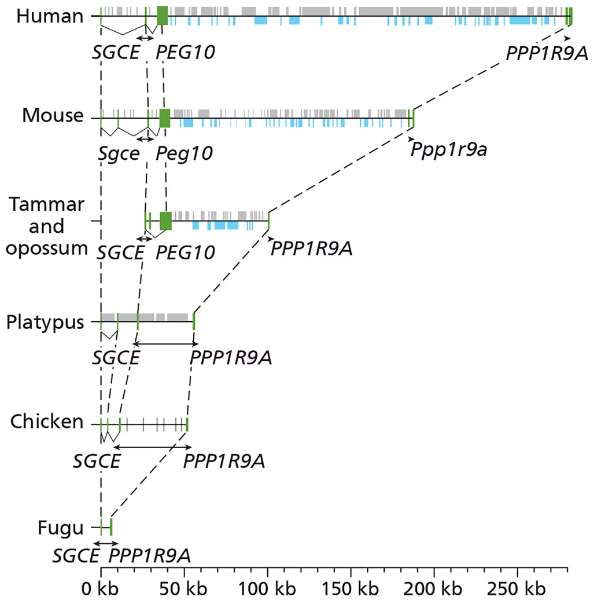
PEG10 (paternally expressed gene 10) is a paternally expressed gene (meaning only the paternal allele is expressed) that has an essential role in the formation of the placenta of the mouse. In the mouse genome, the PEG10 gene is flanked by the SGCE and PPP1R9A genes. To study the origin of PEG10, you examine syntenic regions spanning the SGCE and PPP1R9A loci in the genomes of several vertebrates, and you note that the PEG10 gene is present in the genomes of placental and marsupial mammals but not in the platypus, chicken, or fugu genomes.
The green bars in the figure indicate the exons of each gene. The gray bars represent LINEs and SINEs, and the blue bars represent long terminal repeat (LTR) elements of retrotransposons. Solid black diagonal lines link introns, and dashed black lines connect orthologous exons. Arrowheads indicate the direction of transcription.
Using the predicted protein sequence of PEG10, you perform a tblastn search for homologous genes and find that the most similar sequences are in a class of retrotransposons (the sushi-ichi retrotransposons). Propose an evolutionary scenario for the origin of the PEG10 gene, and relate its origin to its biological function.
Comparative genomics illustration showing PEG10 gene location and synteny across various vertebrate genomes.

Verified step by step guidance
1
Step 1: Understand the concept of retrotransposons and their role in genome evolution. Retrotransposons are genetic elements that can copy themselves and insert into new locations in the genome. They often contribute to the evolution of new genes by providing raw genetic material that can be co-opted for new functions.
Step 2: Analyze the data provided in the problem. PEG10 is present in placental and marsupial mammals but absent in platypus, chicken, and fugu genomes. This suggests that PEG10 originated after the divergence of monotremes (like the platypus) from therian mammals (marsupials and placental mammals).
Step 3: Examine the tblastn search results. The similarity between PEG10 and sushi-ichi retrotransposons indicates that PEG10 likely originated from a retrotransposon insertion event. Retrotransposons can acquire mutations and evolve into functional genes, a process known as 'domestication' of retrotransposons.
Step 4: Propose an evolutionary scenario. PEG10 may have originated from a sushi-ichi retrotransposon that inserted into the genome of a common ancestor of therian mammals. Over time, this retrotransposon was co-opted and evolved to perform a critical biological function, such as contributing to placental development.
Step 5: Relate the origin of PEG10 to its biological function. The placenta is a key innovation in therian mammals, enabling live birth and maternal-fetal nutrient exchange. PEG10's role in placental formation suggests that its domestication from a retrotransposon was an adaptive event that supported the evolution of this reproductive strategy.

Verified video answer for a similar problem:

This video solution was recommended by our tutors as helpful for the problem above.
Video duration:
3m
Was this helpful?

Key Concepts

Here are the essential concepts you must grasp in order to answer the question correctly.

Paternally Expressed Genes

Paternally expressed genes are those genes where only the allele inherited from the father is active, while the maternal allele is silenced. This phenomenon is a key aspect of genomic imprinting, which plays a crucial role in development, particularly in the formation of structures like the placenta. Understanding this concept is essential for analyzing the function of PEG10 in placental development.
Recommended video:
Guided course
02:09
Penetrance and Expressivity

Synteny

Synteny refers to the conservation of blocks of order within two sets of chromosomes that are being compared from different species. In the context of PEG10, examining syntenic regions helps identify evolutionary relationships and gene conservation across vertebrates. This concept is vital for understanding how PEG10 has been maintained or lost in various lineages.
Recommended video:
Guided course
01:49
Humans, Mice, and Chimps

Retrotransposons

Retrotransposons are a type of genetic element that can amplify themselves in a genome and are often involved in gene evolution and regulation. The relationship between PEG10 and retrotransposons, particularly the sushi-ichi retrotransposons, suggests that PEG10 may have originated from a retrotransposon event, which is significant for understanding its evolutionary history and functional role in mammals.
Recommended video:
Guided course
03:14
Eukaryotic Transposable Elements
Related Practice
Textbook Question

You are studying similarities and differences in how organisms respond to high salt concentrations and high temperatures. You begin your investigation by using microarrays to compare gene expression patterns of S. cerevisiae in normal growth conditions, in high salt concentrations, and at high temperatures. The results are shown here, with the values of red and green representing the extent of increase and decrease, respectively, of expression for genes a–s in the experimental conditions versus the control (normal growth) conditions. What is the first step you will take to analyze your data?

379
views
Textbook Question
In conducting the study described in Problem 24, you have noted that a set of S. cerevisiae genes are repressed when yeast are grown under high-salt conditions.How might you determine whether this set of genes is regulated by a common transcription factor?
488
views
Textbook Question

In conducting the study described in Problem 24, you have noted that a set of S. cerevisiae genes are repressed when yeast are grown under high-salt conditions. How might you approach this question if genome sequences for the related Saccharomyces species S. paradoxus, S. mikatae, and S. bayanus were also available?

402
views
Textbook Question

What is the difference between biochemical and biological function?

802
views
Textbook Question

Using the two-hybrid system to detect interactions between proteins, you obtained the following results: A clone encoding gene A gave positive results with clones B and C; clone B gave positive results with clones A, D, and E but not C; and clone E gave positive results only with clone B. Another clone F gave positive results with clone G but not with any of A–E. Can you explain these results? To follow up your two-hybrid results, you isolate null loss-of-function mutations in each of the genes A–G. Mutants of genes A, B, C, D, and E grow at only 80% of the rate of the wild type, whereas mutants of genes F and G are phenotypically indistinguishable from the wild type. You construct several double-mutant strains: The ab, ac, ad, and ae double mutants all grow at about 80% of the rate of the wild type, but af and ag double mutants exhibit lethality. Explain these results. How do the two-hybrid system and genetic interaction results complement one another? Can you reconcile your two-hybrid system and genetic interaction results in a single model?

524
views
Textbook Question

Describe at least two mechanisms by which duplicate genes arise. What are the possible fates of duplicate genes? Does the mode of duplication affect possible fates?

659
views