Pearson+ LogoPearson+ Logo
Ch. 17 - Organelle Inheritance and the Evolution of Organelle Genomes
Sanders - Genetic Analysis: An Integrated Approach 3rd Edition
Sanders3rd EditionGenetic Analysis: An Integrated ApproachISBN: 9780135564172Not the one you use?Change textbook
Chapter 17, Problem 19

What is the most likely mode of inheritance for the trait depicted in the following human pedigree? 
Human pedigree chart illustrating inheritance patterns for a specific trait.

Verified step by step guidance
1
Examine the pedigree chart carefully. Note that shaded symbols represent individuals expressing the trait, while unshaded symbols represent individuals who do not express the trait.
Determine whether the trait appears in every generation. If the trait is present in every generation, it suggests a dominant mode of inheritance. If it skips generations, it suggests a recessive mode of inheritance.
Analyze the distribution of the trait among males and females. If the trait affects both sexes equally, it is likely autosomal. If it predominantly affects one sex, it may be sex-linked.
Check if affected individuals have at least one affected parent. If affected individuals can have unaffected parents, the trait is likely recessive. If affected individuals always have an affected parent, the trait is likely dominant.
Consider whether the trait is passed from fathers to sons. If it is, the trait is likely autosomal. If fathers do not pass the trait to sons, it may be X-linked.

Verified video answer for a similar problem:

This video solution was recommended by our tutors as helpful for the problem above.
Video duration:
2m
Was this helpful?

Key Concepts

Here are the essential concepts you must grasp in order to answer the question correctly.

Pedigree Analysis

Pedigree analysis is a method used to study the inheritance patterns of traits in families. It involves creating a diagram that represents family relationships and the presence or absence of specific traits across generations. By analyzing the pedigree, geneticists can infer whether a trait is inherited in a dominant, recessive, or sex-linked manner.
Recommended video:
Guided course
01:59
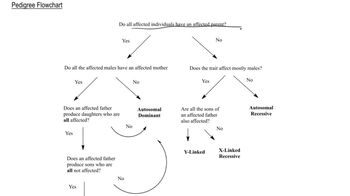
Pedigree Flowchart

Modes of Inheritance

Modes of inheritance refer to the patterns by which genetic traits are transmitted from parents to offspring. The main modes include autosomal dominant, autosomal recessive, X-linked dominant, and X-linked recessive. Understanding these modes helps in predicting the likelihood of a trait appearing in future generations based on the genetic makeup of the parents.
Recommended video:
Guided course
05:13
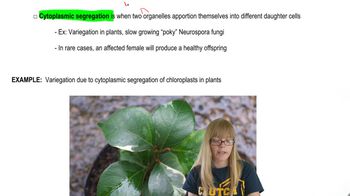
Organelle Inheritance

Dominance and Recessiveness

Dominance and recessiveness describe how alleles interact to express traits. A dominant allele can mask the effect of a recessive allele in a heterozygous individual. In pedigree charts, traits that appear in every generation suggest dominance, while traits that skip generations often indicate recessiveness, providing clues about the inheritance pattern of the trait in question.
Recommended video:
Guided course
04:37
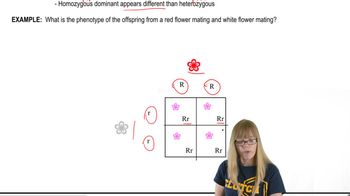
Variations on Dominance
Related Practice
Textbook Question

A 50-year-old man has been diagnosed with MELAS syndrome. His wife is phenotypically normal, and there is no history of MELAS syndrome in either of their families. The couple is concerned about whether their children will develop the disease. As a genetic counselor, what will you tell them? Would your answer change if it were the mother who exhibited disease symptoms rather than the father?

411
views
Textbook Question

The first person in a family to exhibit Leber hereditary optic neuropathy (LHON) was II-3 in the pedigree shown below, and all of her children also exhibited the disease. Provide two possible explanations as to why II-3's mother (I-1) did not exhibit symptoms of LHON.

563
views
Textbook Question

The following pedigree shows a family in which several individuals exhibit symptoms of the mitochondrial disease MERRF. Two siblings (II-2 and II-5) approach you to inquire about whether their children will also be afflicted with MERRF. What do you tell them? 

1092
views
Textbook Question

In 1918, the Russian tsar Nicholas II was deposed, and he and his family were reportedly executed and buried in a shallow grave. During this chaotic time, rumors abounded that the youngest daughter, Anastasia, had escaped. In 1920, a woman in Germany claimed to be Anastasia. In 1979, remains were recovered for the tsar, his wife (the Tsarina Alexandra), and three of their children, but not Anastasia. How would you evaluate the claim of the woman in Germany?

417
views
Textbook Question

The dodo bird (Raphus cucullatus) lived on the Mauritius Islands until the arrival of European sailors, who quickly hunted the large, placid, flightless bird to extinction. Rapid morphological evolution such as often accompanies island isolation had caused the bird's huge size and obscured its physical resemblance to any near relatives. However, sequencing of mitochondrial DNA from dodo bones reveals that they were pigeons, closely related to the Nicobar pigeon from other islands in the Indian Ocean. Why was mitochondrial DNA suited to the study of this extinct species?

759
views
Textbook Question

Cytoplasmic male sterility (CMS) in plants has been exploited to produce hybrid seeds. Specific CMS alleles in the mitochondrial genome can be suppressed by specific dominant alleles in the nuclear genome, called Restorer of fertility alleles, RF. Consider the following cross:

♀CMS 1Rf 1/Rf1 rf2/rf2 × ♂CMS2rf 1/rf1 Rf2/Rf2

What genotypes and phenotypes do you expect in the F₁? If some of the F₁ plants are male fertile, what genotypes and phenotypes do you expect in the F₂?

456
views