Pearson+ LogoPearson+ Logo
Ch. 19 - Genetic Analysis of Quantitative Traits
Sanders - Genetic Analysis: An Integrated Approach 3rd Edition
Sanders3rd EditionGenetic Analysis: An Integrated ApproachISBN: 9780135564172Not the one you use?Change textbook
Chapter 19, Problem 31b

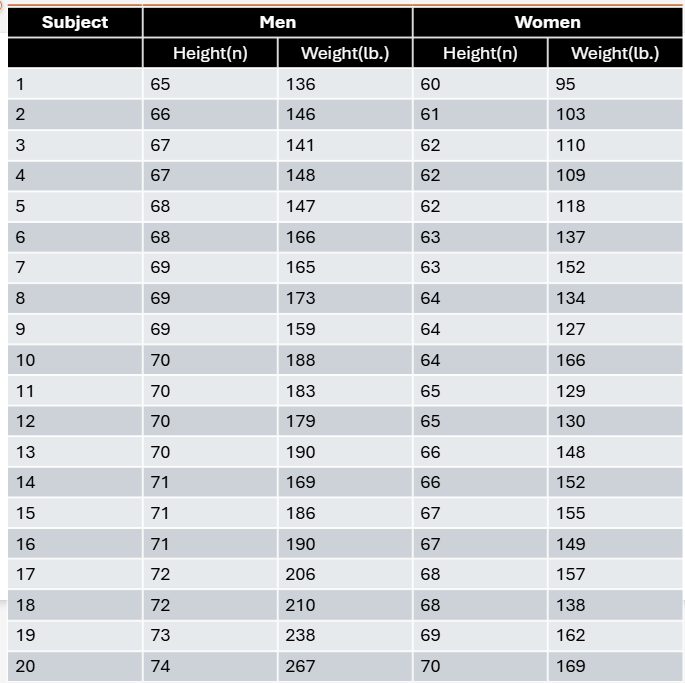
A total of 20 men and 20 women volunteer to participate in a statistics project. The height and weight of each subject are given in the table. Calculate the mean, variance, and standard deviation for height and weight in men and women.

Verified step by step guidance
1
Organize the data by separating the height and weight values for men and women into four distinct groups: men's heights, men's weights, women's heights, and women's weights.
Calculate the mean (average) for each group using the formula: mean = xn, where x represents each individual measurement and n is the number of individuals (20 in this case).
Compute the variance for each group by first finding the squared difference between each measurement and the mean, then averaging these squared differences using the formula: variance = x - mean2n.
Determine the standard deviation for each group by taking the square root of the variance, expressed as: standard deviation = √variance.
Summarize the results by listing the mean, variance, and standard deviation for height and weight separately for men and women, ensuring clarity in the presentation of each statistical measure.

Verified video answer for a similar problem:

This video solution was recommended by our tutors as helpful for the problem above.
Video duration:
1m
Was this helpful?

Key Concepts

Here are the essential concepts you must grasp in order to answer the question correctly.

Mean

The mean is the average value of a data set, calculated by summing all observations and dividing by the number of observations. It provides a measure of central tendency, representing the typical value in the data, such as average height or weight.
Recommended video:
Guided course
11:06
Mathematical Measurements

Variance

Variance measures the spread or dispersion of data points around the mean. It is calculated as the average of the squared differences between each data point and the mean, indicating how much the values vary within the group.
Recommended video:
Guided course
08:34
Analyzing Trait Variance

Standard Deviation

Standard deviation is the square root of the variance and expresses data variability in the same units as the original measurements. It quantifies the typical distance of data points from the mean, helping to understand the consistency of height or weight within men or women.
Recommended video:
Guided course
11:06
Mathematical Measurements
Related Practice
Textbook Question

A three-gene system of additive genes (A, B, and C) controls plant height. Each gene has two alleles (A and a, B and b, and C and c). There is dominance among the alleles of each gene, with alleles A, B, and C dominant over a, b, and c. Under this scheme, the dominant genotype for a gene contributes 10 cm to height potential, and the recessive genotype contributes 4 cm. What is the height potential of a plant that is homozygous for all three dominant alleles?

837
views
Textbook Question

Congenital dislocation of the hip is a threshold condition in which the head of the femur (the femoral head) is out of its normal position relative to the bones that will form the socket of the hip (the acetabulum). This misplacement can lead to potentially serious orthopedic problems later in life if the condition is not treated in infancy. Numerous studies have shown that:

(a) Brothers and sisters of infants born with congenital hip dislocation are more likely to develop the condition than are the siblings of those without the condition. These studies also find that

(b) More female infants than male infants have the trait, and

(c) If the affected child is a girl, the risk to her siblings is lower than if the affected infant is a boy.

Explain the meaning of the three observations (a, b, and c) in the context of proposing a threshold model that explains these observations.

392
views
Textbook Question

A total of 20 men and 20 women volunteer to participate in a statistics project. The height and weight of each subject are given in the table. Draw one histogram for the height of the subjects and a separate histogram for weight. Use different colors for men and women so that you can visually compare the distributions by sex and plot weights in 10-lb intervals (i.e., 90–99 lb, 100–109 lb, 110–119 lb, etc.).

449
views
Textbook Question

A total of 20 men and 20 women volunteer to participate in a statistics project. The height and weight of each subject are given in the table. Compare the numerical values with the visual distribution of heights and weights you drew in the histograms and describe whether you think your visual impression matches the numerical values.

393
views