

Pearson+ LogoPearson+ Logo
Ch. 19 - Genetic Analysis of Quantitative Traits
Sanders - Genetic Analysis: An Integrated Approach 3rd Edition
Sanders3rd EditionGenetic Analysis: An Integrated ApproachISBN: 9780135564172Not the one you use?Change textbook
Chapter 19, Problem 18

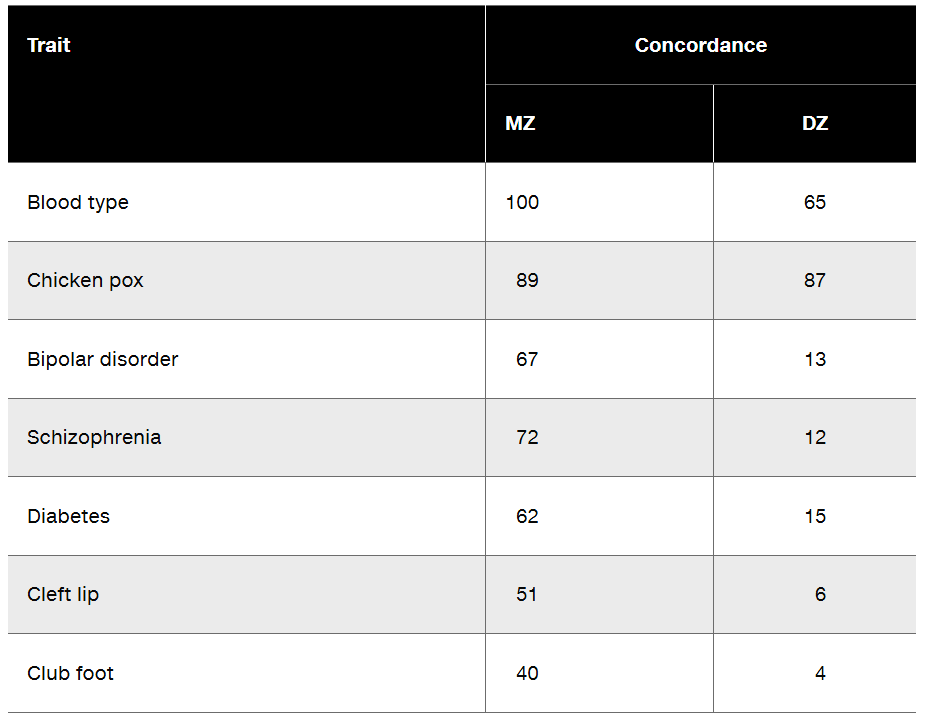
In studies of human MZ and DZ twin pairs of the same sex who are reared together, the following concordance values are identified for various traits. Based on the values shown, describe the relative importance of genes versus the influence of environmental factors for each trait.
Table displaying concordance values for various traits in MZ and DZ twin pairs, highlighting genetic vs. environmental influences.

Verified step by step guidance
1
Step 1: Understand the concept of concordance rates. Concordance rates measure the likelihood that both individuals in a twin pair exhibit the same trait. Monozygotic (MZ) twins share nearly identical genetic material, while dizygotic (DZ) twins share about 50% of their genetic material. Comparing concordance rates between MZ and DZ twins helps determine the relative influence of genetic versus environmental factors.
Step 2: Analyze the concordance rates for each trait. Traits with high concordance in MZ twins compared to DZ twins suggest a stronger genetic influence. Conversely, traits with similar concordance rates in both MZ and DZ twins suggest a stronger environmental influence.
Step 3: Evaluate each trait individually. For example, blood type shows a concordance of 100% in MZ twins and 65% in DZ twins, indicating a strong genetic basis since blood type is determined entirely by inherited genes. Chicken pox, with concordance rates of 89% in MZ twins and 87% in DZ twins, suggests environmental factors play a larger role, as exposure to the virus is the primary determinant.
Step 4: Consider traits with significant differences in concordance rates between MZ and DZ twins. For example, bipolar disorder (67% MZ, 13% DZ), schizophrenia (72% MZ, 12% DZ), diabetes (62% MZ, 15% DZ), cleft lip (51% MZ, 6% DZ), and club foot (40% MZ, 4% DZ) all show much higher concordance in MZ twins, indicating a strong genetic component. However, environmental factors may still contribute to the development of these traits.
Step 5: Summarize findings. Traits like blood type are almost entirely genetically determined, while traits like chicken pox are primarily influenced by environmental factors. For traits such as bipolar disorder, schizophrenia, diabetes, cleft lip, and club foot, the data suggest a significant genetic influence, but environmental factors may also play a role in their expression.

Verified video answer for a similar problem:

This video solution was recommended by our tutors as helpful for the problem above.
Video duration:
4m
Was this helpful?

Key Concepts

Here are the essential concepts you must grasp in order to answer the question correctly.

Concordance Rates

Concordance rates refer to the likelihood that both twins in a pair exhibit the same trait. In twin studies, higher concordance rates in monozygotic (MZ) twins compared to dizygotic (DZ) twins suggest a stronger genetic influence on the trait. For example, a trait with a 100% concordance in MZ twins indicates a strong genetic component, while lower rates in DZ twins highlight the role of environmental factors.
Recommended video:
Guided course
03:03
New Alleles and Migration

Genetic vs. Environmental Influences

The distinction between genetic and environmental influences is crucial in understanding trait development. Genetic influences arise from inherited DNA, while environmental influences stem from external factors such as upbringing, lifestyle, and experiences. Analyzing concordance rates helps determine the relative contributions of these influences, with significant differences between MZ and DZ twins indicating a greater genetic role.
Recommended video:
Guided course
03:45
Descriptive Genetics

Twin Study Methodology

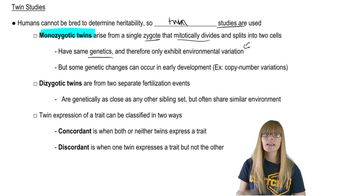
Twin studies are a research method used to assess the relative contributions of genetics and environment to various traits. By comparing MZ twins, who share nearly all their genes, with DZ twins, who share about 50%, researchers can infer the heritability of traits. This methodology allows for a clearer understanding of how much of a trait's variation is attributable to genetic factors versus environmental influences.
Recommended video:
Related Practice
Textbook Question

Two pure-breeding wheat strains, one producing dark red kernels and the other producing white kernels, are crossed to produce F₁ with pink kernel color. When an F₁ plant is self-fertilized and its seed collected and planted, the resulting F₂ consists of 160 plants with kernel colors as shown in the following table.

How many additive alleles are required to explain the five phenotypes seen in the F₂?

465
views
Textbook Question

Two pure-breeding wheat strains, one producing dark red kernels and the other producing white kernels, are crossed to produce F₁ with pink kernel color. When an F₁ plant is self-fertilized and its seed collected and planted, the resulting F₂ consists of 160 plants with kernel colors as shown in the following table.

Using clearly defined allele symbols of your choice, give genotypes for the parental strains and the F₁. Describe the genotypes that produce the different phenotypes in the F₂.

467
views
Textbook Question

Two pure-breeding wheat strains, one producing dark red kernels and the other producing white kernels, are crossed to produce F₁ with pink kernel color. When an F₁ plant is self-fertilized and its seed collected and planted, the resulting F₂ consists of 160 plants with kernel colors as shown in the following table.

If an F₁ plant is crossed to a dark red plant, what are the expected progeny phenotypes, and what is the expected proportion of each phenotype?

436
views
Textbook Question

During a visit, your grandparents comment on how tall you are compared with them. You tell them that in your genetics class, you learned that height in humans has high heritability, although environmental factors also influence adult height. You correctly explain the meaning of heritability, and your grandfather asks, 'How can height be highly heritable and still be influenced by the environment?' What explanation do you give your grandfather?

411
views
Textbook Question

An association of racehorse owners is seeking a new genetic strategy to improve the running speed of their horses. Traditional breeding of fast male and female horses has proven expensive and time-consuming, and the breeders are interested in an approach using quantitative trait loci as a basis for selecting breeding pairs of horses. Write a brief synopsis (∼50 words) of QTL mapping to explain how genes influencing running speed might be identified in horses.

421
views
Textbook Question

Applied to the study of the human genome, a goal of GWAS is to locate chromosome regions that are likely to contain genes influencing the risk of disease. Specific genes can be identified in these regions, and particular mutant alleles that increase disease risk can be sequenced. To date, the identification of alleles that increase disease risk has occasionally led to a new therapeutic strategy, but more often the identification of disease alleles is the only outcome.

From a physician's point of view, what is the value of being able to identify alleles that increase the risk of a particular disease?

374
views