Pearson+ LogoPearson+ Logo
Ch. 19 - Genetic Analysis of Quantitative Traits
Sanders - Genetic Analysis: An Integrated Approach 3rd Edition
Sanders3rd EditionGenetic Analysis: An Integrated ApproachISBN: 9780135564172Not the one you use?Change textbook
Chapter 19, Problem 17d

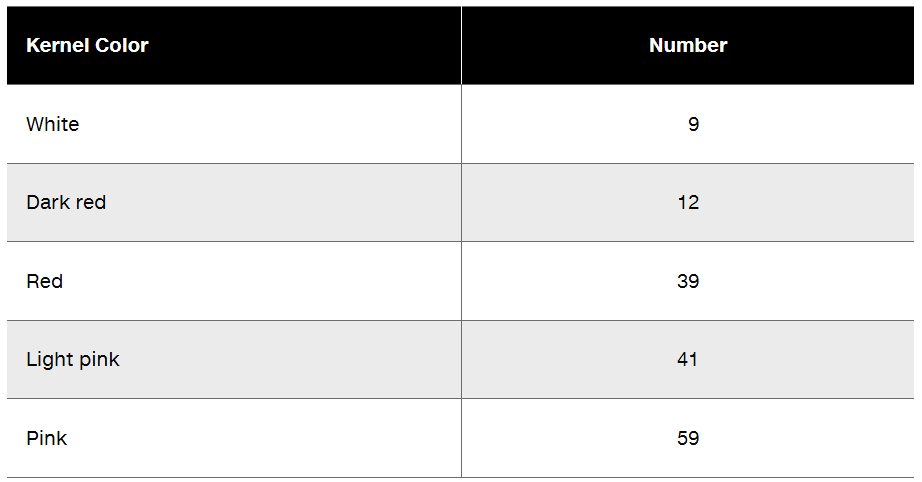
Two pure-breeding wheat strains, one producing dark red kernels and the other producing white kernels, are crossed to produce F₁ with pink kernel color. When an F₁ plant is self-fertilized and its seed collected and planted, the resulting F₂ consists of 160 plants with kernel colors as shown in the following table.
Table displaying the number of wheat plants by kernel color: white, dark red, red, light pink, and pink.
If an F₁ plant is crossed to a dark red plant, what are the expected progeny phenotypes, and what is the expected proportion of each phenotype?

Verified step by step guidance
1
Step 1: Understand the genetic basis of kernel color in wheat. The problem suggests that kernel color is controlled by multiple alleles, likely involving incomplete dominance or additive effects. The F₁ generation exhibits pink kernel color, which is intermediate between the dark red and white parental phenotypes, indicating incomplete dominance.
Step 2: Analyze the F₂ generation data. The phenotypic ratios in the F₂ generation (White: 9, Dark red: 12, Red: 39, Light pink: 41, Pink: 59) suggest that kernel color is influenced by two or more genes, each contributing to the phenotype. Assign genotypes to each phenotype based on the observed ratios and inheritance pattern.
Step 3: Determine the genetic makeup of the F₁ plant and the dark red plant. The F₁ plant is heterozygous for the alleles controlling kernel color, while the dark red plant is homozygous for the alleles producing the dark red phenotype. Represent these genotypes symbolically (e.g., AaBb for F₁ and AABB for dark red).
Step 4: Predict the progeny phenotypes and proportions when the F₁ plant is crossed with the dark red plant. Use a Punnett square to calculate the possible combinations of alleles in the offspring. Consider the contribution of each gene to the phenotype and the dominance relationships between alleles.
Step 5: Translate the genotypic combinations into phenotypic categories. Based on the inheritance pattern, assign phenotypes (e.g., dark red, red, pink, etc.) to each genotype and calculate the expected proportions of each phenotype in the progeny. Ensure the proportions align with Mendelian inheritance principles.

Verified video answer for a similar problem:

This video solution was recommended by our tutors as helpful for the problem above.
Video duration:
3m
Was this helpful?

Key Concepts

Here are the essential concepts you must grasp in order to answer the question correctly.

Mendelian Inheritance

Mendelian inheritance refers to the principles of heredity established by Gregor Mendel, which include the concepts of dominant and recessive traits. In this scenario, the dark red kernel color is likely dominant over white, while pink is an intermediate phenotype. Understanding these principles helps predict the inheritance patterns of traits in offspring.
Recommended video:
Guided course
05:13
Organelle Inheritance

Phenotypic Ratios

Phenotypic ratios describe the relative frequencies of different phenotypes in the offspring of a genetic cross. In this case, the F₂ generation's phenotypic ratio can be analyzed to determine the expected proportions of each kernel color. This ratio is crucial for predicting the outcomes of further crosses, such as the F₁ crossed with a dark red plant.
Recommended video:
Guided course
10:48
Mutations and Phenotypes

Punnett Square

A Punnett square is a diagram used to predict the genotypes and phenotypes of offspring from a genetic cross. By mapping the alleles of the parents, one can visualize the potential combinations in the progeny. This tool is essential for calculating the expected proportions of each phenotype when crossing the F₁ plant with a dark red plant.
Recommended video:
Guided course
18:27
Chi Square Analysis
Related Practice
Textbook Question

Two pure-breeding wheat strains, one producing dark red kernels and the other producing white kernels, are crossed to produce F₁ with pink kernel color. When an F₁ plant is self-fertilized and its seed collected and planted, the resulting F₂ consists of 160 plants with kernel colors as shown in the following table.

Based on the F₂ progeny, how many genes are involved in kernel color determination?

464
views
Textbook Question

Two pure-breeding wheat strains, one producing dark red kernels and the other producing white kernels, are crossed to produce F₁ with pink kernel color. When an F₁ plant is self-fertilized and its seed collected and planted, the resulting F₂ consists of 160 plants with kernel colors as shown in the following table.

How many additive alleles are required to explain the five phenotypes seen in the F₂?

465
views
Textbook Question

Two pure-breeding wheat strains, one producing dark red kernels and the other producing white kernels, are crossed to produce F₁ with pink kernel color. When an F₁ plant is self-fertilized and its seed collected and planted, the resulting F₂ consists of 160 plants with kernel colors as shown in the following table.

Using clearly defined allele symbols of your choice, give genotypes for the parental strains and the F₁. Describe the genotypes that produce the different phenotypes in the F₂.

467
views
Textbook Question

In studies of human MZ and DZ twin pairs of the same sex who are reared together, the following concordance values are identified for various traits. Based on the values shown, describe the relative importance of genes versus the influence of environmental factors for each trait.

484
views
Textbook Question

During a visit, your grandparents comment on how tall you are compared with them. You tell them that in your genetics class, you learned that height in humans has high heritability, although environmental factors also influence adult height. You correctly explain the meaning of heritability, and your grandfather asks, 'How can height be highly heritable and still be influenced by the environment?' What explanation do you give your grandfather?

411
views
Textbook Question

An association of racehorse owners is seeking a new genetic strategy to improve the running speed of their horses. Traditional breeding of fast male and female horses has proven expensive and time-consuming, and the breeders are interested in an approach using quantitative trait loci as a basis for selecting breeding pairs of horses. Write a brief synopsis (∼50 words) of QTL mapping to explain how genes influencing running speed might be identified in horses.

421
views