
Textbook Question
A woman expressing a dominant phenotype is heterozygous (Dd) for the gene.
Draw a pedigree that illustrates the transmission of the dominant trait from the grandmother to two of her grandchildren who are first cousins.
386
views

 Verified step by step guidance
 04:37
04:37
 05:15
05:15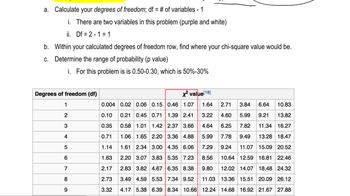 18:27
18:27A woman expressing a dominant phenotype is heterozygous (Dd) for the gene.
Draw a pedigree that illustrates the transmission of the dominant trait from the grandmother to two of her grandchildren who are first cousins.
A woman expressing a dominant phenotype is heterozygous (Dd) for the gene.
What is the probability that two grandchildren of the woman who are first cousins to one another will each inherit the dominant allele?
A male and a female are each heterozygous for both cystic fibrosis (CF) and phenylketonuria (PKU). Both conditions are autosomal recessive, and they assort independently.
What proportion of the children will have either PKU or CF but not both?
A male and a female are each heterozygous for both cystic fibrosis (CF) and phenylketonuria (PKU). Both conditions are autosomal recessive, and they assort independently.
What proportion of the children will be carriers of one or both conditions?
Dr. Ara B. Dopsis and Dr. C. Ellie Gans are performing genetic crosses on daisy plants. They self-fertilize a blue-flowered daisy and grow 100 progeny plants that consist of 55 blue-flowered plants, 22 purple-flowered plants, and 23 white-flowered plants. Dr. Dopsis believes this is the result of segregation of two alleles at one locus and that the progeny ratio is 1:2:1. Dr. Gans thinks the progeny phenotypes are the result of two epistatic genes and that the ratio is 9:3:4.
The two scientists ask you to resolve their conflict by performing chi-square analysis on the data for both proposed genetic mechanisms. For each proposed mechanism, fill in the values requested on the form the researchers have provided for your analysis.
Using any of the 100 progeny plants, propose a cross that will verify the conclusion you proposed in part (c). Plants may be self-fertilized, or one plant can be crossed to another. What result will be consistent with the 1:2:1 hypothesis? What result will be consistent with the 9:3:4 hypothesis?
Two parents who are each known to be carriers of an autosomal recessive allele have four children. None of the children has the recessive condition. What is the probability that one or more of the children is a carrier of the recessive allele?