Pearson+ LogoPearson+ Logo
Ch. 2 - Transmission Genetics
Sanders - Genetic Analysis: An Integrated Approach 3rd Edition
Sanders3rd EditionGenetic Analysis: An Integrated ApproachISBN: 9780135564172Not the one you use?Change textbook
Chapter 2, Problem 30b

A male and a female are each heterozygous for both cystic fibrosis (CF) and phenylketonuria (PKU). Both conditions are autosomal recessive, and they assort independently.
What proportion of the children will have either PKU or CF but not both?

Verified step by step guidance
1
Step 1: Understand the genetic basis of the problem. Both cystic fibrosis (CF) and phenylketonuria (PKU) are autosomal recessive conditions, meaning a child must inherit two recessive alleles (one from each parent) to express the condition. Since the traits assort independently, we can use the principles of Mendelian genetics and a Punnett square for each trait.
Step 2: Construct a Punnett square for CF. Each parent is heterozygous (genotype: Cc), where 'C' is the dominant allele and 'c' is the recessive allele. The possible offspring genotypes are CC, Cc, Cc, and cc. Only the 'cc' genotype results in CF.
Step 3: Construct a Punnett square for PKU. Each parent is heterozygous (genotype: Pp), where 'P' is the dominant allele and 'p' is the recessive allele. The possible offspring genotypes are PP, Pp, Pp, and pp. Only the 'pp' genotype results in PKU.
Step 4: Determine the probability of having either CF or PKU but not both. Use the principle of independent assortment to calculate the combined probabilities. First, calculate the probability of having CF (cc) and not PKU (not pp), then calculate the probability of having PKU (pp) and not CF (not cc). Add these probabilities together.
Step 5: Express the final proportion. The probabilities calculated in Step 4 represent the proportion of children who will have either CF or PKU but not both. Ensure the calculations account for all possible combinations of genotypes and their respective probabilities.

Verified video answer for a similar problem:

This video solution was recommended by our tutors as helpful for the problem above.
Video duration:
3m
Was this helpful?

Key Concepts

Here are the essential concepts you must grasp in order to answer the question correctly.

Autosomal Recessive Inheritance

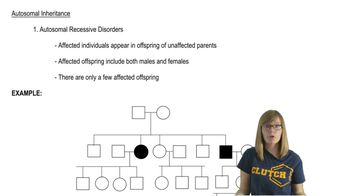
Autosomal recessive inheritance refers to a pattern where two copies of a mutated gene, one from each parent, are necessary for an individual to express a trait or disorder. In the case of cystic fibrosis (CF) and phenylketonuria (PKU), both conditions require that an individual inherits two recessive alleles to exhibit symptoms. If an individual has one normal and one mutated allele, they are carriers but do not show the disease.
Recommended video:
Guided course
09:08
Autosomal Pedigrees

Independent Assortment

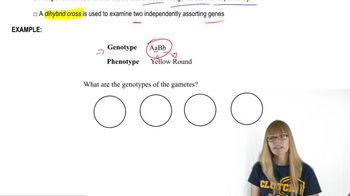
Independent assortment is a genetic principle stating that alleles for different traits segregate independently of one another during gamete formation. This means that the inheritance of one trait, such as CF, does not influence the inheritance of another trait, like PKU. This principle allows for a variety of genetic combinations in offspring, which is crucial for calculating probabilities in genetic crosses.
Recommended video:
Guided course
04:58
Gamete Genetics and Independent Assortment

Punnett Square

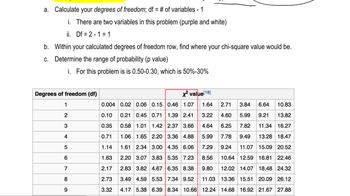
A Punnett square is a diagram used to predict the genetic outcomes of a cross between two individuals. By organizing the possible gametes from each parent, it allows for the visualization of potential genotypes and phenotypes of the offspring. In this scenario, a Punnett square can help determine the proportions of children who will inherit either PKU or CF, but not both, by analyzing the combinations of alleles from the heterozygous parents.
Recommended video:
Guided course
18:27
Chi Square Analysis
Related Practice
Textbook Question

In tomato plants, the production of red fruit color is under the control of an allele R. Yellow tomatoes are rr. The dominant phenotype for fruit shape is under the control of an allele T, which produces two lobes. Multilobed fruit, the recessive phenotype, has the genotype tt. Two different crosses are made between parental plants of unknown genotype and phenotype. Use the progeny phenotype ratios to determine the genotypes and phenotypes of each parent.

 Cross 1 progeny:

3/8 two-lobed, Red

                    3/8 two-lobed, yellow

                    1/8 multilobed, Red

                    1/8 multilobed, Yellow

 Cross 2 progeny:

1/4 two-lobed, Red

                     1/4 two-lobed, yellow

                     1/4 multilobed, Red

                     1/4 multilobed, yellow

709
views
Textbook Question

During your work as a laboratory assistant in the research facilities of Dr. O. Sophila, a world-famous geneticist, you come across an unusual bottle of fruit flies. All the flies in the bottle appear normal when they are in an incubator set at 22°C. When they are moved to a 30°C incubator, however, a few of the flies slowly become paralyzed; and after about 20 to 30 minutes, they are unable to move. Returning the flies to 22°C restores their ability to move after about 30 to 45 minutes.

With Dr. Sophila's encouragement, you set up 10 individual crosses between single male and female flies that exhibit the unusual behavior. Among 812 progeny, 598 exhibit the unusual behavior and 214 do not. When you leave one of the test bottles in the 30°C incubator too long, you discover that more than 2 hours at high temperature kills the paralyzed flies. When you tell this to Dr. Sophila, he says, 'Aha! I know how to explain this condition.' What is his explanation?

393
views
Textbook Question

A male and a female are each heterozygous for both cystic fibrosis (CF) and phenylketonuria (PKU). Both conditions are autosomal recessive, and they assort independently.

What proportion of the children of this couple will have neither condition?

1080
views
Textbook Question

A male and a female are each heterozygous for both cystic fibrosis (CF) and phenylketonuria (PKU). Both conditions are autosomal recessive, and they assort independently.

What proportion of the children will be carriers of one or both conditions?

488
views
Textbook Question

Dr. Ara B. Dopsis and Dr. C. Ellie Gans are performing genetic crosses on daisy plants. They self-fertilize a blue-flowered daisy and grow 100 progeny plants that consist of 55 blue-flowered plants, 22 purple-flowered plants, and 23 white-flowered plants. Dr. Dopsis believes this is the result of segregation of two alleles at one locus and that the progeny ratio is 1:2:1. Dr. Gans thinks the progeny phenotypes are the result of two epistatic genes and that the ratio is 9:3:4.

The two scientists ask you to resolve their conflict by performing chi-square analysis on the data for both proposed genetic mechanisms. For each proposed mechanism, fill in the values requested on the form the researchers have provided for your analysis.


Using any of the 100 progeny plants, propose a cross that will verify the conclusion you proposed in part (c). Plants may be self-fertilized, or one plant can be crossed to another. What result will be consistent with the 1:2:1 hypothesis? What result will be consistent with the 9:3:4 hypothesis?

515
views
Textbook Question

A woman expressing a dominant phenotype is heterozygous (Dd) for the gene.


What is the probability that the dominant allele carried by the woman will be inherited by a grandchild?

524
views