Pearson+ LogoPearson+ Logo
Ch. 2 - Transmission Genetics
Sanders - Genetic Analysis: An Integrated Approach 3rd Edition
Sanders3rd EditionGenetic Analysis: An Integrated ApproachISBN: 9780135564172Not the one you use?Change textbook
Chapter 2, Problem 32

Two parents who are each known to be carriers of an autosomal recessive allele have four children. None of the children has the recessive condition. What is the probability that one or more of the children is a carrier of the recessive allele?

Verified step by step guidance
1
Determine the genotype of the parents. Since both parents are carriers of an autosomal recessive allele, their genotypes are heterozygous (Aa).
Use a Punnett square to calculate the probabilities of the offspring's genotypes. Cross Aa (parent 1) with Aa (parent 2). The resulting genotypes are: 25% AA (homozygous dominant), 50% Aa (heterozygous carrier), and 25% aa (homozygous recessive).
Since none of the children has the recessive condition, the probability of each child being aa (homozygous recessive) is excluded. This means the possible genotypes for each child are either AA or Aa.
Calculate the probability of a child being a carrier (Aa). From the Punnett square, the probability of being Aa is 50%, and the probability of being AA is 50%. Since aa is excluded, the probabilities are normalized: P(Aa) = 50% / (50% + 50%) = 50%.
To find the probability that one or more of the four children is a carrier, use the complement rule. First, calculate the probability that none of the children is a carrier (all are AA). Then subtract this value from 1 to find the probability of at least one child being a carrier.

Verified video answer for a similar problem:

This video solution was recommended by our tutors as helpful for the problem above.
Video duration:
1m
Was this helpful?

Key Concepts

Here are the essential concepts you must grasp in order to answer the question correctly.

Autosomal Recessive Inheritance

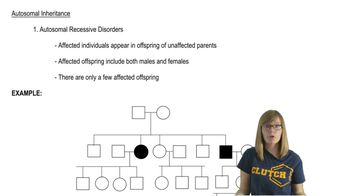
Autosomal recessive inheritance occurs when a trait or condition is expressed only when an individual has two copies of a recessive allele. Carriers, who possess one dominant and one recessive allele, do not exhibit the condition but can pass the recessive allele to their offspring. In this scenario, both parents are carriers, meaning each child has a chance of inheriting the recessive allele.
Recommended video:
Guided course
09:08
Autosomal Pedigrees

Punnett Square

A Punnett square is a diagram used to predict the genetic makeup of offspring from two parents. By arranging the alleles of each parent, it allows for the visualization of possible combinations in their children. In this case, a Punnett square can help determine the probabilities of the children being carriers or expressing the recessive condition.
Recommended video:
Guided course
18:27
Chi Square Analysis

Probability of Inheritance

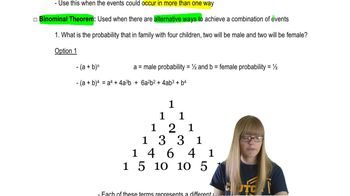
The probability of inheritance refers to the likelihood that a specific genetic trait will be passed from parents to offspring. In the context of this question, it involves calculating the chances that at least one of the four children inherits the recessive allele from the carrier parents. This can be determined using the probabilities derived from the Punnett square.
Recommended video: