Pearson+ LogoPearson+ Logo
Ch. 2 - Transmission Genetics
Sanders - Genetic Analysis: An Integrated Approach 3rd Edition
Sanders3rd EditionGenetic Analysis: An Integrated ApproachISBN: 9780135564172Not the one you use?Change textbook
Chapter 2, Problem 46a

Alleles of the IGF-1 gene in dogs, encoding insulin-like growth factor, largely determine whether a domestic dog will be large or small. Dogs with an ancestral dominant allele are large, whereas dogs homozygous for the mutant recessive allele are small. Chondrodysplasia, a short-legged phenotype (as in dachshunds and basset hounds), is caused by a dominant gain-of-function allele of the FGF4 gene. The MSTN gene encodes myostatin, a regulator of muscle development. Dogs with a dominant ancestral allele of the MTSN gene have normal muscle development, while dogs homozygous for recessive mutants in the MTSN gene are 'double muscled' and have trouble running quickly. However, dogs heterozygous for the mutant allele run faster than either of the homozygotes.
You breed a pure-breeding small basset hound of normal musculature with a pure-breeding 'bully' whippet, a double-muscled large dog with normal legs.
What are the genotypes and phenotypes of the F₁ puppies?

Verified step by step guidance
1
Identify the genotypes of the parent dogs based on the problem description. The small basset hound is homozygous recessive for the IGF-1 gene (small size), homozygous dominant for the FGF4 gene (short legs), and homozygous dominant for the MSTN gene (normal musculature). The 'bully' whippet is homozygous dominant for the IGF-1 gene (large size), homozygous recessive for the FGF4 gene (normal legs), and homozygous recessive for the MSTN gene (double-muscled).
Determine the gametes produced by each parent. The basset hound can only produce gametes with the alleles for small size (igf-1), short legs (FGF4), and normal musculature (MSTN). The whippet can only produce gametes with the alleles for large size (IGF-1), normal legs (fgf4), and double-muscled (mstn).
Combine the alleles from the gametes of each parent to determine the genotypes of the F₁ puppies. Each F₁ puppy will inherit one allele from each parent for each gene. For the IGF-1 gene, the puppies will be heterozygous (IGF-1/igf-1). For the FGF4 gene, the puppies will also be heterozygous (FGF4/fgf4). For the MSTN gene, the puppies will be heterozygous (MSTN/mstn).
Determine the phenotypes of the F₁ puppies based on their genotypes. For the IGF-1 gene, heterozygous puppies will be large because the dominant allele (IGF-1) determines size. For the FGF4 gene, heterozygous puppies will have short legs because the dominant allele (FGF4) causes chondrodysplasia. For the MSTN gene, heterozygous puppies will run faster than either homozygote because of the heterozygote advantage.
Summarize the genotypes and phenotypes of the F₁ puppies. The genotypes will be IGF-1/igf-1, FGF4/fgf4, and MSTN/mstn. The phenotypes will be large size, short legs, and faster running ability due to the heterozygote advantage in the MSTN gene.

Verified video answer for a similar problem:

This video solution was recommended by our tutors as helpful for the problem above.
Video duration:
3m
Was this helpful?

Key Concepts

Here are the essential concepts you must grasp in order to answer the question correctly.

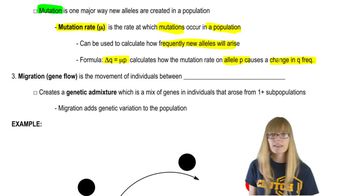
Alleles and Genotypes

Alleles are different versions of a gene that can exist at a specific locus on a chromosome. In this context, the genotypes refer to the genetic makeup of the dogs, specifically the combinations of alleles they possess for the IGF-1, FGF4, and MSTN genes. Understanding how dominant and recessive alleles interact is crucial for predicting the phenotypes of the offspring.
Recommended video:
Guided course
03:03
New Alleles and Migration

Phenotypes and Inheritance Patterns

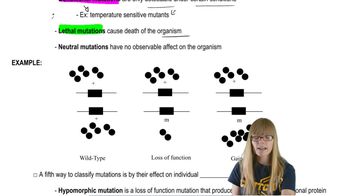
Phenotypes are the observable traits of an organism, influenced by its genotype and environmental factors. In this scenario, the phenotypes of the F₁ puppies will depend on the dominant and recessive alleles inherited from their parents. Recognizing the inheritance patterns, such as dominant gain-of-function and recessive loss-of-function traits, is essential for predicting the traits of the offspring.
Recommended video:
Guided course
10:48
Mutations and Phenotypes

Mendelian Genetics

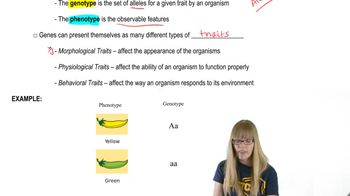
Mendelian genetics is the study of how traits are passed from parents to offspring through the inheritance of alleles. It includes principles such as segregation and independent assortment, which help explain how different traits can be inherited together. Applying these principles to the breeding scenario allows for the prediction of the genotypes and phenotypes of the F₁ puppies based on the parental genotypes.
Recommended video:
Guided course
03:45
Descriptive Genetics
Related Practice
Textbook Question

Situs inversus is a congenital condition in which the major visceral organs are reversed from their normal positions. Investigations into the genetics of this abnormality revealed that individuals with at least one dominant allele (SI) of an autosomal gene are normal but, surprisingly, of individuals that are homozygous for a recessive allele (si), 1/2 are situs inversus and 1/2 are normal.


What genotypes and phenotypes are expected in progeny from a cross of two SI si individuals?

565
views
Textbook Question

Domestic dogs evolved from ancestral gray wolves. Wolves have coats of short, straight hair and lack 'furnishings,' a growth pattern marked by eyebrows and a mustache found in some domestic dogs. In domestic dogs, coat variation is controlled by allelic variation in three genes. Recessive mutant alleles in the FGF5 gene result in long hair, while dogs carrying the dominant ancestral allele have short hair. Likewise, recessive mutant alleles in the KRT71 gene result in curly hair, whereas dogs with an ancestral dominant allele have straight hair. Dominant mutant alleles in the RSPO2 gene cause the presence of furnishings, while dogs homozygous for the ancestral recessive allele have no furnishings. A pure-breeding curly- and long-haired poodle with furnishings was crossed to a pure-breeding short- and straight-haired border collie lacking furnishings


What are the genotypes and phenotypes of the puppies?

508
views
Textbook Question

Domestic dogs evolved from ancestral gray wolves. Wolves have coats of short, straight hair and lack 'furnishings,' a growth pattern marked by eyebrows and a mustache found in some domestic dogs. In domestic dogs, coat variation is controlled by allelic variation in three genes. Recessive mutant alleles in the FGF5 gene result in long hair, while dogs carrying the dominant ancestral allele have short hair. Likewise, recessive mutant alleles in the KRT71 gene result in curly hair, whereas dogs with an ancestral dominant allele have straight hair. Dominant mutant alleles in the RSPO2 gene cause the presence of furnishings, while dogs homozygous for the ancestral recessive allele have no furnishings. A pure-breeding curly- and long-haired poodle with furnishings was crossed to a pure-breeding short- and straight-haired border collie lacking furnishings


If dogs of the F₁ generation are interbred, what proportions of genotypes and phenotypes are expected in the F₂?

510
views
Textbook Question

Alleles of the IGF-1 gene in dogs, encoding insulin-like growth factor, largely determine whether a domestic dog will be large or small. Dogs with an ancestral dominant allele are large, whereas dogs homozygous for the mutant recessive allele are small. Chondrodysplasia, a short-legged phenotype (as in dachshunds and basset hounds), is caused by a dominant gain-of-function allele of the FGF4 gene. The MSTN gene encodes myostatin, a regulator of muscle development. Dogs with a dominant ancestral allele of the MTSN gene have normal muscle development, while dogs homozygous for recessive mutants in the MTSN gene are 'double muscled' and have trouble running quickly. However, dogs heterozygous for the mutant allele run faster than either of the homozygotes.

You breed a pure-breeding small basset hound of normal musculature with a pure-breeding 'bully' whippet, a double-muscled large dog with normal legs.

If the F₁ of this cross is interbred, what proportion of the F₂ are expected to be fast runners and what proportion normal-speed runners?

439
views
Textbook Question

The accompanying pedigree shows a family in which one child (II-1) has an autosomal recessive condition. On the basis of this fact alone, provide the following information.

Using A for the dominant allele and a for the recessive allele, give the genotypes for I-1, I-2, and II-1.

1317
views
Textbook Question

The accompanying pedigree shows a family in which one child (II-1) has an autosomal recessive condition. On the basis of this fact alone, provide the following information.

Using the same alleles, give the possible genotypes for II-2, II-3, and II-4.

775
views