Pearson+ LogoPearson+ Logo
Ch. 2 - Transmission Genetics
Sanders - Genetic Analysis: An Integrated Approach 3rd Edition
Sanders3rd EditionGenetic Analysis: An Integrated ApproachISBN: 9780135564172Not the one you use?Change textbook
Chapter 2, Problem 6b

Consider the cross AaBbCC × AABbCc.
Use a Punnett square to predict the expected ratio of offspring phenotypes.

Verified step by step guidance
1
Step 1: Identify the genotypes of the parents. Parent 1 has the genotype AaBbCC, and Parent 2 has the genotype AABbCc. Each gene pair represents alleles for a specific trait.
Step 2: Determine the possible gametes for each parent. For Parent 1 (AaBbCC), the possible gametes are ABC, AbC, aBC, and abC. For Parent 2 (AABbCc), the possible gametes are ABC, ABc, AbC, and Abc.
Step 3: Construct a Punnett square. Create a grid where the rows represent the gametes of Parent 1 and the columns represent the gametes of Parent 2. Fill in each cell with the combination of alleles from the corresponding row and column.
Step 4: Analyze the offspring genotypes in the Punnett square. For each cell, determine the genotype of the offspring by combining the alleles from the gametes. For example, a cell might contain AaBbCc.
Step 5: Predict the phenotypic ratios. Based on the dominance and recessiveness of the alleles, determine the phenotype for each genotype. Count the occurrences of each phenotype in the Punnett square to calculate the expected ratio of offspring phenotypes.

Verified video answer for a similar problem:

This video solution was recommended by our tutors as helpful for the problem above.
Video duration:
2m
Was this helpful?

Key Concepts

Here are the essential concepts you must grasp in order to answer the question correctly.

Punnett Square

A Punnett square is a diagram used to predict the genotypes of offspring from a genetic cross. It organizes the possible combinations of alleles from each parent, allowing for a visual representation of inheritance patterns. By filling in the squares with the alleles from each parent, one can easily determine the expected ratios of different genotypes and phenotypes in the offspring.
Recommended video:
Guided course
18:27
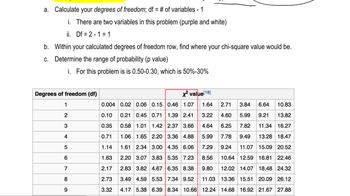
Chi Square Analysis

Genotype and Phenotype

Genotype refers to the genetic makeup of an organism, specifically the alleles it possesses for a particular gene. Phenotype, on the other hand, is the observable physical or biochemical characteristics of an organism, which result from the interaction of its genotype with the environment. Understanding the distinction between these two concepts is crucial for predicting how traits will be expressed in the offspring.
Recommended video:
Guided course
07:52
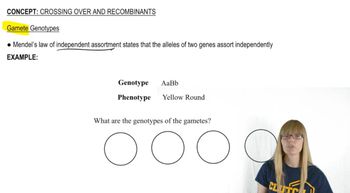
Gamete Genotypes

Mendelian Inheritance

Mendelian inheritance is the set of principles that describe how traits are passed from parents to offspring through alleles. It includes concepts such as dominance, segregation, and independent assortment. These principles help in predicting the ratios of different phenotypes in offspring, especially when dealing with multiple traits, as seen in the cross provided in the question.
Recommended video:
Guided course
05:13
Organelle Inheritance