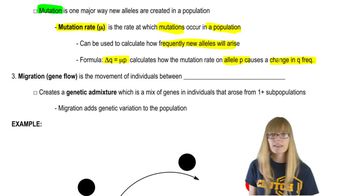
Two populations of deer, one of them large and living in a mainland forest and the other small and inhabiting a forest on an island, regularly exchange members that migrate across a land bridge that connects the island to the mainland. If you compared the allele frequencies in the two populations, what would you expect to find?

Sanders 3rd Edition
Ch. 20 - Population Genetics and Evolution at the Population, Species, and Molecular Levels
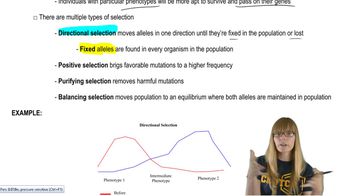
Problem 14Directional selection presents an apparent paradox. By favoring one allele and disfavoring others, directional selection can lead to fixation (a frequency of 1.0) of the favored allele, after which there is no genetic variation at the locus, and its evolution stops. Explain why directional selection no longer operates in populations after the favored allele reaches fixation.
Verified step by step guidance
Verified video answer for a similar problem:
Key Concepts
Directional Selection
Fixation of Alleles
Genetic Variation and Evolution
Two populations of deer, one of them large and living in a mainland forest and the other small and inhabiting a forest on an island, regularly exchange members that migrate across a land bridge that connects the island to the mainland. An earthquake destroys the bridge between the island and the mainland, making migration impossible for the deer. What do you expect will happen to allele frequencies in the two populations over the following 10 generations?
Two populations of deer, one of them large and living in a mainland forest and the other small and inhabiting a forest on an island, regularly exchange members that migrate across a land bridge that connects the island to the mainland. In which population do you expect to see the greatest allele frequency change? Why?
Certain animal species, such as the black-footed ferret, are nearly extinct and currently exist only in captive populations. Other species, such as the panda, are also threatened but exist in the wild thanks to intensive captive breeding programs. What strategies would you suggest in the case of black-footed ferrets and in the case of pandas to monitor and minimize inbreeding depression?
Genetic Analysis 20.1 predicts the number of individuals expected to have the blood group genotypes MM, MN, and NN. Perform a chi-square analysis using the number of people observed and expected in each blood-type category, and state whether the sample is in H-W equilibrium.