

Pearson+ LogoPearson+ Logo
Ch. 20 - Population Genetics and Evolution at the Population, Species, and Molecular Levels
Sanders - Genetic Analysis: An Integrated Approach 3rd Edition
Sanders3rd EditionGenetic Analysis: An Integrated ApproachISBN: 9780135564172Not the one you use?Change textbook
Chapter 20, Problem 17

Genetic Analysis 20.1 predicts the number of individuals expected to have the blood group genotypes MM, MN, and NN. Perform a chi-square analysis using the number of people observed and expected in each blood-type category, and state whether the sample is in H-W equilibrium.

Verified step by step guidance
1
Step 1: Begin by calculating the allele frequencies for the M and N alleles. Use the observed genotype counts to determine the frequency of each allele. For example, if the observed counts are given for MM, MN, and NN, calculate the frequency of M as (2 * MM count + MN count) / (2 * total individuals) and the frequency of N as 1 - frequency of M.
Step 2: Use the Hardy-Weinberg equilibrium principle to calculate the expected genotype frequencies. The expected frequency of MM is p^2, the expected frequency of MN is 2pq, and the expected frequency of NN is q^2, where p is the frequency of the M allele and q is the frequency of the N allele.
Step 3: Multiply the expected genotype frequencies by the total number of individuals in the sample to calculate the expected counts for each genotype (MM, MN, NN). For example, expected count for MM = p^2 * total individuals.
Step 4: Perform the chi-square analysis using the formula χ² = Σ((observed - expected)^2 / expected), where the summation is over all genotype categories (MM, MN, NN). For each genotype, calculate the difference between the observed and expected counts, square it, divide by the expected count, and sum these values.
Step 5: Compare the calculated chi-square value to the critical value from the chi-square distribution table at the appropriate degrees of freedom (df = number of categories - 1) and significance level (commonly 0.05). If the chi-square value is less than the critical value, the sample is in Hardy-Weinberg equilibrium; otherwise, it is not.

Verified video answer for a similar problem:

This video solution was recommended by our tutors as helpful for the problem above.
Video duration:
3m
Was this helpful?

Key Concepts

Here are the essential concepts you must grasp in order to answer the question correctly.

Blood Group Genotypes

Blood group genotypes refer to the genetic variations that determine an individual's blood type, specifically the presence of alleles M and N. The genotypes MM, MN, and NN correspond to different combinations of these alleles, which are inherited from parents. Understanding these genotypes is crucial for predicting the distribution of blood types in a population.
Recommended video:
Guided course
07:52
Gamete Genotypes

Chi-Square Analysis

Chi-square analysis is a statistical method used to compare observed data with expected data to determine if there is a significant difference between them. In genetics, it helps assess whether the distribution of genotypes in a sample fits the expected ratios under Hardy-Weinberg equilibrium. The chi-square statistic is calculated using the formula: χ² = Σ((O - E)² / E), where O is the observed frequency and E is the expected frequency.
Recommended video:
Guided course
02:48
Chi Square Analysis

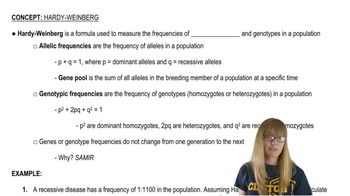
Hardy-Weinberg Equilibrium

Hardy-Weinberg equilibrium is a principle that describes the genetic variation in a population that remains constant from one generation to the next in the absence of evolutionary influences. For a population to be in H-W equilibrium, certain conditions must be met, including no mutation, random mating, no gene flow, infinite population size, and no selection. Deviations from this equilibrium can indicate evolutionary changes or influences affecting the population.
Recommended video:
Guided course
13:04
Hardy Weinberg
Related Practice
Textbook Question
Directional selection presents an apparent paradox. By favoring one allele and disfavoring others, directional selection can lead to fixation (a frequency of 1.0) of the favored allele, after which there is no genetic variation at the locus, and its evolution stops. Explain why directional selection no longer operates in populations after the favored allele reaches fixation.
460
views
Textbook Question
What is inbreeding depression? Why is inbreeding depression a serious concern for animal biologists involved in species-conservation breeding programs?
839
views
Textbook Question

Certain animal species, such as the black-footed ferret, are nearly extinct and currently exist only in captive populations. Other species, such as the panda, are also threatened but exist in the wild thanks to intensive captive breeding programs. What strategies would you suggest in the case of black-footed ferrets and in the case of pandas to monitor and minimize inbreeding depression?

579
views
Textbook Question

In a population of rabbits, f(C₁) = 0.70 and f(C₂) = 0.30. The alleles exhibit an incomplete dominance relationship in which C₁C₁ produces black rabbits, C₁C₂ produces tan-colored rabbits, and C₂C₂ produces rabbits with white fur. If the assumptions of the Hardy–Weinberg principle apply to the rabbit population, what are the expected frequencies of black, tan, and white rabbits?

850
views
Textbook Question

Sickle cell disease (SCD) is found in numerous populations whose ancestral homes are in the malaria belt of Africa and Asia. SCD is an autosomal recessive disorder that results from homozygosity for a mutant β-globin gene allele. Data on one affected population indicates that approximately 8 in 100 newborn infants have SCD.

What are the frequencies of the wild-type (βᴬ) and mutant (βˢ) alleles in this population?

572
views
Textbook Question

Sickle cell disease (SCD) is found in numerous populations whose ancestral homes are in the malaria belt of Africa and Asia. SCD is an autosomal recessive disorder that results from homozygosity for a mutant β-globin gene allele. Data on one affected population indicates that approximately 8 in 100 newborn infants have SCD.

What is the frequency of carriers of SCD in the population?

681
views