Pearson+ LogoPearson+ Logo
Ch. 20 - Population Genetics and Evolution at the Population, Species, and Molecular Levels
Sanders - Genetic Analysis: An Integrated Approach 3rd Edition
Sanders3rd EditionGenetic Analysis: An Integrated ApproachISBN: 9780135564172Not the one you use?Change textbook
Chapter 20, Problem 13a

Two populations of deer, one of them large and living in a mainland forest and the other small and inhabiting a forest on an island, regularly exchange members that migrate across a land bridge that connects the island to the mainland. If you compared the allele frequencies in the two populations, what would you expect to find?

Verified step by step guidance
1
Understand the concept of gene flow: Gene flow refers to the transfer of alleles or genes from one population to another. In this case, migration across the land bridge facilitates gene flow between the mainland and island deer populations.
Consider the size of the populations: The mainland population is large, while the island population is small. This difference in population size affects the impact of gene flow. Allele frequencies in the smaller island population are more likely to be influenced by incoming migrants from the mainland.
Analyze the effect of migration: Migration tends to homogenize allele frequencies between populations. Over time, the allele frequencies in the island and mainland populations will become more similar due to the regular exchange of individuals.
Account for genetic drift: In the smaller island population, genetic drift (random changes in allele frequencies) may have a stronger effect compared to the larger mainland population. However, gene flow from the mainland can counteract these random changes, stabilizing allele frequencies.
Predict the outcome: Given regular migration, you would expect the allele frequencies in the two populations to converge over time, becoming more similar. However, the rate of convergence depends on the migration rate and the relative sizes of the populations.

Verified video answer for a similar problem:

This video solution was recommended by our tutors as helpful for the problem above.
Video duration:
2m
Was this helpful?

Key Concepts

Here are the essential concepts you must grasp in order to answer the question correctly.

Allele Frequency

Allele frequency refers to how often a particular allele appears in a population compared to other alleles for the same gene. It is a key measure in population genetics, indicating genetic diversity and the potential for evolution. Changes in allele frequencies over time can signal evolutionary processes such as natural selection, genetic drift, or gene flow.
Recommended video:
Guided course
03:03
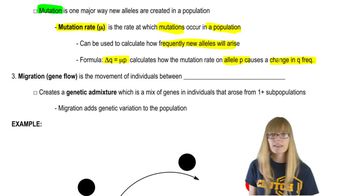
New Alleles and Migration

Gene Flow

Gene flow is the transfer of genetic material between populations through migration and interbreeding. In the context of the deer populations, the exchange of members across the land bridge allows for gene flow, which can alter allele frequencies by introducing new alleles or changing the proportions of existing ones. This process can reduce genetic differences between populations and increase genetic diversity.
Recommended video:
Guided course
09:09
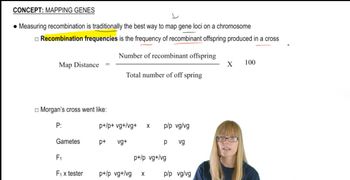
Mapping Genes

Population Structure

Population structure refers to the composition of a population in terms of genetic variation and how it is distributed among subpopulations. In this scenario, the mainland and island deer populations may exhibit different allele frequencies due to their distinct environments and sizes. However, regular migration can lead to homogenization of allele frequencies, making the populations more genetically similar over time.
Recommended video:
Guided course
03:49
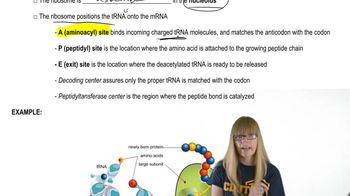
Ribosome Structure
Related Practice
Textbook Question

The ability to taste the bitter compound phenylthiocarbamide (PTC) is an autosomal dominant trait. The inability to taste PTC is a recessive condition. In a sample of 500 people, 360 have the ability to taste PTC and 140 do not. Calculate the frequency of each genotype.

1235
views
Textbook Question

The figure illustrates the effect of an ethanol-rich and an ethanol-free environment on the frequency of the Drosophila AdhF allele in four populations in a 50-generation laboratory experiment. Population 1 and population 2 were reared for 50 generations in a high-ethanol environment, while control 1 and control 2 populations were reared for 50 generations in a zero-ethanol environment. Describe the effect of each environment on the populations, and state any conclusions you can reach about the role of any of the evolutionary processes in producing these effects.

498
views
Textbook Question
Biologists have proposed that the use of antibiotics to treat human infectious disease has played a role in the evolution of widespread antibiotic resistance in several bacterial species, including Staphylococcus aureus and the bacteria causing gonorrhea, tuberculosis, and other infectious diseases. Explain how the evolutionary mechanisms mutation and natural selection may have contributed to the development of antibiotic resistance.
484
views
Textbook Question

Two populations of deer, one of them large and living in a mainland forest and the other small and inhabiting a forest on an island, regularly exchange members that migrate across a land bridge that connects the island to the mainland. An earthquake destroys the bridge between the island and the mainland, making migration impossible for the deer. What do you expect will happen to allele frequencies in the two populations over the following 10 generations?

455
views
Textbook Question

Two populations of deer, one of them large and living in a mainland forest and the other small and inhabiting a forest on an island, regularly exchange members that migrate across a land bridge that connects the island to the mainland. In which population do you expect to see the greatest allele frequency change? Why?

447
views
Textbook Question
Directional selection presents an apparent paradox. By favoring one allele and disfavoring others, directional selection can lead to fixation (a frequency of 1.0) of the favored allele, after which there is no genetic variation at the locus, and its evolution stops. Explain why directional selection no longer operates in populations after the favored allele reaches fixation.
460
views