Pearson+ LogoPearson+ Logo
Ch. 20 - Population Genetics and Evolution at the Population, Species, and Molecular Levels
Sanders - Genetic Analysis: An Integrated Approach 3rd Edition
Sanders3rd EditionGenetic Analysis: An Integrated ApproachISBN: 9780135564172Not the one you use?Change textbook
Chapter 20, Problem 22c

Tay–Sachs disease is an autosomal recessive neurological disorder that is fatal in infancy. Despite its invariably lethal effect, Tay–Sachs disease occurs at very high frequency in some Central and Eastern European (Ashkenazi) Jewish populations. In certain Ashkenazi populations, 1 in 750 infants has Tay–Sachs disease. Population biologists believe the high frequency is a consequence of genetic bottlenecks caused by pogroms (genocide) that have reduced the population multiple times in the past several hundred years. In the population described, what is the frequency of the recessive allele that produces Tay–Sachs disease?

Verified step by step guidance
1
Step 1: Recognize that Tay–Sachs disease is autosomal recessive, meaning individuals with the disease must inherit two copies of the recessive allele (homozygous recessive). The frequency of affected individuals in the population is given as 1 in 750. This corresponds to the genotype frequency of homozygous recessive individuals (q²).
Step 2: Use the Hardy-Weinberg equation to relate genotype frequencies to allele frequencies. The equation is: \( p^2 + 2pq + q^2 = 1 \), where \( q^2 \) represents the frequency of homozygous recessive individuals, \( q \) is the frequency of the recessive allele, and \( p \) is the frequency of the dominant allele. Start by setting \( q^2 = \frac{1}{750} \).
Step 3: Solve for \( q \), the frequency of the recessive allele, by taking the square root of \( q^2 \). This gives \( q = \sqrt{\frac{1}{750}} \).
Step 4: Once \( q \) is determined, you can also calculate \( p \), the frequency of the dominant allele, using the relationship \( p + q = 1 \). Rearrange to find \( p = 1 - q \).
Step 5: Interpret the result. The value of \( q \) represents the frequency of the recessive allele in the population, which is higher than expected due to historical genetic bottlenecks as described in the problem.

Verified video answer for a similar problem:

This video solution was recommended by our tutors as helpful for the problem above.
Video duration:
2m
Was this helpful?

Key Concepts

Here are the essential concepts you must grasp in order to answer the question correctly.

Autosomal Recessive Inheritance

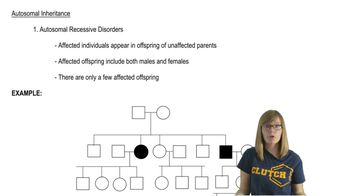
Tay-Sachs disease is inherited in an autosomal recessive manner, meaning that an individual must inherit two copies of the recessive allele (one from each parent) to express the disease. Carriers, who possess only one copy of the recessive allele, do not show symptoms but can pass the allele to their offspring. This inheritance pattern is crucial for understanding the genetic basis of the disease and its prevalence in certain populations.
Recommended video:
Guided course
09:08
Autosomal Pedigrees

Hardy-Weinberg Principle

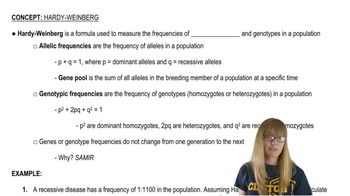
The Hardy-Weinberg principle provides a mathematical framework for understanding allele frequencies in a population at equilibrium. It states that allele and genotype frequencies will remain constant from generation to generation in the absence of evolutionary influences. This principle can be used to calculate the frequency of the recessive allele in the context of Tay-Sachs disease, given the prevalence of affected individuals in the population.
Recommended video:
Guided course
13:04
Hardy Weinberg

Genetic Bottleneck

A genetic bottleneck occurs when a population's size is significantly reduced for at least one generation, leading to a loss of genetic diversity. In the case of Ashkenazi Jews, historical events such as pogroms have caused such bottlenecks, resulting in a higher frequency of certain genetic disorders, including Tay-Sachs disease. Understanding this concept helps explain why certain alleles can become more common in specific populations due to historical demographic events.
Recommended video:
Guided course
03:45
Descriptive Genetics
Related Practice
Textbook Question

The frequency of tasters and nontasters of PTC varies among populations. In population A, 64% of people are tasters (an autosomal dominant trait) and 36% are nontasters. In population B, tasters are 75% and nontasters 25%. In population C, tasters are 91% and nontasters are 9%.

Assuming that Hardy–Weinberg conditions apply, determine the genotype frequencies in each population.

1286
views
Textbook Question

Tay–Sachs disease is an autosomal recessive neurological disorder that is fatal in infancy. Despite its invariably lethal effect, Tay–Sachs disease occurs at very high frequency in some Central and Eastern European (Ashkenazi) Jewish populations. In certain Ashkenazi populations, 1 in 750 infants has Tay–Sachs disease. Population biologists believe the high frequency is a consequence of genetic bottlenecks caused by pogroms (genocide) that have reduced the population multiple times in the past several hundred years. What is a genetic bottleneck?

800
views
Textbook Question

Tay–Sachs disease is an autosomal recessive neurological disorder that is fatal in infancy. Despite its invariably lethal effect, Tay–Sachs disease occurs at very high frequency in some Central and Eastern European (Ashkenazi) Jewish populations. In certain Ashkenazi populations, 1 in 750 infants has Tay–Sachs disease. Population biologists believe the high frequency is a consequence of genetic bottlenecks caused by pogroms (genocide) that have reduced the population multiple times in the past several hundred years. Explain how a genetic bottleneck and its aftermath could result in a population that carries a lethal allele in high frequency.

552
views
Textbook Question

Tay–Sachs disease is an autosomal recessive neurological disorder that is fatal in infancy. Despite its invariably lethal effect, Tay–Sachs disease occurs at very high frequency in some Central and Eastern European (Ashkenazi) Jewish populations. In certain Ashkenazi populations, 1 in 750 infants has Tay–Sachs disease. Population biologists believe the high frequency is a consequence of genetic bottlenecks caused by pogroms (genocide) that have reduced the population multiple times in the past several hundred years. Assuming mating occurs at random in this population, what is the probability a couple are both carriers of Tay–Sachs disease?

498
views
Textbook Question
Cystic fibrosis (CF) is the most common autosomal recessive disorder in certain Caucasian populations. In some populations, approximately 1 in 2000 children have CF. Determine the frequency of CF carriers in this population.
796
views
Textbook Question

In the mouse, Mus musculus, survival in agricultural fields that are regularly sprayed with a herbicide is determined by the genotype for a detoxification enzyme encoded by a gene with two alleles, F and S. The relative fitness values for the genotypes are

Why will this pattern of natural selection result in a stable equilibrium of frequencies of F and S?

462
views